This Great Horned Owl was found here in Bucks County. Weak and underfed, we took him to a rehabilitation center but unfortunately, he didn't survive. He was beautiful to observe though!
This Great Horned Owl was found here in Bucks County. Weak and underfed, we took him to a rehabilitation center but unfortunately, he didn’t survive. He was beautiful to observe though!

If you’re reading this chances are you love animals! Me too! However, as animal lovers, we need to know how to best protect and care for them, especially in the wild.

Short Answer

This question “To rescue or not,” is a difficult one to answer. Short answer –  if it’s human caused (ex. A bird hits a window or you cut down a tree and discover a squirrel nest, etc…) then yes, try to save it! Otherwise, allow nature to take its course.

That’s the hard part… Nature is intricately connected. Predators need to eat. Carrion-eating animals need dead animals to eat. Decomposing animals benefit the soil by adding valuable nutrients. They help fertilize new plant growth that gets eaten by animals low on the food chain. EVERYTHING, life and death, is connected. It may be hard to witness or let happen, but sometimes, allowing an animal to die is what’s best for nature as a whole.

Now, there are circumstances that do call for rescuing, as mentioned above.

A few indirect circumstances are habitat destruction, pollution, and climate change. Yes, the earth does go through changes to its climate, but human actions have accelerated this change, preventing a lot of animals and plants from adapting to this natural change. Therefore, I believe that protecting species that are threatened due to climate change or habitat destruction need our protecting.

Long Answer

If you see an injured, sick, or strangely behaving animal in the wild, here are some steps to ensure it’s overall well-being. 

*If you rescue animals, consider your safety! Be aware of your surroundings and wear gloves. Scared animals are dangerous animals.
*If you rescue animals, consider your safety! Be aware of your surroundings and wear gloves. Scared animals are dangerous animals. This bird here died after colliding with a window. It was a good opportunity to learn more about this amazing species up close without worrying about scaring the animal before placing it in the woods for an animal to eat.

Analyze & Observe

Analyze the situation – is it caused by nature (ex.- predator got it) or humans?

Nature – Leave it alone! Take the moment to appreciate that their nutrients will return to the soil to benefit others.

Humans – Now, answer the question – “What animal is it” and “What happened?”

Deer

Is it a fawn? Chances are, if you see a fawn all alone, it’s supposed to be there and removing it will reduce it’s chance of survival! Mommy deer leave their babies in one spot for days and tell it “Don’t move, I’ll be back.” The baby listens to mom (shocking, I know…). If it moves, predators are more likely to see it. Mom goes off to find food and will return to get her baby.

Birds (Songbirds, Raptors, & Waterfowl)

If you need to take a songbird to a wildlife rehabilitator, put it in a towel in a small cardboard box. Cover the box and keep it in the dark until the animal gets to the rehabilitator. Do not feed it.

Did it the songbird hit a window? Do not move it until you are sure that it is actually injured! Sometimes, as one can imagine, they get a little dazed and stunned and need 15-30 minutes to regain their senses and fly off.

Is it a baby (fluffy feathers that might stick out at angles with open eyes) found at the base of a tree? It may be a fledgling. As the baby grows up, the parents will try to get it to fly and this may just be an unsuccessful attempt. Let it be.

If you found a raptor, cover it’s head and eyes. Place the raptor gently in a towel and in a large box and keep it in the dark until they get to the rehabilitator. Do not feed it. Remember, owls are nocturnal, so if you see one flapping around on the ground during your 12pm lunch break, this is not normal behavior. Observe it before rushing to action, though!

Is the raptor bleeding and you can’t find out why? It may have been poisoned accidentally. Putting out rat poison to get rid of the mouse population in your cupboards is doing more harm than good. The rodents don’t die right away and raptors will gladly go for the easy-to-catch dinner. The raptor will digest the food, poison and all. Using snap traps or sticky traps are better.

Is it dazed and not able to fly very far? It may have been clipped by a car or it could just be a weak hunter and natural selection is taking place. Observe the bird and to make a wise decision before rushing to action.

If you found a water bird, observe to see what it’s doing. Is it’s leg injured or did you witness it flapping about in the water? Leave it! A Snapping Turtle probably was looking for lunch.

Turtles

If it’s in the middle of the road, don’t take it anywhere except for the the side of the road that it was trying to get to.

Those are only a limited number of animals that you may come across! Please, think first before you take anything out of the environment! If you do decide to rescue it, click here for a list by county of licensed wildlife rehabilitators in PA.

Wish that you could save all of the animals and keep them with you? Don’t worry! Visit my shop for all of the wildlife conservation swag you could want! A portion of the proceeds benefits wildlife conservation efforts.

Supporting The Art of Ecology through the online shop or by becoming a Patron at any tier on Patreon can help keep educational content coming!

About this time (maybe even earlier!) each year, I start missing the sunshine and heat like crazy! Fortunately, nature’s got my back and I can get my “spring fix” even during the last dreary winter days. A few flowers get tired of the grey like I do and do something about it; they heat up the snow around them and melt it away, making way for their cheerful colors!

Some of these plants are the recognizable Snow Drop, Crocus, and Skunk Cabbage! But you may ask – “How do these flowers burn through the snow? That’s crazy!” It is pretty amazing, but guess what… we have a very similar ability as well!

Plant Thermogenesis

This Skunk Cabbage, Symplocarpus foetidus, is pushing it's way up through the snow. Notice the ring of melted snow around the cluster!
This Skunk Cabbage, Symplocarpus foetidus, is pushing it’s way up through the snow. Notice the ring of melted snow around the cluster!

Thermogenesis is the process of creating one’s own heat. As a warm-blooded animal, humans and our kitties and puppies, have this ability. Instead of needing to sun ourselves on a toasty rock or roadside like cold-blooded snakes do, we simply warm our bodies up (I may struggle with this, but still, I’m not THAT reptilian)! We ingest food, metabolize it, and create heat. What do you think a calorie is? It’s a unit of heat! The process of metabolizing nutrients is similar to the workings of a factory, and boy, with all of that work, it can get warm.

Plant Metabolism

Plants like these do similar things! These flowers don’t only do photosynthesis, they can metabolize as well! As they ingest nutrients, they metabolize it and produce heat. In fact, they have the ability to increase their surrounding temperature by 50-60°F!

Many plants can metabolize glucose to create heat, but few do it so well as these three snow-melting plants. It’s always a happy sight when we see the purple tops of a crocus bursting through the snow, or the white snow melting away to reveal the milky-white Snowdrops.

As you walk through the woods, see if you can find these marvelous heralds of spring! Skunk Cabbage loves marshy wetlands and Snowdrops love roadsides and small forests.

Galanthus nivalis (Snowdrop) is such an iconic late winter flower. Here, in Southeastern PA, we can find this flower blooming in Mid-February through March, even when there’s snow on the ground still!

If you’re looking to add the Skunk Cabbage’s purples and greens or the Snow Drop’s bell-like flowers to your collection, check out my Shop page to place an order!

Supporting The Art of Ecology through the online shop or by becoming a Patron at any tier on Patreon can help keep educational content coming!

Compare the two seemingly dissimilar plants. The Sundew has tiny hairs, as does the pitcher plant!

As kids, we’re all taught that plants eat sunlight through a complex process called “Photosynthesis.” This is one of the many things that, as humans, make plants a little hard to relate to. If you’re feeling disassociated from plants, here’s something to make you feel better – some plants eat meat! Yum.

Meat-Eating Plants

Carnivorous plants are rare and fascinating organisms. They have adapted to low nutrient levels in their environment by drawing in insects (some may eat small amphibians and mammals!) and digesting them. Habitats low in nitrogen and phosphorus that still have other environmental requirements, like high moisture and sunlight, are hard to come by and habitat destruction of bogs and wetlands are making these plants exceedingly rare.

If you are lucky enough to come across one in the wild (or a local plant nursery), take a moment and observe them! There are a whole variety (at least 600 species!) of carnivorous plants that have different adaptations to attract and trap insects.

Sneaky Traps

Look deeply into the tubes that the leaves of the pitcher plants form and you can see the liquid! Both the smell of the plant and the coloration (insects like red) will attract prey.

Some, like the pitcher plant, have Pitfall traps. The leaves of this plant are folded to create a deep pool of water and digestive enzymes. When an insect comes to check out the odor that this plant emits, it falls in and can’t get back out. Pitcher plants can either hang or sprout up from the ground. The ones that hang inflate themselves with air to look like large, oblong balloons. These balloons then fill up with the digestive liquid. The sprouting ones catch rainwater and secrete digestive enzymes to help make it attractive. This plant is great at ensnaring unwitting fruit flies as I have one next to a sunny kitchen window AND my compost bucket.

Others, like the Venus Flytrap, have hinged leaves that snap shut when tiny, sensitive hairs on the inside of the trap are touched. The teeth of the trap prevent unwitting prey from escaping. This isn’t an adaptation that the plant can keep doing forever. After 7-10 snaps, even if they’re not closing on prey, the trap turns black and die. There are multiple traps per plant system which allows the plant to continue living. NEVER force a trap to close by teasing it just to watch this adaptation. You don’t want to kill it! This is a common houseplant, so click here to learn more about caring for your green friend!

Here you can see how the tips of the leaves of the Sundew plant will curl up. The tiny hairs prevent ANYTHING from escaping.

Flypaper is another form of trap. This type is common to sundews, the beautiful plant that appears to sparkle in the light. Flypaper traps are just like the white, paper traps that many put in their house or porch to get rid of flies. On a sundew, the “dew” part of the plant is actually sticky, digestive enzymes that cover glands on a stalk. Once prey touches those sticky glands to figure out, again, what that yummy odor is, the plant will curl itself up and those stalks will be similar to the teeth of the Venus Flytrap and ensnare the prey.

Explore Carnivorous Plants Up Close

If you’re interested in having these fascinating plants in your house, but don’t want to worry about the bizarre and strict plant care! Sundews are my favorite as the light does bounce off of the “dew” of the plant.

Supporting The Art of Ecology through the online shop or by becoming a Patron at any tier on Patreon can help keep educational content coming!

Fungi in Winter

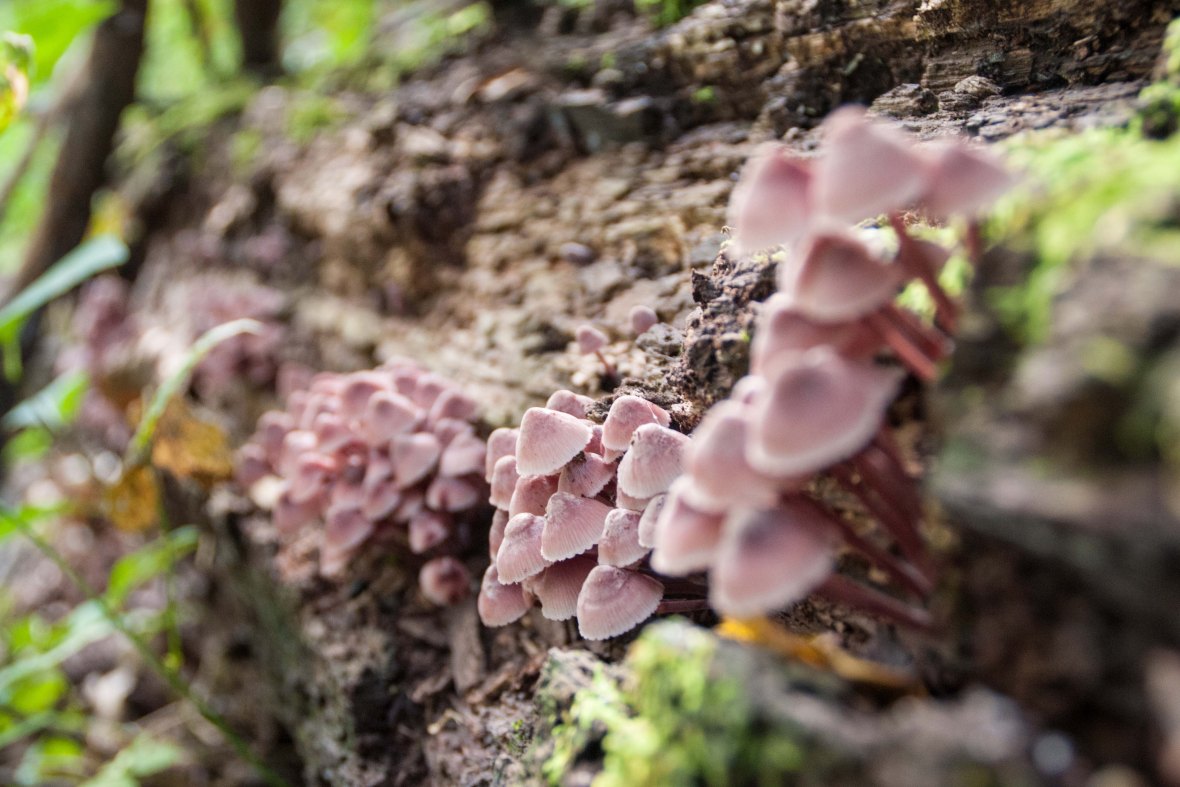
Typically, we think of winter as a time for plants and animals to go dormant and settle down. Really there are hundreds of thousands of organisms growing during these cold, wet, dreary months! During the winter, we can go out and see so many different types of (drum roll, please…) – FUNGUS! What is growing beneath our feet? Fungi in winter!

Basidiomyscetes are "club" fungi and release their spores from the underside of their cap.
Basidiomycetes are “club” fungi and release their spores from the underside of their cap.

What is Fungi?

Did you know that fungi aren’t weird plants? They are their own separate kingdom comprised of things other than just the mushrooms from the grocery store. To learn about some common Eastern United States Fungi and their purpose in the ecosystem, click here! Some look like a typical “mushroom” (club-like), others are little cups or sacs that shoot their spores out (think of them as fungi seeds), and others are molds (yeah, those gross, fuzzy looking things on that 6-week old refrigerator food).

yellow brain fungus
This Yellow Brain fungus may look gross and squishy, but is actually a fascinating part of the ecosystem. Both this and the title image were both taken during a hike late January!

Don’t be grossed out by them though! Fungi are amazing organisms that can survive for thousands of years (the oldest is roughly 8,650 years old and lives in the Blue Mountains!). Without these tiny little guys, we wouldn’t survive.

Fungi & the Ecosystem

Imagine all of the trees, leaves, and dead animals that have ever existed just littering the forest floor. We would be buried in dead stuff – and THAT is gross! Fungi are decomposers, so they eat the dead things that we don’t want around. While they don’t have visible mouths or tummy’s, they do have chemicals and enzymes that break down organic material to absorb nutrients through their cell walls.

Some fungi are parasites, slowly decomposing their live host. While this sounds bad, the end product can be a dead tree that provides habitat for so many animals like beetles and other insects that woodpeckers love to munch on, and Osprey that only nest in dead trees. Once a tree dies, it opens up a space in the canopy, allowing sunlight to reach to the forest floor where saplings and other understory plants grow.

Others are much more happy-sounding. Mycorrhizal fungi participate in a mutually beneficial relationship with plants. They wrap hyphae (think “roots”) around the plant roots and exchange nutrients! The fungus provides the plant with soil nutrients that the plant can’t access and the plant provides the fungus with some energy that it obtained through photosynthesis (a process that fungi can’t do). This is so important to healthy plant growth to most plant species all over the world!

Fungi as Food

Fungi also can be a valuable winter food resource to animals like squirrels and other small rodents like voles. Slugs, while we don’t often think of them as beneficial, also enjoy eating a mushroom or two!

Shelf fungus like these do end up decomposing the tree, but the dead wood provides valuable habitat to so many animal species!

Fascinated by fungi but don’t want them decomposing your house? Check out some of my art to see what mushrooms or fungi can catch your eye!

Supporting The Art of Ecology through the online shop or by becoming a Patron at any tier on Patreon can help keep educational content coming!

This Rose-Breasted Grosbeak is one of the birds found in this area that are being threatened by Climate Change.

Did you know that by 2050, roughly ⅓ of all bird species might be extinct? Protecting these animals is important if we want to not only keep these wonderful birds around for future generations to enjoy, but also to keep healthy ecosystems!

Migratory Bird Treaty Act & Protections

Fortunately, 100 years ago, one of the most important pieces of legislation for birds was brought into existence – The Migratory Bird Treaty Act. This act makes it illegal to take, possess, import, export, transport, sell, or purchase any migratory bird parts, nests, or eggs (unless you have a permit from the government for environmental and educational purposes).

2018 is the “Year of the Bird” to many organizations, including National Geographic and others, want to celebrate this and raise awareness for the current state of bird populations.

There are many ways to learn more about the wonderful birds that live around you and to help all birds survive and thrive! Here is a list of my top favorite ways to help our feathered friends and “Bird Your World”:

Go Bird Your World!

Research what nature organizations might have events for you to participate in!
  1. Go on a birding walk! – Not only will you enjoy the outdoors, but it also will get you familiar with the birds in your area. I have learned about how bird populations change with the season simply by watching them! If you don’t want to go out alone, join up with a local nature group!
  2. Participate in Community Science Projects – Too few scientists, too little time, and too many birds to monitor across the world! Fortunately, you can help scientists by sharing your bird observations! Check out eBird for a great collective database.
  3. Drink Bird-Friendly CoffeeDid you know that coffee trees are vital to migratory songbirds? Look on the label of your favorite coffee to see if they are shade-grown or certified bird-friendly!
  4. Garden for Birds – What you plant in your garden can impact the birds that you’ll see. Planting native flowers, trees, and shrubs can help maintain populations. Picking plants that will continue to provide winter habitat or food will help them to survive year-round!
  5. Go forth and Lead! – Once you’re comfortable with your passion for birds, spread it with others! Can you lead a walk, buy shade-grown coffee for friends as presents, or organize volunteer days to set up feeders/nest boxes in local parks? Encourage those around you to care for these wonderful species by leading by example!
  6. Purchase Art that Positively Impacts Wildlife – Did you know that by purchasing any one of my pieces, you helping to support organizations that educate and conserve/protect bird species? A portion of all of the proceeds goes to wildlife conservation, habitat preservation and environmental education! Click here to learn more about the conservation I’ve been able to do thanks to you!

Supporting The Art of Ecology through the online shop or by becoming a Patron at any tier on Patreon can help keep educational content coming!

Hope you had a wonderful Year of the Bird and did lots of learning and helping! Birds featured: Peacock, Barred Owl, Canadian Goose, Flamingo, Snow Goose, Seagulls, Lesser Goldfinch, Pigeon, Hummingbird, Sparrow, Hummingbird, White-Throated Sparrow, American Goldfinch, and Kestral
Hope you had a wonderful Year of the Bird and did lots of learning and helping! Birds featured: Peacock, Barred Owl, Canadian Goose, Flamingo, Snow Goose, Seagulls, Lesser Goldfinch, Pigeon, Hummingbird, Sparrow, Hummingbird, White-Throated Sparrow, American Goldfinch, and Kestrel
Masked bandits like this one leave little hand prints all over forest trails! Raccoons are opportunistic feeders and can be found anywhere that food exists!
Masked bandits like this one leave little hand prints all over forest trails!

One of the things I remember my father saying the most when I was a child was – “There’s always evidence!” This was typically said because I would wonder how he knew that I didn’t do a certain chore, but it definitely applies in the ecology world too.

Mammals are among some of my favorite animals (followed closely by sharks and octopuses!), so naturally, I tend to look for them wherever I go. If you, like me, want to go mammal tracking here are some tips!

Tracking Down Mammals

When you go mammal tracking, look for the animal itself. If you can’t find it, look for evidence like tracks, scat/droppings, bones (especially skulls), or behavioral signs (like buck rub or digging). These things can not only let you know what mammal was around, but even what it was doing and when! Here are some key features of PA’s more common mammals.

  • Raccoon (Procyon lotor) – These masked mammal’s tracks look like little hand prints that can be often seen near water as they like to hunt for aquatic animals like, crayfish, and wash their food. If you ever come across a skull (as I have!) you can identify that they are omnivores, having large canines, cutting teeth, and grinding molars. They love berries, so if you find their scat, it’ll be yellowish-red and full of seeds!
  • Eastern Cottontail Rabbit (Sylvilagus floridanus) – This isn’t your pet. This wild rabbit is a rusty brownish-grey color with white undersides (their cotton ball looking tail is where they get their name from!). Search for browse (twigs low to the ground that have been chomped to a stub) or droppings similar to a deer’s, but more spread out. They are a common prey animal, so finding rabbit bones in the woods is more likely. Their skull is easily identifiable as they are lacey in front of the eye sockets. They also have pronounced front teeth (incisors). Another great thing to look for are rabbit droppings. They are small and round, and slightly bean-shaped. If you look closer, you can see that they are usually a dark, muddy green since they eat so much plant-matter!
deer and mammal tracking
Deer will make huffing sounds and stomp their feet when they want to look intimidating and scare something away. More often than not, they will turn their tails up and leap away!
  • White-tailed Deer (Odocoileus virginanus) – They are almost the only cloven hoofed mammal in PA and come into so many people’s yards that they are well known. They are a greyish-brown color and have white around their eyes and nose and on the underside of their chest and tail. Their tail is a flag signal for other deer when they feel threatened. Evidence of them being nearby can be droppings (round pellets clumped in large piles), browse, or buck rub (when males rub bark from trees using their antlers to get rid of the velvety covering). Their skull is identifiable as they may still have antlers attached. The nose part (rostrum) is prolonged and they have several incisors in the front with grinding molars in the back of their jaw. Looking at how worn these back teeth are can help you to identify how old the deer was. If they are very worn, and almost flat, this is an old deer! While a deer lifespan can be up to 20 years old, it’s more likely to only live to 2-3 years.
squirrel and mammal tracking
This squirrel may look as if it has some red tints to it’s fur, but it’s not a Red Squirrel. Red squirrels have long ear tufts, while the Eastern Grey doesn’t.
  • Eastern Grey Squirrel (Sciurus carolinensis) – These dusty greyish-brown mammals are easily identifiable with their bushy tails and tiny paws! Their tracks look like tiny hand prints and are in a hopping formation more than a walking one. Search the tree tops for bushy, leafy, squirrel nests (called dreys) or chewed through acorns. Their skulls are smaller, rounder, and have a more blunt rostrum with large incisors and blunt molars.
  • Skunk (Mephitis mephitis)  With their black body and long white stripe running from their nose to their tail, these animals are easily identifiable! Search the woods for large dig marks, crushed egg shells near nests, and scat made of insect parts and seeds. Don’t confuse this skull with the raccoon! This skull is wider and has a slightly more blunt rostrum.
  • Red Fox (Vulpes vulpes) – Don’t think a “Red” fox needs to be red! There are various color morphs (black, silver, blonde and red), but have white on the tip of their tail. They have dog-like tracks, but with a longer stride. Search for dens in the woods with food scraps or dirt piled up outside the entrance. Their scat looks similar to a dog’s, but with twisted ends. In the winter, it’ll be full of hair, but in the growing season, the hair is mixed with berries. The skull is easily identifiable as a canine since there are large “bubbles” on either side of the brain stem opening. These are called auditory bullae and are pronounced in dogs. They also have large and sharp canines and teeth called carnassial pairs that are built for cutting meat.
fox kit in spring - bucks county Pennsylvania

Next time you take a nature walk, look for animals and go mammal tracking! If you don’t see any just know – there is always evidence!

Ecologists and naturalists love the quote “Take only photos, leave only footprints.” While we may want to pick up feathers, rocks, and other animal artifacts, leave them be. If want to bring one of these adorable mammals to your home , do so with a photo! You’ll be able to start some great mammal tracking conversations.

Supporting The Art of Ecology through the online shop or by becoming a Patron at any tier on Patreon can help keep educational content coming!

Discover more about local PA species, how to identify them, and how to participate in an easy Community Science project during my Fall 2020 “Intro to Mammals” virtual presentation with Bucks Audubon

what causes sunsets
This sunrise greeted me one winter morning, but was so much more vivid right when I had woken up! In a matter of minutes, it was completely gone. How does this happen?

Recently, I’ve been waking up to some strikingly vivid sunrises. Unfortunately, by the time that I see the sunrise, get my camera, half stick my boots on and dash into the backyard, the colors have lost much of their vibrancy.

How do the colors disappear so quickly and what causes sunsets and sunrises to be there in the first place?

What Causes a Colorful Sky?

The colors of both sunrises and sunsets have to do with scattering. When light hits an air particle, the light waves bounce and scatter. Blue-ish violet is the shortest wavelength and is easily scattered by the numerous particles in the air. However, the human eye has a difficult time perceiving violet. This is why we see the sky as bright blue, not purple, during the day when the sun is right on top of us. The waves don’t have as far to travel to get to the rods and cones in our eyes!

Once the sun starts going down (or coming up), the sun is farther away from us and the light waves have to travel farther to reach our eyes. The greater the distance, the more molecules there are in the air. This causes the bluish-violet color to scatter and bounce so much that it bounces away and we lose it. The rest of the colors, like red, orange, pink, and yellow, wind up being what we see!

What’s amazing is that we on the East Coast of America are seeing the same sky as someone on the West Coast. The only difference is that (other than varying weather conditions) the wavelengths of light are traveling different amounts to reach our eyes. The blue sky doesn’t change into a pinkish sky – It’s our eyes missing out on the bounced blue light that the West Coasters are seeing. It’s almost as if we’re getting California’s “leftover” light waves.

Light Waves and a Round Surface

So why do sunsets and rises come and go so quickly? Well, the answer is because the Earth bends A LOT. We may not realize in our day to day lives how circular our seemingly “flat” path is. The sun may seem to move more quickly once it reaches the horizon because the atmosphere is bending the light – the sun isn’t going down a flat plane.

This sunset was the second one during our Maine vacation and I almost missed it! It's incredible how the colors change and fade into the dark night sky so quickly.
This sunset was the second one during our Maine vacation and I almost missed it! It’s incredible how the colors change and fade into the dark night sky so quickly.

Fortunately, once I get a good photo of the brilliance of the painted sky, I can have that with me even once the sun fully sets or rises and you can too! Explore what causes sunsets through art.

Supporting The Art of Ecology through the online shop or by becoming a Patron at any tier on Patreon can help keep educational content coming!

Right now there is a trend in “owl-love”. People think they’re so cute and decorate everything from paper-products, to clothes, to wall art with rather cartoony looking owls. Is there anything wrong with that – NO!

Owls definitely are super cute, but they are so much more than just fluffy balls of feathers. They are important parts of our ecosystem and food web.

Barred Owls are general predators that eat more than just rodents. They will also eat lizards, frogs, snakes, and salamanders!

Owls & The Food Chain

These nighttime raptors are Apex Predators. This means that not only do they eat animals lower on the food chain, but they also eat other predators, such as insect-eating birds, weasels, bats, and shrews. Owls themselves are predated upon by almost nothing. They die from natural (or man-made) causes.

Rodents – one of the main food sources of owls – can cause many problems. They can get into our houses (I have a mouse in my walls that I’ve named Fievel), eat our food, and spread diseases. Amazingly enough, one Barn Owl can eat up to 1,000 rodents each year! Imagine a whole population (over 1,000 Barn Owls have been banded in PA) not playing their part – that’s a whole bunch of rodents running around that we wouldn’t have had otherwise! By eating mice, rats, and other rodents, owls are helping to decrease some of the negative impacts that these pest species can have on humans.

The Great Eagle Owl may not be found in American, but it's relative, the Great Horned Owl does!
The Great Eagle Owl may not be found in America, but it’s relative, the Great Horned Owl does!

Not only can owls help to reduce problems for humans, but they can also reduce problems (specifically those of the genetic kind) in their prey populations. By eating animals that are too slow or weak to evade capture, the owls are getting rid of the “weakest-links.”  This can help to ensure that overall prey population is healthy and strong.

While we may not see these nocturnal raptors often, we can definitely appreciate the benefits that they have on our ecosystem!

Eastern Screech Owl
The Eastern Screech Owl is similar to the Barred Owl in that it is also a general predator eating insects, crustaceans, amphibians, reptiles, and other small mammals!

Do you need more of these elusive species in your life? I don’t blame you! Add any of these photos to your collection today.

Supporting The Art of Ecology through the online shop or by becoming a Patron at any tier on Patreon can help keep educational content coming!

Juncos are identifiable by being the tiny grey bird that "sat in milk". These are one of the common birds that you may see during the winter.
Juncos are identifiable by being the tiny grey bird that “sat in milk”. These are one of the common birds that you may see during the winter.

We always think of birds as migrating south for the winter (wish I could too!), but obviously, some birds do stick around. There are many bird adaptations to the cold to allow them to stick around chilly Pennsylvania!

How do Birds Adapt to the Cold?

Birds adapt in many ways that are similar to humans. They eat yummier foods (did Christmas treats hit anyone else pretty hard?), change their clothes (feathers), stay out of the wind, cuddle and stay inside!

Many songbirds eat insects in the spring, summer, and fall. However, when the insects die off or go into dormancy for the winter, the birds still need to eat! This is when these little songbirds will change their diet and eat more seeds. This works out nutritionally as well. Insects are high in protein, which is great for growing and developing babies! Once winter rolls around though, a bird’s need changes from getting strong to staying warm. Eating seeds that are high in oils and fats provides them with burnable energy to stay warm. By eating seeds from plants like trees and wildflowers or by visiting feeders, they are able to stay warm.

This White-Throated Sparrow loves the seeds of the Sumac during the cold winter months!

Another method of staying warm is by puffing up. Humans have the ability to put on base layers, hoodies, and scarves. Birds have the ability to fluff up their downy feathers. This lets the bird stay insulated and keep warm air trapped against their little bodies. Many bird species will nest in tree cavities (or a box if you’ve put some up for them) lined with their own soft, warm feathers. Their whole family may be in there helping to keep each other warm!

Temporary Torpor

For some birds, this may not be enough to keep them warm at night, however they have another method of staying warm – they simply cease to function at night. Birds like chickadees can enter something called “torpor”, which is similar to hibernation. They temporarily drastically slow bodily functions in order to conserve energy.

Chickadee Bird Adaptations to the cold
Chickadees can enter torpor, which is similar to a self-induced hypothermia or mini-hibernation, in order to save energy.

During the day, birds, like humans, have to deal with the wind! Research has shown that birds try to avoid the wind by ceasing flying and hopping around to protected sides of trees or buildings.

Help Birds this Winter

If you’re looking to help these little guys out, try putting up nest boxes to provide them with a home, or put up suet and black-oil sunflower seed feeders to provide them with that yummy, fatty food to keep them warm! These will help ensure that even with their bird adaptations to the cold, that they stay warm.

Miss the birds this winter? Check out my Shop so they can stick around your home with ease!

Supporting The Art of Ecology through the online shop or by becoming a Patron at any tier on Patreon can help keep educational content coming!
Sometimes you visit a place, not knowing what impact it’ll have on you, and when you leave it, all you want is to return! For me, that place is Kenya.

I have been to Kenya, to a small village on the coast of Lake Victoria to do some missions work in orphanages and for other groups. The first time, I didn’t have a fancy camera to document the trip, but the second time I did! Below are some images of the wildlife I captured the second time I visited. Each and every photo I took has a story behind it!

Exploring Elephants

This baby is potentially in danger - not from wildlife, but from the poaching industry. The tusks are made of Ivory, something relished in the poaching world.
This baby is potentially in danger – not from wildlife, but from the poaching industry. As the tusks grow larger, so does it’s risk of attracting poachers!

During the second trip, my family and I had the chance to visit David Sheldrick’s Wildlife Trust in Nairobi. This organization is one of the most successful orphaned elephant rescues in the world. They rehabilitate babies that have lost their mothers due to, or have been directly impacted by, the poaching industry. Most of the poaching is for Ivory, but elephants will also be hunted for bush meat and to prevent (or get revenge for) human-wildlife conflicts.

The elephants seen here are two of the cuties that were in the process of being rehabilitated when I visited in 2015. All elephants at this wildlife trust are babies or very young juveniles. As of today, they have successfully raised and released over 150 elephants back into the wild!

To learn more about their amazing work or to get to know some of the elephants in need, click here!

Observing Ostriches

It's not just elephants that David Sheldrick's Wildlife Trust rescues! This ostrich was also an animal in need who found a temporary home at the rehabilitation center.
It’s not just elephants that David Sheldrick’s Wildlife Trust rescues! This ostrich was also an animal in need who found a temporary home at the rehabilitation center.

Also seen at David Sheldrick’s Wildlife Trust were a pair of Ostriches who were rescued. It’s amazing how when raised together from a young age, different species can become friends! This ostrich (along with the other one seen there) appeared to think that it was a baby elephant, often playing among and with the herd of large, baby mammals. It would walk through mud, pick up tree branches to swing around, and poke some of the elephants!

Examining Egrets

The Great Egret and the Little Egret are both common wading birds near Lake Victoria.

These Egrets can often be seen right around Lake Victoria. Their primary food is fish so they love hanging around near fishermen, waiting to see if they can sneak a meal! While the Great Egret (the one with the yellow bill) had relatively low numbers in America due to hunting for it’s plumage, it’s a common bird in Africa. The Little Egret (the one perched on the boat) was similarly hunted and it’s populations are now back to where they should be. During their migration they stop at Lake Victoria and may reach over 25,000 at one time at the lake!

Gazing at Giraffes

Giraffes and Elephants were only two of the various wildlife species that I had the opportunity to see during my trips to Kenya!
This beautiful Rothschild giraffe has antiseptic saliva, making it’s kisses actually good for you!

This is a Rothschild Giraffe (Kelly, who gave me lots of giraffe kisses!) at the African Fund for Endangered Wildlife in Nairobi. This centers goal is to provide education to the local groups and visitors and help increase the population of this endangered giraffe species through conservation efforts. To learn more, click here!

The Rothschild giraffe is only found in the grasslands of Eastern Africa and no where else. In the 1980’s, there were roughly 130 of these giraffes left, due to habitat loss from overdevelopment. Today, thanks to conservation efforts, there are now over 300 Rothschild Giraffes scattered throughout Kenya!

Want to bring one of these animals to your home? Do it through art! Getting a Kenyan Wildlife print set is a great idea, but stickers are wonderful too! A portion of all of the proceeds supports organizations like David Sheldrick’s Wildlife Trust and the African Fund for Endangered Wildlife!

Supporting The Art of Ecology through the online shop or by becoming a Patron at any tier on Patreon can help keep educational content coming!

kenya photo summary 2015
There were so many wildlife photos to go through from my trip to Kenya, and funnily enough, each trip I’ve taken has also marked a milestone in my photography path. The first time I went, I had a simple point and shoot digital camera. The second time, I had just learned what shooting RAW meant and had my NikonD300 body. Who knows what stage I’ll be at when I get to visit my favorite place on earth next!