In Peril: WILD ART 2021

As part of the Wild Art 2021 November Challenge, put on by Zoe Keller, I illustrated two pieces focusing on the theme, “In Peril”. Each month, I will focus on two pieces – one highlighting flora, the other highlighting fauna. This month, the first is a flower who brought me great joy picking them as a child in the Pocono Mountains, but now is threatened (hopefully not due to my bouquets!). The other is a marshy water bird whose populations decreased due to habitat loss.

Let’s start by figuring out what “in-peril” or threatened officially means!

“Threatened Definition”

Threatened covers a wide spectrum of organisms. Overall, any creature that is Critically Endangered, Endangered, or Vulnerable are considered to be threatened, or under “threat” of extinction. As of 2021, there are 16,000+ endangered species, with 35,000+ threatened species!

As climate change, overdevelopment, desertification, habitat loss, disease, and invasive species competition continue, many plants and animals face extinction. Extinctions happened before, so why is this a big deal now?

The 6th Mass Extinction Event

The most recent mass extinction event occurred when the dinosaurs died. Now species are going extinct so quickly that we are in the 6th Mass Extinction Event. Human-caused climate change threatens vital habitats, and as our own population grows and we don’t practice sustainable land development, construction, and more, we run the risk of ruining areas for wild plants, animals, and ourselves!

How does a mass extinction impact us, though? All of life is interconnected. Let’s look at wetlands as an example of an interconnected ecosystem.

Wetlands are home to amphibians, fish, insects, plants, turtles, water birds, and more. As water dries up due to overdevelopment in a housing community down the street, the habitat becomes unsuitable for these animals. Plants can’t grow without steady water and can no longer provide food for animals. Insects stop laying eggs without their aquatic nesting sites, so now frogs and fish can’t eat. Water birds leave since their prey of frogs and fish are gone. The animals have nowhere else to go, so they die off. Now, nutrients aren’t cycled and stagnant pools of contaminated runoff from roadways and storm water drainage form in these lifeless wet zones, sharply increasing our risk of disease and illness.

Building wildlife habitats, supporting green infrastructure and industry, voting with the environment in mind, and reducing waste whenever possible are great ways to mitigate this extinction event and protect the plants and animals we love!

What are some plants and animals that are currently threatened on a local scale?

Eastern Blue-eyed Grasses

The Eastern Blue-eyed Grasses (Sisyrinchium atlanticum) are native to the New England region. They are low growing plants with beautiful, small purply-blue flowers. They grow scattered in fields, woodlands, and marshes, especially if there is steady access to water near streams or wetlands.

Native grasses are important soil erosion managers and pollution absorbers. Although they are closely related to an iris, they are no different in their abilities! They provide food resources for several small bee species and tiny butterflies. After pollination and seed production (small green balls in the illustration), they also provide food for birds.

Unfortunately, these flowers, common as I thought they were growing up in damp woodlands, are listed as “Threatened” in Pennsylvania. Aside from plants, animals are threatened too!

Least Bittern

This bird, despite it’s very small size, is a heron species. They are a little bigger than an American Robin, although their neck size is quite deceiving! While perching on reeds, watching for prey, they keep their necks folded against their body, causing them to look hunchbacked. Once they spot their fishy food, they shoot out their long, heron-like neck and stab down. These acrobatic birds have long toes and talons with which to precariously straddle water reeds. As they crane their neck, the stripes along their body helps them blend in with the tall plant life.

Similarly to the Eastern Blue-Eyed Grasses, this bird is also a Pennsylvania resident who is struggling! Here in PA, wetland environment is quickly drying up. Tidal marshes have disappeared and many wetlands across the state were impounded. They require constant aquatic environments (where frogs, fish, and crustaceans live), so ephemeral wetlands, or areas that hold water only in the spring after a snow melt, or in the fall after the late-summer storms, aren’t suitable.

What Does This All Mean?

Fortunately, we can mitigate these threats and help restore plant and bird populations! By creating suitable wildlife habitat, removing competing invasive species, and restoring native wetland environments, we can help the Eastern Blue-eyed grass AND the Least Bittern!

Together, we can make the world a better place and transform these threatened organisms into ones that thrive! Interested in learning about other plants and animals that do actually transform, or change appearance over time? Stay tuned next month to learn more about post-pollination communication in plants and house hunting animals with the “Transformation” theme!

Click below for more scientific illustrations, illustration workshops, or some new home dรฉcor that supports conservation for species in peril!

Supporting The Art of Ecology through the online shop or by becoming a Patron at any tier on Patreon can help keep educational content coming!

Gauging Human Age: Hard. Determining Squirrel Age: Easy!

Have you ever been slightly abashed when you assume someone’s age and then find out that either wow…. they are waaayyy older than you thought, or dear goodness, this person is a baby?! Determining age in humans just by sight can be really challenging! Determining squirrel age and the ages of other wildlife, on the other hand, is much easier! With wild animals we can look at them and gauge their age based on development and growth!

Isn’t Age Just a Number? Why Should We Care?

In the human world, age really doesn’t matter for the most part once we hit certain milestones. In the wildlife world though, age can play a factor in how they interact with the ecosystems they live in. Baby dragonflies (nymphs) live in water, whereas adult dragonflies live on land. This completely changes their diets and adaptations! Another example is octopuses. For females, generally around their 3rd birthday they lay their own eggs. This triggers senility and degradation of their brain as they care for the eggs. Knowing the age of an octopus can help veterinarians and marine biologists identify potential health issues.

Age doesn’t matter for just insects or marine species. As mammals age and develop they may have their own unique adaptations and skills that they get along with age. Their teeth may change and their behaviors may differ. Their fur colors may transition and how they live (either socially or independently), may change as well. This kind of sounds like humans, right? Developmentally, we might start walking around, lose our first baby teeth, or hit puberty generally around similar ages, but personal growth varies greatly! When we land a career, find a significant other, have children, move to a new place, etc… all happen at vastly different rates.

The Life of a Squirrel

There’s nothing wrong with humans growing and experiencing life at different rates, but for wildlife, life comes and goes in a fairly straightforward manner. Let’s take a look at one such species: the squirrel!

determining squirrel age_pinkie one week old
This pinkie (baby, hairless squirrel), has been out of the nest for too long without mom and most likely won’t survive, even with human intervention. Unfortunately, the life expectancy for young squirrels is very low due to predation, falling from nests, or disease.

Eastern Grey Squirrels in the wild usually live to be roughly 2 years old. At birth, their chances of survival aren’t very high, but if they can actually make it to adulthood, their life expectancy can increase to 4-6 years old! In fact, the oldest Eastern Grey Squirrel in the wild was recorded to be 12 years old. Incredible! Predation in younger squirrels is quite high, which is what threatens the baby’s life expectancy the most. Once they mature, they have adaptations to help them avoid predation.

When a baby is born, it takes roughly 8-10 weeks for it to be grown enough to survive without their mother’s care. The next spring or summer season after they were born, they reach sexual maturity and have their own litters.

Determining Squirrel Age

Squirrels have very obvious milestones as they age. When they are born, they are little, weighing about a half ounce, pink, and hairless. Their eyes are closed and they need their mother’s care and warmth constantly! At 1 week old, they are still hairless and blind, yet they are now looking a little more grey, rather than pink along their backs. When they reach 2 weeks, they appear to have a 5 o’clock shadow or peach fuzz of fur and are now over an ounce in weight! At 3 weeks, they have a thin layer of fuzz and their skinny tails now have greyish-silver fur. Even at 4 weeks, when the squirrels have over doubled in size and have an obvious “squirrel-like appearance” with their grey fur along their backs, white tummies, and bushy tails, they are still blind.

determining squirrel age_ 6 week old squirrel
Notice how the tail has started to get bushier and the squirrel is obviously squirrel colored? This is a 6 week old squirrel.

Finally, at 5 weeks old they have finally opened their eyes and are ready to play! It’s amazing how much movement and jumping you can do if you can see! The mothers do not need to constantly watch over and warm the babies and she teaches them how to navigate tree branches and jump around. At 6 weeks old, the tail gets noticeably bushier and they now look like miniature adults. At 7 weeks old, the baby squirrel (similarly to human teens) starts to behave like an adult and tries to feed itself, jump around, and explore the world, although they still need the attention of the mother!

Finally, at 8 weeks old, they don’t need mom to provide food with them and she has taught them how to escape predators. They leave the nest a few days later and attempt to successfully find their way in the world!

determining squirrel age_ adult squirrel
Adult squirrels are able to forage and nest build on their own.

Caring for Squirrels

Being able to recognize wildlife by their age can help humans understand their care and point of growth and development when our paths cross. Squirrel nests can fall out of trees during storms, babies who are learning to jump can lose balance and fallen, or squirrels get injured by cars or predators. Just because a squirrel looks like it needs help though, doesn’t mean it needs help from a rehabilitation center! It could just need help from it’s mom, who might be nearby.

If you find baby squirrels and have a bit of time to observe and make sure the mom returns, try to play (using this YouTube Video) recordings of baby squirrels crying. While the babies are still young, the mothers know that they can’t wander too far from the nest and will hear the crying sound. She’ll come running and can help care for fallen babies.

Babies that have their eyes open are able to survive a little longer without mom. Try to find the nest to return them to, or if you can’t, put them in a shoebox with some warm blankets and leaves until the mom returns. Try to play the recording again, just be aware that the mom may have further to travel to get them and it may take a half hour – hour for her to find them.

Do you Love Squirrels?

First of all, thank you for caring about these fuzzy acrobats of the mammal world! They are important members of the ecosystem, even if they do happen to steal your birdseed.

Showcase your love of squirrels by bringing them home (although not from the wild – that’s illegal), by shopping with The Art of Ecology.

Supporting The Art of Ecology through the online shop or by becoming a Patron at any tier on Patreon can help keep educational content coming!

Flight: WILD ART 2021

As part of the Wild Art 2021 November Challenge, put on by Zoe Keller, I illustrated two pieces focusing on the theme, “FLIGHT”. Each month, I am going to focus on two pieces – one highlighting flora, the other highlighting fauna. This month, I focused on two species, one amphibian who glides (instead of flies), and the other uses special morphological adaptations to catch the wind to move.

Let’s Define Flight

Flight occurs when a species can actively flap wings made of a thin skin or wings in order to maintain distance and height. Animals such as birds and bats are able to truly fly since they can maintain being airborne for long periods of time, sustaining flight by flapping. While animals such as Sugar Gliders, Wallace’s Flying Frog, Sailfin Flying Fish, and others, soar overhead, they don’t actually fly. Instead, they glide! They use thin membranes to catch air and wind, similarly to a parachute, in order to glide along before landing.

But why would an animal want to only “sort-of” fly?

wallaces-flying-frog illustration for Flight: Wild Art

The Benefits of Gliding

The Wallace’s Flying Frog, and many others (except for the fish), live in tree tops. Instead of clumsily jumping from branch to branch, they can leap off and soar from one tree to the next! This allows for a fast escape from predators.

Imagine being this jungle-residing, tree-dwelling frog… You are about the size of an adult fist, and hop around the tops of tree canopies in search of insects. Suddenly, you see a large, tree-climbing snake here too. Eek! This is one of your predators. In order to escape, you need to quickly get out of the tree you’re in, and to the tree next to you. Unfortunately, if you just drop out of the tree, you’ll have a LOOONG way to fall. Fortunately, you have adapted gliding mechanisms! You leap out of the tree, and spread your feet out, allowing the fleshy membrane between your toes to catch the wind. This carries you quickly away from the reach of the snake!

It’s not just animals though that have developed pseudo-flight mechanisms! Plants are able to take to the air as well, or at least some of the seeds are.

Importance of Seed Dispersal

A plant’s goal is to produce and release seeds to germinate and perpetuate it’s genes. In order to ensure that this happens, plants need to make sure that the flowers get pollinated and fertilized. This fertilization creates seeds, which will be dispersed to grow up into new plants. Some plants drop the seeds at the base of the plant. Next season, when it germinates, these plants are pollinated one after another and all have the same genetics. The gene pool won’t expand and the plant runs the risk of becoming diseased or deformed. Think of seeds like dog breeds. Purebred dogs, with the same gene pool being tapped into repeatedly, the more likely it is to have health issues. Mutts have a ton of diverse genes and will be more likely to overcome health issues. Seeds want a wide variety of genes too!

How do plants, without feet to walk and meet new plants, ensure that the genes they pass down contain diversity? One way is to rely on animals to move for them! As animals, such as birds or small mammals, eat the fruits or nuts, they run around all over the place. When they poop out the undigested seeds, it’s usually not in the same place that they ate. Now, the seeds are in little packets of fertilizer and can germinate away from the parent plant, thus being more likely to be fertilized by another plant with different genetics! Other plants develop sticky seeds that attach to the fur of animals running by. Other plants don’t want to rely on animals to spread the seeds. Animals might not travel by while the flowers or seeds are ready, so what can the plant do to adapt?

milkweed-plant and seeds taking off_Flight: Wild Art 2021

They can learn to fly on their own!

Seed Dispersion by Wind

What better way to ensure that you will be able to move, regardless of if an animals passes by or not, than by just taking flight yourself?! Wind is always available, so many plants have adapted ways to have their seeds be wind-dispersed. Whenever you see a seed that is attached to soft, feathery hairs, you can be sure that this plant has learned to “fly”. Dandelions, milkweeds (as illustrated here), clematis, and more have seeds attached to lightweight sails that are caught by wind and can be blown almost a mile away; a super long way for a plant to travel! The dandelion holds the record for seed dispersion, with a dandelion seed being blown over 60 miles (100km) from it’s parent plant!

While these plants and animals technically don’t have flight capabilities, it is amazing to see how they have overcome and adapted to be able to glide and use the wind to their advantage in order to ensure their survival. Interested in learning more about plant adaptations, and how important and difficult survival is? Stay tuned next month to learn more about plants and animals that are threatened, and ways to make a positive difference for their populations with the “In Peril” theme!

Click below for more scientific illustrations, illustration workshops, or some new home dรฉcor!

Supporting The Art of Ecology through the online shop or by becoming a Patron at any tier on Patreon can help keep educational content coming!

Garden Seed Saving

flower of the hour wildflower and garden seed saving

Flowers die back, but not before producing what they are specifically designed to produce – Seeds! This autumn, prepare for your spring and summer garden by harvesting these future plant-makers!

Seed Saving is the perfect way to save money in future years, and you also will be able to perpetuate the plants you love the most. Year to year, nursery’s and greenhouses will stop stocking plants to make room for newer, trendy cultivars, leaving you without some of your favorites! Personally, I really loved and wanted Sunshine Yarrow, a gorgeous, vibrant yellow cultivar of the native yarrow, and when I went to return for another one to add to the other side of the garden to balance it out, the nursery didn’t stock it any more. They only had the new “Strawberry Passion Yarrow”! This was another lovely cultivar, but it wasn’t what I was looking for. Seed saving can help prevent this particular challenge!

Some plants are easier to do this with than others.

Understanding Timing

First off, not all plants have seeds that are ready to harvest when we’d typically think they are. Plants, such as cucumbers, have vegetables and fruits that are picked and eaten before the seeds are mature! We eat these, and maybe try to save the seeds, but won’t be mature unless the vegetable is left to grow a little longer. This typically means that you won’t be able to eat the vegetable! For example, kale needs to bolt and produce flowers before it goes to seed. When many leafy greens, including kale, bolt, the leaves turn very bitter, making them practically inedible. Planting multiples can ensure that you get to enjoy your veggie garden for the food, and be able to leave some to go to seed!

clematis wildflower and garden seed saving

Other plants, such as this Clematis, have very obviously mature seeds. Once the flower dies back, the dry seeds are left behind to be carried by the wind to a new spot to germinate. These already-dried seeds are great to harvest!

Easy Garden Seed Saving

orange cosmos garden seed saving

Flowers with large, easily visible seeds, such as this clematis, the cosmos (pictured here), milkweeds (pictured below), or sunflowers (seeds in my hand), have seeds that will come off of the plant an into your hand very easily. If you have to tug to get the seed off, then it’s not mature and ready yet! Give it a few days, then return. Other plants, such as the Flower of the Hour (pictured at the very top), have little seed pods, or containers, that break open when mature. If you need to double check if the seeds are ready to harvest, shake the pod. If the seeds rattle around inside, they are ready and often times can just be dumped right into a seed-saving paper pouch.

Vegetable plants that can be great for beginners to harvest from are peas, beans, and pumpkins. In fact, many pumpkins that become autumn decoration, when they are composted, turn into their own little pumpkin patch on their own!

Storing Harvested Seeds

Regardless of the plant, when you harvest the seeds, be sure to be gentle with them! Some seeds, such as lobelia seeds can be extremely tiny, and if dropped can be impossible to find (although, if you drop them out in the garden, hopefully they will germinate when they’re ready!) Others, such as nasturtiums or black walnuts, are very large! and store them properly.

sunflower garden seed saving

Seeds need to be fully dried before storing, since any excess moisture can create mold growth – and moldy seeds won’t germinate! After you harvest the seeds, keep them on a paper towel in a dark, cool place to finish drying. Then, they can be stored in a paper bag, or seed pouch until you wish to use them. To check if seeds are dried, try to press into them with a fingernail. If the nail leaves an indent, they are still to moist. If not, your seed is dried!

Store various species’ seeds in different, labeled bags so that you don’t confuse them in future seasons. I store my seeds in paper pouches labeled with the date and location of harvest, in a drawer.

Wildflower Seed Saving

If you’re trying to harvest seeds from your garden, that’s great! Those were plants that you put there, took the time and effort to care for, and maintain. Wild plants, on the other hand, are not just for you to enjoy! These wildflowers are important food resources for the native wildlife that rely on the nectar, pollen, seeds, berries, or home they provide.

When harvesting seeds from wildflowers and plants, be sure to:

milkweed seed dispersion by wind
  • Ask permission to harvest seeds if on private land first! Never take if you don’t know if you are allowed to.
  • Harvest no more than 1/3 of the seeds available. You love the plant, so be leave enough for the plant to reseed itself so that more grow in the future! Other animals rely on the seeds for late season food as well, so leave some for them to eat.
  • Never harvest from endangered, or rare plants. Seed collectors can accidentally damage the plant, which will prevent it from establishing it’s population in the area!
  • Avoid invasive plants! Yes, some may be gorgeous, however invasive plants hurt the ecosystem. If the seeds spread, they can outcompete native plants that are more nutritious to local wildlife populations, and provide better ecological functions. Instead, see if you can eat it! Eating invasive plants is a great way to appreciate the plant, while ensuring the seeds don’t spread.

Looking for other ways to enjoy the garden? Check out my upcoming gardening workshops (virtual presentations are perfect for those who aren’t local!), or visit the shop for botanical art in the form of photo prints or illustrations.

Supporting The Art of Ecology through the online shop or by becoming a Patron at any tier on Patreon can help keep educational content coming!

Autumn Eco-Recipes to Inspire You

autumn foraging harvest

We are definitely starting to feel that Autumn is fully upon us, and this season is ripe for foragers! Fortunately, there are so many things to search for out there and use in our cooking. When we forage for and create eco-recipes for our meals, snacks, and drinks directly from nature, we have such control of what goes into our bodies as well as start to understand and appreciate the ecosystems around us a little bit more.

What are you foraging for in Autumn? Here in Southeastern PA, there are many goodies available, from the fruits of the native Black Tupelo tree, to the invasive fruits of the Autumn Olive shrub. Mushrooms are starting to pop up like crazy, and there are many Chicken of the Woods, Chanterelles, and Turkey Tails available to use, provided we’ve identified them correctly.

Are you new to foraging and want to learn how to get started and what foraging etiquette to abide by as you harvest?

Get inspired to forage with some of these wild-plant based snacks and autumn eco-recipes and you’ll never look at the natural world the same way again!

Nasturtium Salsa

homemade foraged Nasturtium Salsa
  • Clean, sealable jar
  • Diced tomatoes to fill 1/2 the jar
  • Diced peppers to fill 1/4 the jar
  • Diced onions to fill 1/4 the jar
  • Red Pepper flakes, garlic powder, sugar, salt, and lime juice (to taste)
  • 5-10 cut up Nasturtium flowers

Dice all veggies and add into the jar. Stir together. As you stir, you may notice that the levels that they fill the jar decrease. Feel free to add more of any type of vegetable. Occasionally, I will supplement with black or kidney beans. Add spices & lime juice, and stir again. Harvest and wash Nasturtium flowers, removing any extra stems or unwanted debris. Be sure to leave the back, pointy end of the flower, as this is where much of the spicy flavor is located! Chop or rip up the flowers into bite sized pieces and stir into your salsa mixture. Enjoy with tortillas (I personally love it with blue corn chips)! Store in the refrigerator. Salsa can last for up to 3 months in the fridge.


Wildberry Jam

  • Clean ball pint jars (6)
  • 1 packet of Jelly-making Pectin
  • 2 – 3 c. of wild, foraged berries (Blueberries, Blackberries, Wineberries, Black Raspberries, and Black Cherries were what I used)
  • Sugar (as called for in the instructions in the Pectin box)
  • Water (as called for in the instructions in the Pectin box)

Wash all berries and mush them up in a saucepan with water. Inside the pectin box, you will be able to find a table of ratios that will instruct you how much water to add to the saucepan based on the type and amount of berries that you foraged. Follow those ratios for both the water AND the sugar. Boil the berries and water quickly for 1 minute, then strain the fruit bits out (If desired. I only strained out the black cherry pits, but kept the rest for a chunky jam). Add sugar, and boil again while stirring until the sugar is dissolved. Quickly pour jam mixture into your clean ball jars and fully seal. Jam will be ready to store in the refrigerator or pantry once you hear the pressurized lid “pop”. My 2 1/2 c. mixed berries created 6 full pint jars of wildberry jam.


Goldenrod Honey over Pears

floral infused honey
  • 8 oz. local, unflavored, wildflower honey
  • 1 1/2 c. Goldenrod flowers that haven’t fully bloomed yet
  • 1 clean pint ball jar
  • 1 pear
  • 3 tbsp. crumbled feta cheese

Harvest and wash your goldenrod flowers gently. Dry flowers between paper towels for a few days, or quickly in the microwave (do not heat the flowers in the microwave for more than 20 seconds at a time!). Once the flowers are dried, add to clean jar. Pour honey overtop of the flowers and seal the container. Every day, for one week, flip the jar over to ensure that all of the flowers are being covered and infusing their goodness into the honey. When prepared to serve, slice pears thinly and lay them out, slightly overlapping each other. Microwave (or double boil) the honey mixture until it becomes very runny, then strain or pick out the flowers (discard them or eat them raw). Drizzle honey over the pears, then crumble the feta overtop.


Cosmos-Dandelion Cupcakes

cosmos and dandelion cupcakes
  • Vanilla Cupcake mix
  • 10-15 Cosmos Flowers
  • 10-15 Dandelion Flowers
  • Buttercream Frosting
  • 12 Cupcake liners (either reusable or paper)

Follow the instructions on the cupcake mix box, or follow your favorite cupcake recipe! Gently wash and remove the petals from the flowers. During the step where you add flour, or the dry ingredients, also add the flower petals (leaving a handful to the side to add to the icing) and mix in. Finish the recipe as directed. Once the cupcakes have come out of the oven baked and cooled, spread buttercream frosting overtop. You can either mix the remaining petals into the frosting, or use as a garnish.


Autumn Olive-Rosehip Limeade

  • 1 c. Autumn Olive fruits
  • 1 c. Rosehips
  • 8 c. water (2 for the autumn olive-rosehip mixture, and the rest for the limeade)
  • 1 c. sugar
  • 1 c. lime juice

Wash the harvested fruits and remove unwanted debris. Add fruits and 2 c. water to a saucepan and bring to a rolling boil. Some of the water may boil off – don’t worry about that! Reduce heat and simmer for 10 minutes, or until the fruits are easily squished (rosehips can be rather hard sometimes and need to soften). Once the fruits are soft, mush them up with the side of a spoon, or a fruit masher. Remove from heat and let cool. Strain out seeds and pour remaining liquid into a pitcher. Add the lime juice, remaining water, and sugar to the pitcher. Adjust the sweetness to taste by adding more sugar or lime juice if needed. Serve cold. You may notice some separation of color/autumn olive skins; this is natural! Stir quickly before serving to blend the autumn olive skins and color throughout the drink.


Now that you’re more comfortable with foraging, learn more about creating specialty drinks with wild-edibles, regardless of the season with my “Trails-to-Tasting” Foraging Guide & Cocktail Eco-Recipe Book!

Discover more wonders of the natural world, tips for how to forage, and some eco-recipes and tutorials on my YouTube channel’s Wild-Edibles & Foraging playlist!

Supporting The Art of Ecology through the online shop or by becoming a Patron at any tier on Patreon can help keep educational content coming!

Marvelous Mushrooms & the Fall Fungi Challenge

September marks National Mushroom Month, and rightfully so! Many amazing, forage-able fungi start appearing around this time of year. Whether you’re looking for mushrooms to eat, to use for making botanical dye, or just because you plain old appreciate them and find them fascinating, September is a great time to start going around searching for fungus. As the temperature drops from the intense summer heat and the late summer rains create a moist environment, perfect for growing fungi.

To celebrate Mushroom Month, I participated in the #FallFungiChallenge on Instagram, put on by Alison Lyon. During the whole month, I drew and learned about various fungi species. Each scientific illustration tells a story of the fungal species, from highlighting their role as decomposers, to how the fungi spread their spores, to how important their bioluminescence is in identification! What I love the most about the challenge is that with each illustration I do, I grow in my understanding of fungi and I get to see what about that species other artists find fascinating and choose to highlight!

The primary role of fungi is to act as a decomposer either through digesting dead organic material (Saprobial fungi), or through eating living organic matter (Parasitic fungi). As organic matter builds up in the fall (think of all those fallen leaves!), fungus are in heaven and will break down that matter so that the nutrients may be cycled back into the ecosystem.

Below, you’ll get to see some of my favorite pieces from the #FallFungiChallenge, as well as get to learn about the stories each fungal species tells!

Scarlet Elf Cup

First in the series was the Scarlet Elf Cup Fungi (seen above). When drawing fungi, I love showing and telling the story of the species, and in this case, I was excited to learn more about how the Scarlet Elf Cup (Sarcoscypha coccinea) gives it’s nutrients back to the cycle of life! As fungi play an important role in nutrient cycling, I really wanted to highlight one of the ways in which it does that – by being eaten! Snails and slugs LOVE this species and are and one of it’s primary resource users. As fungi break down rotting organic matter and turn that into usable nitrogen and other nutrients to share with plants again, they also store much of these nutrients inside their visible, above ground fruiting bodies. When the snails and slugs come to eat the mushroom, they are also ingesting those nutrients. Eventually, when a bird or other mammals eats the snail, they are ingesting not just the nutrients (such as calcium, which is important for healthy egg production) from the snail, they are also getting the nutrients from the fungi that the snail ate earlier! When the bird that ate the snail lays an egg, eventually the egg will hatch and the shell will break down in the nest or fall to the ground where other fungi species may help to decompose it. Everything is connected!

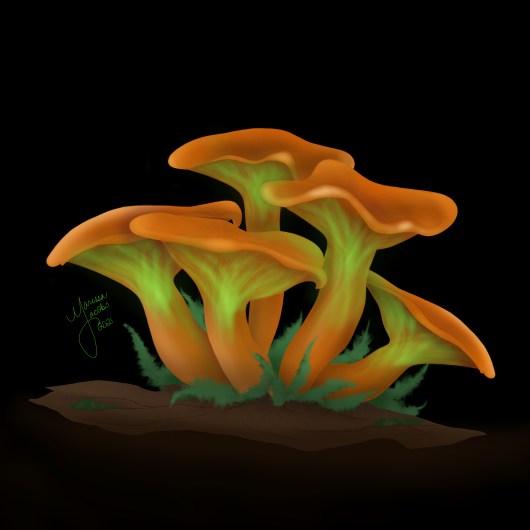
Jack-o-Lantern Fungi

Next was the Jack-o-Lantern Mushroom (Omphalotus olearius), which is an incredible fungi for MANY reasons, but my favorite thing about it is that it is bioluminescent! This fungi produces an enzyme called Luciferase, which is also what helps create the glow in fireflies! This enzyme is used in a reaction that helps the fungi process and remove waste materials during it’s “digestion” process. During the 1700-1800s, the American Pioneers found a creative use for these fungi. Harvested Jack-o-Lantern mushrooms would still glow faintly, and if you were walking around at night, you could use them as a torch or as a trail marker so you wouldn’t get lost even if it was dark!

During the day, these fungi might be indistinguishable (to the untrained eye) from Chanterelles, a delicious edible mushroom, however, forager beware! The Jack-o-Lanterns are toxic, so getting this wild-edible wrong can have terrible consequences. One of the best ways to differentiate between the two is to look at the gills on the underside of the cap. The Chanterelle has forking, chunky gills while the Jack-o-Lantern has straight, parallel and very thin gills. f you’re out walking around at night, check to see if the fungi is glowing! If it is, it’s absolutely NOT a chanterelle and should not be eaten.

Morels

Morels (Morellcha esculenta) is one of the most common edible mushrooms, but edible is a tricky term! Not everything that’s edible can be eaten willy-nilly. Most mushrooms contain toxins that are destroyed when exposed to heat, so cooking the mushroom can remove those toxins. Morels contain amounts of hydrazine toxins, which is combustible, toxic, and can even cause cancer! This is definitely not a toxin that you want to go around eating raw in the woods. Once it’s cooked though, that toxin vanishes, leaving a delicious food that is beyond tasty in a cream sauce over chicken and asparagus!

As with many edible fungi, there is also a completely toxic look-alike. Even cooking the False Morel can still be fatal! The edible morel has a hollow stipe, whereas the False Morel isn’t hollow and is filled with a whitish, somewhat stringy material.

Now, with the next fungus, those who know me, or have listened to my YouTube videos, read previous blogs, or listened to my podcast will immediately know why I find this a fascinating species!

Blue Pinkgill

The Blue Pinkgill (Entoloma hochstetteri), native to New Zealand, is actually true blue! While this is very uncommon and extremely rare in the natural world, this fungus produces Azulene pigments that are only really found in a handful of fungi and marine invertebrates. Typically, the color blue in the natural world is caused by iridescence, although species of fish, such as the Mandarin Goby, do have a cyanophores, which contain other blue pigments. In Maori legends, the Kokako bird got a blue wattle because it rubbed up against this mushroom, forever staining it!

When looking at the gills, as one should always do when trying to identify a mushroom, you can see a faint hint of red, which gives the fungus it’s very appropriate name of Blue Pinkgill. The spores of this fungus is red, so before releasing the spores, you may notice that the gills look slightly pink!

Magpie Ink Cap

Magpie Ink Cap (Coprinopsis picacea) is typically found by itself in the wild, however you might be lucky enough to come up on a cluster of these incredible fungi! They thrive in leaf litter, so going into a deciduous broadleaf forest, especially if there are beech trees around, is a good idea if you’re looking for these elusive mushrooms.

As an artist, these are a foragers dream find, not to eat it, but to use in art! The “ink” produced by the mushroom as it ages can actually be used as an ink source for writing, drawing, and painting. This happens when the mushroom “Deliquesces”, or melts away in order to aid spore dispersal through moisture. To use the ink, you can simply bottle the melting portions and then use to refill ink cartridges or to dip a quill or brush into, or you can simply use the cap itself as a stamp or paint sponge to smear the ink around!

Fortunately, if you use the cap to smear ink, you probably won’t be tempted to eat this toxic mushroom. Similarly with the other fungi here, they do have a look-alike relative that IS edible! The Shaggy Ink Cap is known to be edible when cooked, however, when combined with alcohol, become extremely toxic. Aren’t fungi bizarre?

Fly Agaric Toadstool

A mushroom that’s very easily recognized, other than the Morel, is the Fly Agaric Toadstool (Amanita muscaria). Many people buy these as statues for fairy gardens, or just to decorate with. Dishes and tea towels are emblazoned with their illustrations; they are such an iconic mushroom! Many people people also know about their hallucinogenic and toxic properties when eaten.

While these fungi are rather toxic to humans, they are to animals for the most part too! Many mammals, such as foxes, have been known to eat these mushrooms and have similar, yet less dangerous than what humans experience, reactions that make them “feel good”.

While humans may hallucinate, have seizures or loose all control over their muscles and bodily functions, vomit, and more. However, not all animals who eat the toadstool experience this, or find the reactions as bad, and therefore are willing to consume the easy calories. For example, the Red Squirrel isn’t able to consume unripe acorns that the Eastern Grey Squirrel can. Due to this, red squirrels need to find alternate food sources and mushrooms are great for year-round calories! They will occasionally forage for the Fly Agaric mushroom and hang them up to dry in trees until they need the calories later. This drying process helps mitigate the symptoms and the squirrels don’t seem to mind, or at least, are very impacted by it!

Parrot Waxcap Toadstool

Another beautiful, yet relatively inedible toadstool is the Parrot Waxcap Toadstool (Gliophorus psittacinus). This is a small mushroom that is covered in a sticky, clear substance, hence the name “waxcap” and scientific genus name meaning “Glue Bearing”. While many waxcaps are considered edible, the slimy nature, especially when humidity increases due to dew or rain, increases and people don’t really like eating slimy things.

These waxcaps are considered relatively common, however they are becoming increasingly less. Many waxcap species, including the Parrot Waxcap, are bioindicators of the health of the land they grow on. They are known to grow in conjunction with mosses and grasses and are often growing in pastures or low-maintained grassy spots, such as cemeteries or abandoned agricultural fields. A large amount of waxcaps can signify that here hasn’t been a high use of chemical fertilizer in quite a long time, since the fungi are very sensitive to chemical pollutants. Fields with many waxcaps can also signify that there might be less nutrients in the soil overall since it hasn’t been modified.

More Things Fungi!

Do you love these fungi as much as I do? While I don’t recommend foraging for fungi unless you are beyond 100% sure of it’s identity (without a shadow of a doubt….) as an edible fungi, there are some other great ways to get your fill of fungi! You can find some mushroom prints in my shop, as well as take my online botanical illustration course “Focus on Fungi”! In that 50 minute course, you’ll learn more about mushroom anatomy and fungi taxonomy, as well as some helpful illustration tips for drawing fungi.

Supporting The Art of Ecology through the online shop or by becoming a Patron at any tier on Patreon can help keep educational content coming!

Prehistoric: WILD ART 2021

As part of the Wild Art 2021 August Challenge, put on by Zoe Keller, I illustrated two pieces focusing on the theme, “PREHISTORIC”. Each month, I am going to focus on two pieces – one highlighting flora, the other highlighting fauna. This month, I focused on two species, one commonly found along beaches and the other commonly found in wooded areas – both of which are considered to be “living fossils”.

So what is a living fossil? These are creatures that are considered to be relatively unchanged from their ancestors in a previous geological era. For example, the Ginkgo (Ginkgo biloba) is a species of tree that we may see commonly growing in spacious areas of full sun, with beautiful yellow fall foliage and some absolutely terribly smelling fruits, that was also around at the same time as the Cretaceous period (Mesozoic Era) dinosaurs, which include the T-Rex!

One reason why these species are around still unchanged from their ancestors is because they had no evolutionary advantage to changing and adapting over time! As other animals and plants had to adapt and change in order to keep up with various changes in atmosphere composition, soil and rock layer composition, water quality, and to keep up with the changes in the animals and plants around it (co-evolution), these living fossils were able to withstand these environmental changes without changing themselves! This form of extremely slow evolutionary rate is called Bradytelic Evolution. Most living things were not able to sustain life in new conditions and had to adapt, and often, these adaptations happened so drastically and in various ways so new species developed over time. These species, who changed at a normal (or average) rate are Horotelic.

Other Living Fossils include the Horseshoe Crab and the Cinnamon Fern, as shown here in my illustrations.

The Horseshoe crab (Limulus polyphemus), much like the Ginkgo, was around at the time of the dinosaurs, however the Horseshoe crab spent most of it’s prehistoric time in the Paleozoic Era, which marked the mass extinction of many animals. What is so surprising, and really is a testament to the strength and sturdiness of the Horseshoe Crab is that 90%+ of marine species (which the horseshoe crab is), went extinct during this time. Then, during the extinction of the Dinosaurs during the Mesozoic Era, the horseshoe crabs remain! And even today, during this time of climate change, horseshoe crabs remain. The biggest threat to their survival is actually overexploitation by humans. These incredible species are harvested to be used in the biomedical industry, since their blood can be used as a tool for quantifying endotoxin bacteria (such as E. coli) in the body or on objects that are put in the body (pace makers, vaccines, artificial knees, etc…). While this may be a noble cause, they are also losing habitat as well due to over development and sea level rise, and now, after millions and millions of years, are considered Critically Threatened and almost Endangered. Fortunately, many states where Horseshoe Crabs reside, there are now laws that protect these ancient animals – a good thing indeed to protect animals that are older than the human race!

The Cinnamon Fern (Osmundastrum cinnamomeum) is considered a living fossil as fossil records indicate that it was around as well perhaps 75 million – 180 million years ago! Ferns in general are incredibly ancient plants, having been some of the earliest plant species around; in fact many tree ferns have been dated back to the Triassic period! More recently (yet still ancient history to us!), the genus that the Cinnamon Fern belongs to was recognized in Norse Mythology! In fact, the Latin name references this myth. Osmandar, the Saxon name of the Norse god Thor, needed to hide in a cluster of these tall ferns to protect family. To this day, these ferns can be rather tall and the non-fertile (green) fronds form a large cluster around the fertile (cinnamon colored) fronds, which would definitely provide a hiding space for something!

Ferns are vascular plants, much like the trees and flowers that we think of growing in forests and meadows today, however they lack seeds and instead are similar to fungi in the fact that they have spores instead. In the Cinnamon Fern, the fertile frond is covered in the spores while the sterile fronds do not grow spores on the underside of their foliage as other ferns do.

As a child growing up in the mountains of the Northeast, I remember playing among these ferns in the woods and could even use the fertile fronds to pretend sword-play with my brother. Are there any of these living fossils that you interact with and love having around in this modern day? Let me know in the comments!

Stay tuned next month to learn more about various flight mechanics of animals and plants, and the difference between gliding and flying with the “Flight” theme!

Click below for more scientific illustrations, illustration workshops, or some new home dรฉcor!

Supporting The Art of Ecology through the online shop or by becoming a Patron at any tier on Patreon can help keep educational content coming!

What’s ACTUALLY Making You Sneezy This Fall?

For many of us, the start of the school year marks the start of fall seasonal allergies and… and… ACHOO!!!! (Excuse me…) our eyes, noses, and throats can suffer as we enjoy the great outdoors, but what is it that’s making us so sneezy?

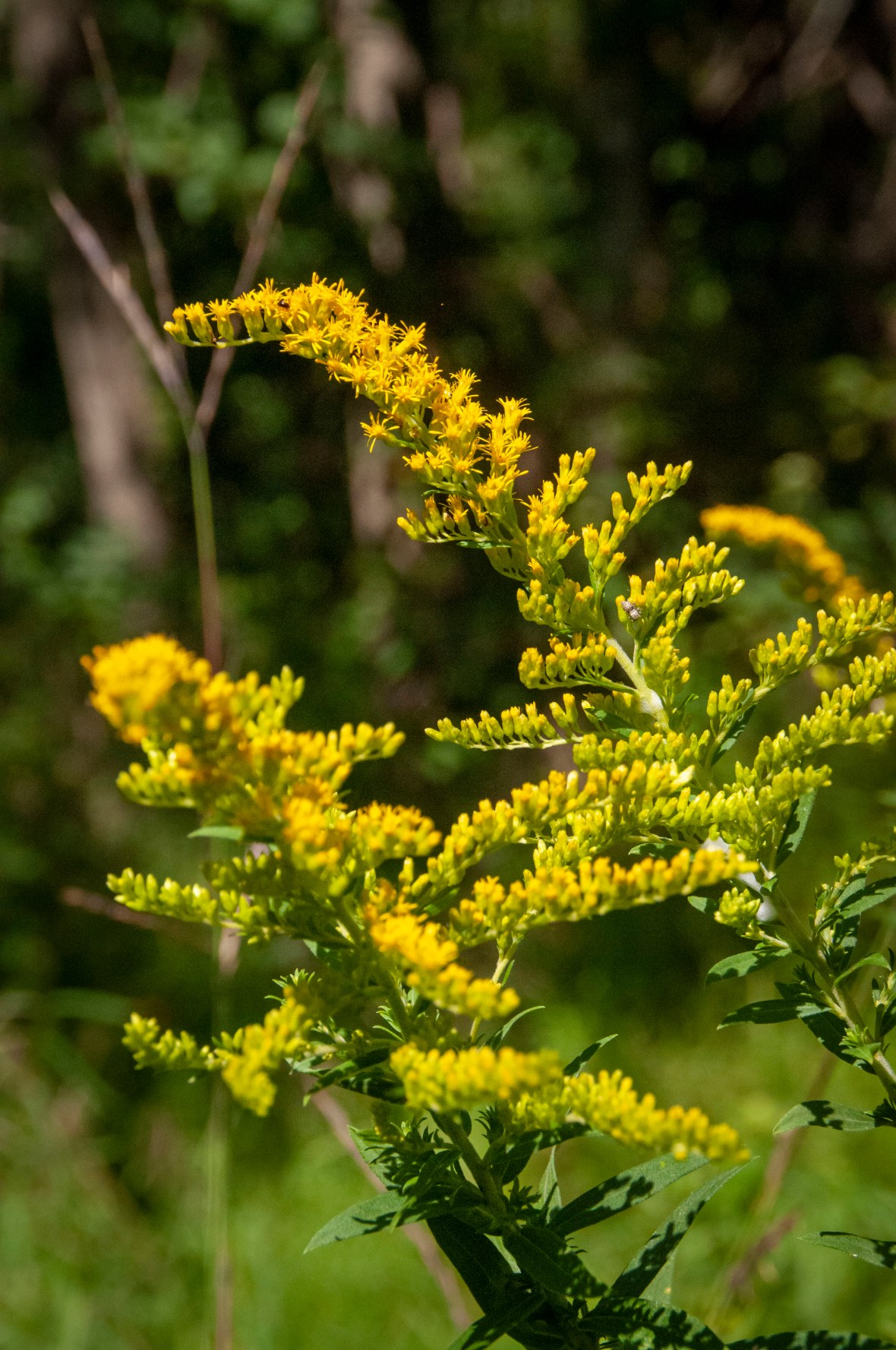
Unfortunately for this amazing plant, the blame usually is directed at the highly suspicious yellow flower that blooms right around the start of September and continues to bloom well into late fall: Goldenrod! We know that our seasonal allergies come from pollen, and nothing looks more covered in pollen than this vibrant yellow flower that the bees love to hang out on. However, what we aren’t aware of is that there is another, much sneakier culprit!

Ragweed is typically the primary cause of seasonal allergies that start this time of year. While there are many causes to seasonal allergies, including mold growth on fallen leaves, Ragweed pollen dispersion is definitely a huge source of our sniffles, without many of us event knowing it!

Ragweed often goes unnoticed, mainly due to the fact that even though it is also blooming at the same time, the flowers are very inconspicuous and the pollen grains are virtually unnoticeable. How could that be impacting us so much?!?! Well, flowers are uniquely adapted to their methods of pollination. In bright, happy, and colorful flowers, they are colorful for a reason. These flowers are primarily insect or bird pollinated and need to capture the attention of these creatures. Then, for creatures like bumblebees, the pollen grains need to be able to stick to the hairs on the body and legs in order to be moved from one flower to the next. Yellow is one of the bumblebees favorite colors and acts as leading lines or bright flags shouting “come and eat here!” to various pollinators. For inconspicuous flowers, such as the flowers for Ragweed, the pollen grains are small and don’t attract pollinators because they aren’t specially adapted to have larger creatures moving the pollen from one flower to the next. They are specially suited to be dispersed through the wind! As the wind blows the tiny pollen grains around the air, they land on the large stalks of Ragweed flowers in the surrounding area to help pollinate each other. While the pollen is blowing around in the wind, they also find their way up our noses and into our sinuses!

While you might not want to go around planting Ragweed, not just because they don’t really add color to the fall landscape, but because you also might be allergic to them, I do highly recommend that if there is one flower you will plant this year, that you plant Goldenrod!

This goldenrod stem has become a home for overwintering insects.

Goldenrod is such an important plant in your local landscape. They are natives to the entire eastern portion of North America – from the Great Plains all the way to the coastline! Not only do they have a wide native range, so they are great for many people to plant, but there are also so many species that are adapted to mountains, plains, marshes, and roadsides! Their blooms happen just in time for the end of the larger summer blooms, and their blooms can last for months! This provides important end of season food for numerous pollinators. In fact, 120+ native insect pollinators, including butterflies, moths, bees, wasps and others rely on this plant, as well as numerous native bird species. Without goldenrod, these creatures wouldn’t have enough energy to fuel migrations or be able to make it through the long winter!

Goldenrod stalks also provide habitat for overwintering insects and larvae. Several types of wasps will lay their eggs on goldenrod and create something called a gall. Galls are usually swollen portions of plants that have reacted to the laying of eggs. Often, a wasp will lay their egg inside the stem of a plant, and the hormones released encourage the plant to grow and swell, creating a “nursery” for the new baby when it hatches! On goldenrod plants, this can be seen as large spherical swelling in the middle of the stem, or as a bunch gall, where sudden, mutated leaf growth protects the larva.

Trying to figure out if what you have growing in your community is goldenrod or ragweed? Let’s take a look at some identifying traits:

Ragweed (Allergen – below swipe left to right)Goldenrod (Not an Allergen – below swipe right to left)
No conspicuous flowersBright yellow flowers
Tall spikes of flowers (looks like a candelabra)Flowers growing in spiked clusters that are usually
wider at the base and taper at the top.
Lobed, fern-like Leaves with petioleLinear Leaves that lack a petiole
Typically < 1′, but can grow up to 6′ tall.Typically 3-4′, but can grow up to 6′ tall.
Not covered in bees and butterfliesProbably covered in bees and butterflies

Supporting The Art of Ecology through the online shop or by becoming a Patron at any tier on Patreon can help keep educational content coming!

Home: WILD ART 2021

As part of the Wild Art 2021 August Challenge, put on by Zoe Keller, I illustrated two pieces focusing on the theme, “HOME”. Each month, I am going to focus on two pieces – one highlighting flora, the other highlighting fauna. This month, I focused on how different species create their homes and shelters. One uses plants, and the other forms a symbiotic relationship with other animals.

Typically, when we think of animals creating their homes, we often think of animals using plants to make their nest or cocoon. In the moth world, the caterpillars roll themselves up in plant matter such as leaves or needles, and complete the remainder of their metamorphosis. Mammals, such as beavers, build their homes out of sticks and branches. Birds build their nests out of all manners of plant life! The hummingbird collects lichen and moss and creates small nests by adhering the plants with spider silk. Swallows make mud and grass nests that stick to flat surfaces. Herons create large stick and branch platforms high in treetops near bodies of water.

One bird’s stick or grass home isn’t complete though without a little more decoration. Typically, birds finish their nests and don’t worry about home dรฉcor, yet the male bowerbird (a type of bird native to Australia) are VERY concerned about the aesthetics of the bower, or enclosed nesting site. In the case of bowers like the one shown here, where there are relatively parallel walls of sticks and grasses, they are called avenues. These avenues can be almost 6 feet in length and are adhered and made to stick up using a paste made of chewed plants and spit!

Once the sticks and grasses are placed perfectly, the male bowerbird starts the decoration process. He goes off to collect pieces of trash, flower petals, feathers, and other relatively small items that match his selected theme. Sometimes, the theme is a color, sometimes it is a texture or material. In the case of the Satin Bowerbird (Ptilonorhynchus violaceus) the theme is often the color blue. Since blue is a difficult color to find in the natural world, they often search out and bring back trash bits such as bottle caps, pens, small plastic ice cream scoops, and clothespins. Each item is placed meticulously and the male may adjust and re-adjust time and time again until he gets the placement perfect. Once he’s done, he stands outside the bower and waits for the females to arrive to check out his beautifully decorated home. She’ll examine his craftsmanship and he performs an elaborate courtship dance outside the bower to boost his chances of successful mating. If the female likes what she sees, they’ll mate and the male will no longer play a role in parenting. His job of creating the dream bowerbird home is done until he needs to create a new home.

Yet not every animal creates their homes out of plants! Some animals, such as the clownfish, forms symbiotic relationships with other animals and call that other animal their home.

As seen in this illustration, the Percula Clownfish (Amphiprion percula) spends it’s time finding solace and protection in an anemone. Not every anemone is a good fit for these fish though, and they can normally be found forming these relationships with Sebae Anemone (Heteractis crispa). The clownfish provides some valuable things for the anemone in exchange for the home the anemone provides. Most fish are stung by stinging cells, called Nematocysts, on the anemone, however clownfish – covered in a mucus layer – are immune to this sting. The clownfish take shelter inside the anemone’s tentacles. Their bright coloration attracts potential predators who come to eat the clownfish, yet ultimately succumb to the anemone’s stings. The anemone gains it’s nutrients by eating those would-be-predators! The clownfish, being the ever-perfect tenants, will also clean up. When the anemone is dirty, the clownfish eats up the muck, keeping the anemone and themselves happy!

These are some incredible examples of the many ways in which animals create their homes. While anemones and bowers aren’t found around my home of eastern USA, there are definitely some intriguing bird nests, fox dens, and insect galls. What sort of animals homes do you have around your community? Let me know in the comments!

Stay tuned next month to learn more about ancient “living fossils” with the “Prehistoric” theme!

Click below for more scientific illustrations, illustration workshops, or some new home dรฉcor!

Supporting The Art of Ecology through the online shop or by becoming a Patron at any tier on Patreon can help keep educational content coming!

Isn’t A Vulture Just a Vulture….? Uncovering differences between local species.

When looking up in the sky, we can often see vultures hovering and gliding in large circular patterns. With as much deer, fox, raccoon, groundhog, and opossum roadkill as is in this area, it’s not surprising to be able to look up at any point in time and see vultures! Many look up and see these large black birds and automatically assume, oh look, a Vulture, when in reality, there are many different vulture species, not just one general vulture! These local (Southeastern Pennsylvania) vulture species can include the Turkey Vulture and Black Vulture! So short answer for you – NO! Not all vultures are JUST vultures.

Identifying black vs. turkey vulture. Turkey Vulture eating carrion

Identifying Vulture Species

To tell the difference between these two species, you can look at the head and the underwing. When looking up at these high-soaring birds, you can see a difference in the wings. When looking up at them, you may notice that the Turkey Vulture has some silver or grey feathers. The Black Vulture will have those grey or white feathers, but only at the very tips of the wings instead of all along the bottom side. The head of the Turkey Vulture is bald and a reddish-pink color, while the head of the Black Vulture is, well, Black! The Black Vultures may also have some feathers on the tops of their heads, but leave their face featherless.

Adaptations of Vultures

Why do these birds have those bald faces to begin with? Are they sick? Nope! In fact, it’s the opposite! The bald, featherless faces allow these carrion (or dead matter) eating birds to stay healthy and clean as they eat disease or bacteria ridden carcasses. As they rip flesh with their beaks, they prevent the rest of their body and feathers from getting the gunk on them. The bald head and faces of some vultures also help them handle thermoregulation. As they fly high into the chilly air, then descend, often onto black roadways that absorb heat as they eat roadkill, they need to be able to handle these sudden temperature changes. Head is often lost from the head, and their featherless heads allow them to lose heat quickly when it’s hot. When it’s cold, you may see them hunched up, or with their head tucked back to prevent that heat loss.

While their task of eating dead things may seem pretty gross, this is actually a vital and marvelous job! Not only do they help “prettify” our world by removing dead things, they also help to sterilize and mitigate some disease spread. Their stomach acid and digestive system is so powerful that they scrub the bodies they eat of diseases like rabies, botulinum, and even anthrax! Without carrion-eaters like the Black and Turkey Vulture, the number of carcasses would pile up and the number of deadly diseases could spread quickly. Imagine having to wade through dead bodies as we tried to get around…. That is gross, but fortunately for us, we have the Black and Turkey Vultures cleaning up the ecosystem and cycling that dead creature’s nutrients back into the life cycle and food chain.

Protecting These Incredible Birds

Identifying black vs. turkey vulture. Juvenile Black Vulture

Have I convinced you to show some love to your local Black or Turkey Vulture populations yet? There may be even more, or other vulture species where you live too! You can help to protect these species by slowing down when you see roadkill. Be aware of Black or Turkey vultures that may be on the roadsides, trying to snag that meal in the middle. It would be so sad to hit a vulture as it’s trying to clean the road! Keep them safe by allowing them to do their job and slowly drive around them. If you notice them nesting in trees nearby, let them do so! They are probably cleaning themselves (they take very good care of their feathers, especially after a meal) and warming up before heading back out. If you see one, thank them for the messy job they do for the environment!

Bring these animals indoors, but not in a messy way, by exploring prints in the shop!

Supporting The Art of Ecology through the online shop or by becoming a Patron at any tier on Patreon can help keep educational content coming!