What is a Mushroom?
Mushrooms are some funky organisms. The at first appear similar to plants. They grow outside near plants, produce seed-like (spores) objects that help with fungi reproduction, and sometimes seem to grow up out of the soil, just like plants do. The visible portion of the mushroom, the part that pokes out of the soil or the tree, is called the “fruiting body”, and if often compared to the fruits of a plant, with the main body of the fungus living underground. However, fungi are actually more closely related to animals! A study on plant, animal, and fungi proteins revealed that fungi and animals are sister groups!
Despite their sisterhood with animals, fungi are still definitely different. They have different anatomical features, grow and develop differently, as well as reproduce differently. Let’s take a look at their anatomical structures first. Below is a diagram that labels some of their features.
Anatomy of Fungi

Starting from the top of the Fruiting Body of mushrooms and working down:
- Pileus (Cap) – This is the top portion of the fungi that holds the spore-bearing surface
- Veil Remnants – Before the mushroom matures, it is often covered by a veil (it may look like an egg shell surrounding the immature mushroom). As the mushroom grows, it bursts out of the veil, breaking it almost in two. Scales or other bumps on the surface of the cap, and the volva at the base of the stipe are remnants of this veil, also called a Universal Veil (meaning it originally covered the entire fungus). There can also be a Partial Veil (see Annulus below).
- Spore Bearing Surface – This includes gills, asci, pores, or slimey surface.
- Spores – The spores are then spread, like a plant seed could be, and aid in fungi reproduction. Examining spores under a microscope, or taking a spore print and examining the pattern and color of the print, can help with mushroom ID.
- Stipe (stem) – This is also called the stalk. Some fungi, like shelf or bracket fungi, lack a stipe, and instead stick directly out of their substrate.
- Annulus (Ring) – This is the remnant of a partial veil that protects the gills before the mushroom matures. Once the mushroom is mature, the partial veil falls, and all we see is the leftover annulus. Not all fungi, even gilled fungi, have this ring, making it helpful in narrowing down mushroom ID!
- Mycelium – These are fine tubes, similar in appearance plant roots, that function as the primary body, or vegetative part of the fungus. These underground tubes make up the biggest mass of the fungi, or fruiting body, that we see above ground! The mycelium aids in digestion, communication, and sensory response.
These are all important features to observe in order to properly identify a fungus. However, there is more to mushroom ID than just those anatomical features that can help with identification! As investigation continues, do not worry about damaging the above-ground, or fruiting body of the mushroom. Since this is not the main body, only the reproductive one, we are not hurting the individual as we make more detailed observations.
Making More Detailed Observations
- Does the mushroom bruise? – When a mushroom breaks, it can bruise, or changes colors. This happens when damaged tissue oxidizes (like how a banana turns brown when damaged). Not all fungi do this, however, the Two-Colored Bolete (aka Ink Staining Bolete) is a great example of this oxidation at work!
- Is the stipe solid or hollow? – Some stalks are like a hollow tube, while others are more of a solid pillar. Breaking open the stipe will reveal it’s identify! For example, a true Morel Mushroom has a hollow stipe, while the False Morel has a solid one.
- Does the mushroom have a distinct smell? – Mushrooms can be like scratch-‘n-sniff stickers! Scratch the top, then take a big whiff. What does it smell like? Some mushrooms, such as the Stinking Earthfan, Almond Scented Russula, Chanterelles, and the Mouse Pee Pinkgill, have very distinct aromas (some much nicer than others, as their names often imply!).
- What does the cap feel like? – The feel of the mushroom can help us narrow down their identity. Are they rough, brittle, slimy, or waxy? Mushrooms are safe, and fun, to touch and observe! As a disclaimer – be sure to wash your hands before eating anything, and never ingest a mushroom whose identity you’re unsure of! Not all wild mushrooms are safe to eat, and many can cause serious harm or even death.
- What is the mushroom growing on or near (what is it’s substrate?) – Mushrooms can be rather particular with where they grow. Chicken Fat Mushrooms are beneficial to the trees they’re associated, and grow on the ground near Pine trees. Chicken of the Woods Mushrooms, on the other hand, are a delicious edible mushroom that grows on the base of hardwood, especially oak trees, and is parasitic to its host.
Beautiful Biodiversity
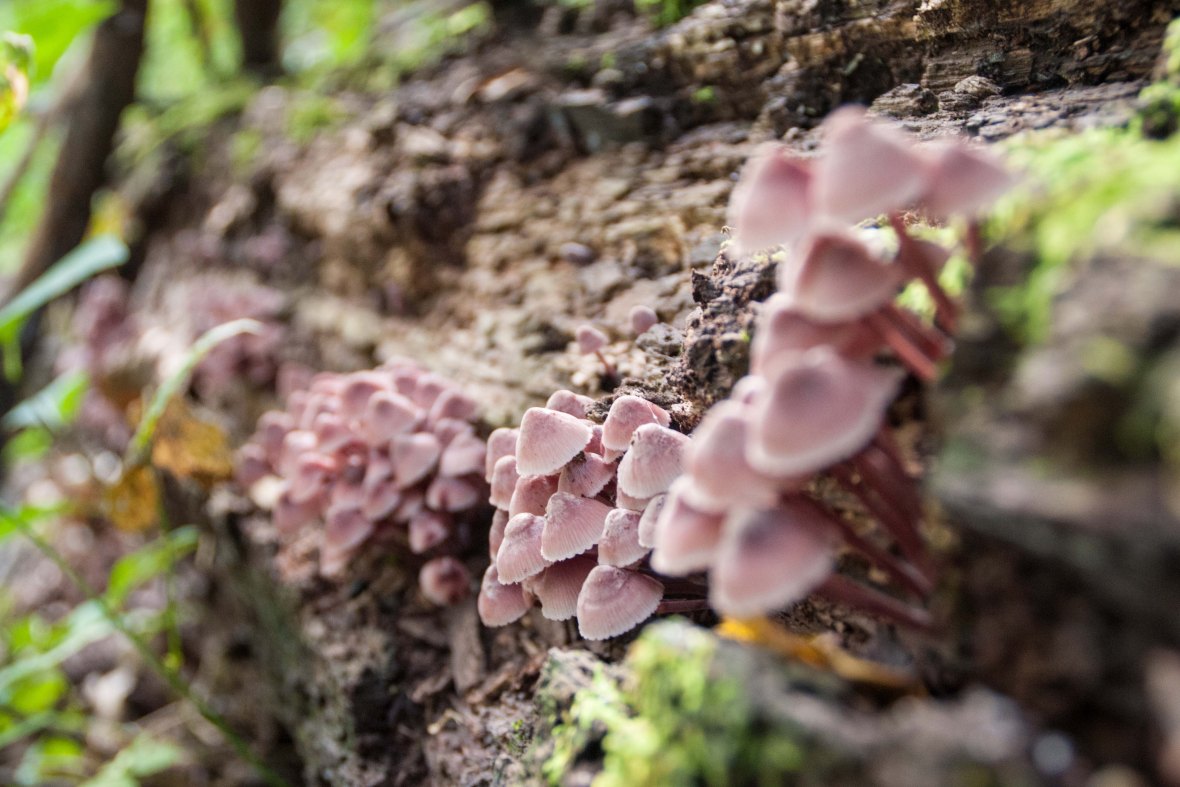
There are some incredible species that live all around us! From the vibrant orange Chicken of the Woods, to the purple of the Violet Bolete, to the Red Cups, and more, there are such beautiful species to observe! Next time you’re out for a walk, try to see what different species you can find in the mulch, dirt, moss, dead leaves, or tree trunks. Below are some of my personal favorite fungi finds! Can you find any veil remnants, stipes, gills, pores, and rings?