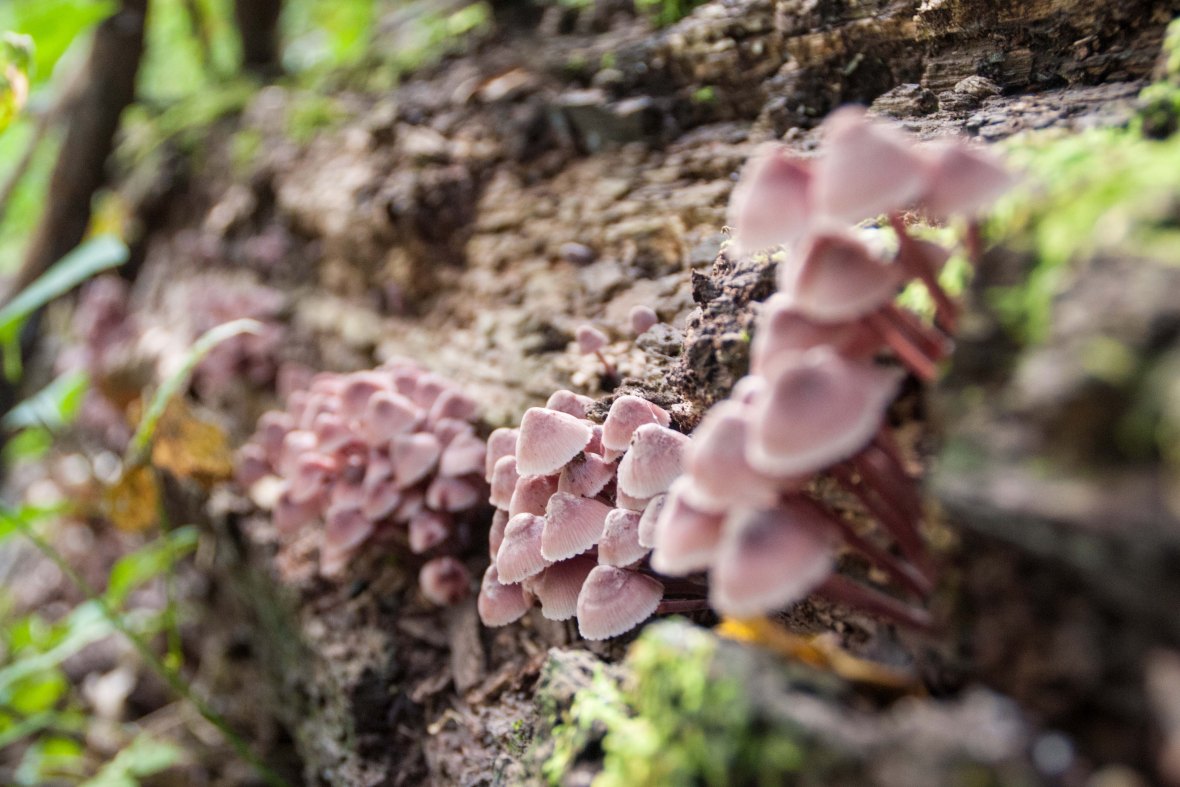
Autumn is probably most known for 3 things (well, 4 if you count pumpkins…): Fall Foliage, Colder (and shorter) Days, and Bird Migration, but there is way more going on! Why do those leaves change color, who uses those fallen leaves and why are they important to the survival of so many? Let’s examine some of these lesser looked-at changes as summer gives way to autumn.

“Tree Clocks” and Falling Leaves

Trees can “count”, meaning that they can keep a record of time in order to know when is the right time to enter the next season’s mode of operation. They keep track of night vs. day time hours, which makes sense, seeing as the plant relies on sunlight to photosynthesize and has unique adaptations and functions during the night. They also can keep track of temperature. This, among other cues, help to tell a tree how to behave.

We can see what pigments are in leaves through a process called “Chromatography”.

In fall, there is less daylight hours, meaning that the tree can’t photosynthesize as efficiently. It takes a lot of energy to produce chlorophyll, the pigment needed to photosynthesize, and if the tree is not producing energy at the same high levels as in the summer in order to make that green pigment, the tree simply takes back the chlorophyll out of its leaves and keeps their molecules for later! When the overwhelming green pigment is taken away, the other pigments that were always there, are revealed.

Eventually, there is so little light that the tree doesn’t find its leaves useful anymore. It takes back all of the pigment, leaving only brown, crinkly leaves. The petioles (stem-like structures that adhere the leaf to the branch) detach as a strong wind blows. The leaf falls to the ground, leaving a tiny scar on the branch. This is called abscission, and trees do this at different times, if at all! Some deciduous trees, like beeches (pictured here) and some oaks, retain some old leaves, and only shed them in the spring when new buds burst into baby leaves and push the old leaves out of the way. This retaining of old leaves is called Marcescence. Examining the shape and size of the scar can actually be a great way to identify tree species in the winter!

These leaves tend to fall exactly where the tree wants. Creating those leaves took a lot of nutrients, which decomposers enjoy munching on throughout the season. This leaves decomposes and sits at the base of the tree, where fungal decomposers can return the nutrients to the tree.

Insects Overwintering in Fallen Leaves

Not only do fallen leaves act as food for decomposers and the parent tree, but they also provide vital habitat to overwintering insects. The endangered Rusty-patched Bumblebee, isopods, Hairstreak moths, ladybugs, spiders, Luna Moths, Wooly-bears (Isabella Tiger Moth caterpillars), and many other arthropods and insects spend their entire winter safely tucked in and insulated beneath these leaves. So please, leave the leaves in the autumn to help protect these insects!

Not all insects require leaves, but another sort of protected home. Some insects produce glycerol, a chemical utilized in antifreeze, as part of a foamy house that protects them over the winter. Others live as eggs and hatch inside of stems and twigs in houses called “Galls”. The adult lays an egg inside the plant tissue, which results in the plant hormones running wild! Instead of growing normally, it poofs out like a balloon or a fluffy bunch, to create a “living room”. Throughout the winter, the insect is protected inside the plant, then chews its way to freedom when it’s warmer!

Decomposition of Leaves Replenishes Exhausted Soil

Earlier, I mentioned the importance of leaves staying where they fell. The leaf litter does feed more than just the trees, though. By the time summer, the growing season, has ended, the soil is often exhausted! It takes a lot of work to feed all of the plants growing quickly!

In a healthy forest ecosystem, the forest itself is a land manager and each part helps maintain one another. The leaf litter becomes a layer of valuable organic matter, which provides good nutrients. Microbes, insects, fungi, and other larger squirmy-wormies break down the organic matter and crawl about in the soil, adding air and space for water to flow. The air flow prevents sensitive plant roots from rotting after a rain storm, and allows for good water infiltration. Unfortunately, healthy woodlands aren’t super easy to come by anymore. Unsustainable development, invasive species spread, and human-caused climate change are all negative impacts on habitats. In curated habitats, like urban and suburban environments where trees are managed by people, ecosystem health needs a helping-hand.

When we remove the leaves from the environment, the health of all plants and animals within that system suffer too. Those decomposing leaves feed the parent tree, but also the rest of the plants growing in the area. Native flowers, pollinators, secondary consumers, and ultimately local apex predators are all at risk of suffering if soil health suffers.

For example, Pennsylvania’s native Joe-Pye Weed relies on moist, loamy soil. Loam is a blend of silt, sand, and clay. Organic matter feeds the loamy soil. The Joe-Pye Weed grows tall and with many blossoms during the summer growing season. These blooms feed over 40 species of caterpillars, provide nectar for countless adult butterflies and moths, and provide food for seed-eating birds in autumn. The hard stems provide overwintering homes to Mason and Leaf-cutter bees, and some Black Swallowtail pupae find shelter in their chrysalis attached to the stems. Then, in fall and winter, as leaves fall around the old Joe-Pye Weed stems, soil microbes, fungi, and other decomposers return those leaves to the plants in the spring in the form of nutrients! The cycle continues and the soil stays healthy.

So, Respect Overwintering Lifeforms and Soil Replenishers!

Love nature? Join my Patreon for themed monthly environmental education, art, nature & science tutorials, and join my Sticker of the Month Club! Support my environmental education content and programming through purchases in my shop, and by sharing my shop with others. A portion of all proceeds benefits wildlife conservation, habitat preservation, and environmental education efforts.

From the delicious fruits of the Staghorn Sumac, Sweet Crabapple, and the tart Callery Pear, to the deliciously savory and bitter Mugwort leaf, autumn is a great season to find foraged goodies! Fall foods tend to be warming and have some dense nutrients, all to help prepare the body for the cooler months ahead. The crabapple and the pear, used in some of the recipes below, are often best later in autumn, after the first frost. Frost helps make the sugars bioavailable, which makes them sweeter. This isn’t necessary though, since some folks (like me!) like tart, bright fruit flavors.

Foraged Piyaz Salad

  • Tomatoes & Red Onion chopped (to taste – omitted in the dish pictured here due to allergies)
  • 15oz. can of White Beans
  • Parsley (fresh, if able, and to taste!)
  • 2 tblsp. Lemon Juice
  • Olive Oil, Sumac, Red Wine Vinegar, and Chopped Garlic Cloves

Combine chopped tomatoes, onions, and beans in a bowl. Stir in lemon juice and fresh parsley. The more parsley, the merrier (if you like the taste)! In a separate dish, emulsify the oil, vinegar, garlic, and sumac to drizzle on as a vinaigrette.

Staghorn Sumac grows beautiful red “horns” in the summer, and the fruits stay on until the winter (or the birds have had their way with them!). Harvest the horns, allow to dry, then use gloves or a paper towel to rub the dehydrated powder off of the fruits. You can also grind the fruits into a powder.


Crabapple-Cedar Handpies

  • 1 c. Cored crabapples
  • 1/2 c. Sugar or Honey
  • 1/4 c. (+1tblsp.) Apple Juice
  • 3 tblsp. Finely chopped (or powdered) Eastern Red Cedar leaves
  • Cinnamon (to taste)
  • Pie Crusts (as per any recipe, or pre-made)
  • 1/4 c. Powdered Sugar
  • 1 tblsp. Milk
  • 1 tsp. Eastern Red Cedar Extract

While the image shows Cranberry instead of apple, both are yummy! I often make the cranberry with leftover Thanksgiving fruits.

Mix fruit and cedar in a bowl along with sweetener and apple juice to make the filling. Leave 1 tblsp. of juice to use later. Cut pie crusts into hand-sized blocks. Spoon fruit mix onto one crust, leaving the edges open, then brush some apple juice onto the open edges. Lay another crust on top of the fruit and gently press the edges together. The juice helps act like a glue. Then, use fork tines to press into the edges, creating a seal. Bake pies at 350 degrees (F) for 12-15 minutes. Add milk and Eastern Red Cedar extract to powdered sugar to create a glaze. Drizzle glaze over cooled pies, then serve!


Orange Mugwort Bitters

  • 1 Orange (Blood Oranges are tasty!)
  • Leaves of 2 large Mugwort stems
  • 3-5 Chopped Callery Pears
  • Clear Alcohol (I prefer gin, but any will work!)

Gently wash mugwort leaves, then pat dry. Chop up orange and pears into a sealable 1/2 pint jar. Add leaves and top with clear alcohol. Seal and put in a cool, dry place for 2-3 days. Take a tiny sip to taste, then, when you like it, strain liquid into a bottle. Serve as a bitters substitute in cocktails, or take a sip before a big meal to aid in digestion.


Supporting The Art of Ecology through the online shop or by becoming a Patron at any tier on Patreon can help keep educational content coming!

What is a Mushroom?

Mushrooms are some funky organisms. The at first appear similar to plants. They grow outside near plants, produce seed-like (spores) objects that help with fungi reproduction, and sometimes seem to grow up out of the soil, just like plants do. The visible portion of the mushroom, the part that pokes out of the soil or the tree, is called the “fruiting body”, and if often compared to the fruits of a plant, with the main body of the fungus living underground. However, fungi are actually more closely related to animals! A study on plant, animal, and fungi proteins revealed that fungi and animals are sister groups!

Despite their sisterhood with animals, fungi are still definitely different. They have different anatomical features, grow and develop differently, as well as reproduce differently. Let’s take a look at their anatomical structures first. Below is a diagram that labels some of their features.

Anatomy of Fungi

Starting from the top of the Fruiting Body of mushrooms and working down:

  1. Pileus (Cap) – This is the top portion of the fungi that holds the spore-bearing surface
  2. Veil Remnants – Before the mushroom matures, it is often covered by a veil (it may look like an egg shell surrounding the immature mushroom). As the mushroom grows, it bursts out of the veil, breaking it almost in two. Scales or other bumps on the surface of the cap, and the volva at the base of the stipe are remnants of this veil, also called a Universal Veil (meaning it originally covered the entire fungus). There can also be a Partial Veil (see Annulus below).
  3. Spore Bearing Surface – This includes gills, asci, pores, or slimey surface.
  4. Spores – The spores are then spread, like a plant seed could be, and aid in fungi reproduction. Examining spores under a microscope, or taking a spore print and examining the pattern and color of the print, can help with mushroom ID.
  5. Stipe (stem) – This is also called the stalk. Some fungi, like shelf or bracket fungi, lack a stipe, and instead stick directly out of their substrate.
  6. Annulus (Ring) – This is the remnant of a partial veil that protects the gills before the mushroom matures. Once the mushroom is mature, the partial veil falls, and all we see is the leftover annulus. Not all fungi, even gilled fungi, have this ring, making it helpful in narrowing down mushroom ID!
  7. Mycelium – These are fine tubes, similar in appearance plant roots, that function as the primary body, or vegetative part of the fungus. These underground tubes make up the biggest mass of the fungi, or fruiting body, that we see above ground! The mycelium aids in digestion, communication, and sensory response.

These are all important features to observe in order to properly identify a fungus. However, there is more to mushroom ID than just those anatomical features that can help with identification! As investigation continues, do not worry about damaging the above-ground, or fruiting body of the mushroom. Since this is not the main body, only the reproductive one, we are not hurting the individual as we make more detailed observations.

Making More Detailed Observations

  1. Does the mushroom bruise? – When a mushroom breaks, it can bruise, or changes colors. This happens when damaged tissue oxidizes (like how a banana turns brown when damaged). Not all fungi do this, however, the Two-Colored Bolete (aka Ink Staining Bolete) is a great example of this oxidation at work!
  2. Is the stipe solid or hollow? – Some stalks are like a hollow tube, while others are more of a solid pillar. Breaking open the stipe will reveal it’s identify! For example, a true Morel Mushroom has a hollow stipe, while the False Morel has a solid one.
  3. Does the mushroom have a distinct smell? – Mushrooms can be like scratch-‘n-sniff stickers! Scratch the top, then take a big whiff. What does it smell like? Some mushrooms, such as the Stinking Earthfan, Almond Scented Russula, Chanterelles, and the Mouse Pee Pinkgill, have very distinct aromas (some much nicer than others, as their names often imply!).
  4. What does the cap feel like? – The feel of the mushroom can help us narrow down their identity. Are they rough, brittle, slimy, or waxy? Mushrooms are safe, and fun, to touch and observe! As a disclaimer – be sure to wash your hands before eating anything, and never ingest a mushroom whose identity you’re unsure of! Not all wild mushrooms are safe to eat, and many can cause serious harm or even death.
  5. What is the mushroom growing on or near (what is it’s substrate?) – Mushrooms can be rather particular with where they grow. Chicken Fat Mushrooms are beneficial to the trees they’re associated, and grow on the ground near Pine trees. Chicken of the Woods Mushrooms, on the other hand, are a delicious edible mushroom that grows on the base of hardwood, especially oak trees, and is parasitic to its host.

Beautiful Biodiversity

There are some incredible species that live all around us! From the vibrant orange Chicken of the Woods, to the purple of the Violet Bolete, to the Red Cups, and more, there are such beautiful species to observe! Next time you’re out for a walk, try to see what different species you can find in the mulch, dirt, moss, dead leaves, or tree trunks. Below are some of my personal favorite fungi finds! Can you find any veil remnants, stipes, gills, pores, and rings?

Celebrate the summer season with some all-natural and sustainable crafts, designed to get you outside, learning more about local insect communities, investigating the summer blooms in a way that allows you to enjoy them year-round, and discovering the beautiful night sky in a whole new way.ย 

This is part 5 of my “Eco-friendly” & sustainable art projects. Find more projects and sustainable activities below!

Nature-made Dragonflies

Did you know that dragonflies are the most efficient predators on the planet?! Dragonflies have a catch rate of roughly 95%, meaning that they are more successful hunters than hawks, big cats, reptiles, and other apex hunters! These incredible insects also have a fascinating life cycle and can be seen in a variety of dazzling colors. This craft gets you outside, harvesting nature materials to paint and design your own incredibly colorful hunter.

Methods:

  1. Gather twigs the size of your index finger to be the “body” of your dragonfly. Allow them to dry out of there was a recent rain.
  2. Gather Maple or Ash (pictured here) tree seeds (also called Samaras) to act as wings. You will need 4 per dragonfly. Allow them to dry out of there was a recent rain.
  3. Paint the body and wings of the dragonfly in bright, metallic colors, or research your favorite local dragonfly species (The Eastern Amberwing male and female are the dragonflies I used as inspiration here, but Green Darners are colorful too!).
  4. Hot glue the wings onto the body. Add string if you want to hang them!

Pressed Plant Stickers

Who doesn’t love the colors of fall foliage or the bright flowers of summer?! Keep these memories year-round, as well as to be used for arts and crafts or keepsakes. I love using these on journal pages, calendars (yes, I still have a paper calendar), and for stationary labels.

Methods:

  1. Harvest plants to press. Using a pressure pressing method will help flatten these flowers and foliage to be used for stickers.
  2. Keep plants in a press for 1-2 weeks, or until they are flat and fully dry. Be careful as you check them – fully dried plants can be very brittle!
  3. If you have “waterproof” sticker sheets, lay the plants on the top of the sticker paper, then cover the sheet in its waterproof sticker laminate. If you don’t have these sheets, stick clear packing tape over top of wax paper. Then lay the plants on top of the clear tape, and add another layer of clear packing tape. The wax paper acts as the sticker backing and can be peeled off (or slightly heated with a hairdryer if it’s hard to peel).

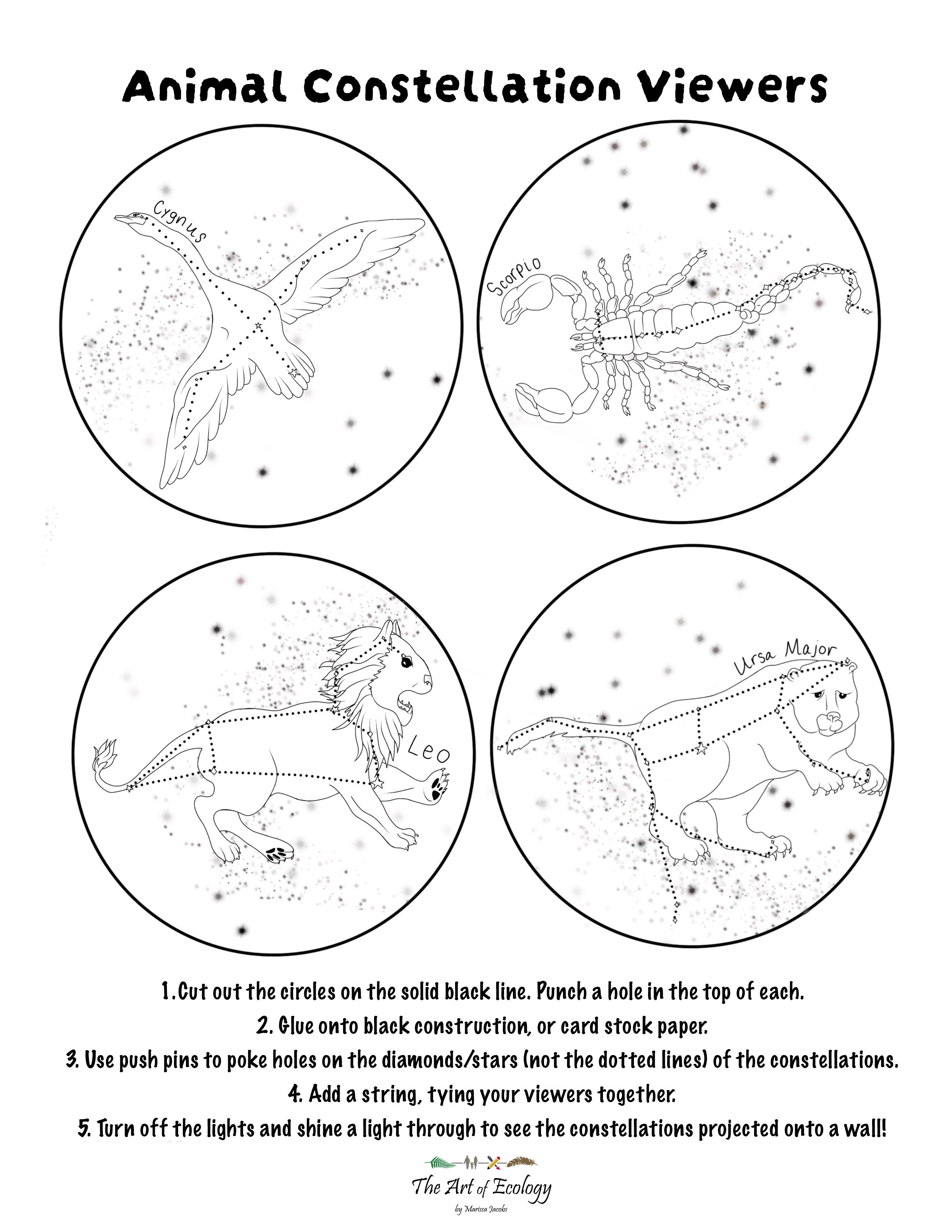
Constellation Viewers

One of my favorite activities growing up in the darkness of the Pocono Mountains (where there was very little light pollution!) was stargazing with my dad. Learning the story of the constellations, along with how to navigate using the stars was always fascinating to me! This is a great activity to use to practice viewing the constellations, then go outside and put your knowledge to the test in the winter, when it gets darker earlier.

Methods:

  1. Either, print out my template (Download it HERE) and cut out the pre-made constellation guides, or choose your own constellations to draw onto white paper.
  2. Glue your white paper onto black card stock or construction paper and draw on the constellations.
  3. Sit them on a cork board, or pin cushion, and use a thumb-tack to poke holes where the stars of the constellations are. You should see your drawing on the front, but on the back (the black side), you would only see the poked holes.
  4. Hole punch a circle to tie your constellation circles together.
  5. Hold the circle up to a bright window to see the pinpricks of light shine through, OR go to a dark room and shine a flashlight through the viewer to shine the constellation onto a wall or sheet.
  6. Go outside at night and see if you can use your constellation practice to identify what you see in the sky!
Looking for Pre-Made Nature Art or other artistic activities? A portion of all proceeds from my shop benefits wildlife conservation and habitat preservation efforts.

A blanket of fresh snow, the soft feathers of birds, and soothing petals of roses and lilies. The color of these natural artifacts are so tranquil, but what exactly is that color called? Pantone has selected Cloud Dancer, a blank slate of a hue to be the 2026 color of the year!

With its expansive presence, PANTONE 11-4201 Cloud Dancer invites a space where function and feeling intertwine to build atmospheres of serenity and spaciousness, providing a refuge of visual cleanliness that inspires well-being and lightness.

Pantone.com

Where is Cloud Dancer found in Nature?

To me, white is the color of imagination alighting, creativity waiting to be expressed, and the world ready to be explored. White, while definitely NOT my favorite color, symbolizes readiness and an imaginative spark waiting to ignite. The natural world is one of my favorite canvases, and it was a joy to look through my photos to discover what “Cloud Dancer” colored-organisms I could find.

In the collage here, I selected my favorite nature photos that I’ve taken over the past couple of years that highlight Cloud Dancer. I will definitely be on the watch in 2026 for this color, and remember to take a step back, allow my creative thinking to meditate on what the future beautiful canvas holds, rather than being so hasty to cover up the white!

Supporting The Art of Ecology through the online shop or by becoming a Patron at any tier on Patreon can help keep educational content coming!

In spring of 2021, I wrote the Habitat Article for the local River Towns Magazine. The below is the blog version of the post – enjoy!


A once dying raptor, Bald Eagles now have healthy habitat they need to thrive! In the 1960โ€™s and 70โ€™s, the Bald Eagle, our National symbol, was on the verge of extinction. DDT, a harsh chemical insecticide was sprayed all over agricultural fields and roadsides. As the rains fell it washed into waterways. Bald Eagles would catch fish, their ideal food source, in those polluted waters and ingest the insecticide. Their eggs became too thin and corroded to properly hatch, and the bird almost completely disappeared. 

In 1972, DDT was banned, and the Delaware River was cleaned. Over the next few decades, as the water quality and local habitat, including streams like the Tohickon, improved, the Bald Eagles were able to re-establish themselves in the River Towns region.

Diane Allison, local birding expert and data compiler for the Central Bucks Christmas Bird Count, a Community Science project put on by the National Audubon Society, was able to provide some historical data. The first Bald Eagle observed in the Christmas Bird Count was in 1966. For many years to come, no other eagles were observed until 1975. Finally, in 2015, there was evidence that the local habitat was healthy enough to sustain successful nests. There were 11 Bald Eagles observed that year, and each year since, the numbers rose! In the 2019 Christmas Bird Count, 19 Bald Eagles were recorded.

While these Community Science projects help to provide scientists with a general idea of population growth, itโ€™s not unlikely that the data doesnโ€™t fully depict populations. Only birds observed within a certain timespan are counted, and due to the fact that birds can move freely, may be counted too many times or not at all if they are absent from the count location. However, these counts do provide valuable information on general trends, climate change impact, and movement over time.

Art by Marissa Jacobs (Find more bird & eagle art HERE). Illustrated Bald Eagle over photographed Poconos river during peak fall migration time highlights the absence of these once present birds due to population decline. Hopefully, through raised awareness and collective conservation efforts, the eagle will once again be a commonplace sight!

Allison contributes these numbers to decreased DDT and cleaner habitat. Many wildlife-lovers may be concerned about the amount of human recreation along the river causing a disturbance to eagles. Despite tubing, kayaking, fishing, and other recreational activities, Bald Eagles donโ€™t seem to be disturbed by human presence. If you are hoping to observe these local treasures, a good rule of thumb is to maintain a distance from the eagles and their nest. If you notice that your presence has them behaving oddly or they seem stressed, back off. Binoculars, telephoto lenses, and Nest Cams set up by the PA Game Commission are excellent tools to observe Bald Eagles from a safe distance.

Despite Bald Eagles being removed from the Endangered Species list in 2007, our concern for their health should not dwindle. Lead poisoning, from ingesting fish with lead weights or lures, or carrion that was shot with lead ammo, can seriously harm or kill eagles. Replacing lead ammunition and fishing gear with bird-safe alternatives is a great personal action to take to protect eagles. 

Due to the health of the local habitat and that our own homes sit adjacent to the river and wild places, we may notice that not only are Bald Eagles nesting along the river, but in our backyards and communities as well! If you notice anything concerning in regards to Bald Eagle nests (the tree the nest is in is falling over, people are deliberately harassing the nests, etcโ€ฆ), please contact your local wildlife services – the PA Game Commission or the NJ Division of Fish & Wildlife.

Halloween has come and gone – it’s November and already the Christmas decorations are available in stores! Let’s face it, it’s almost time to swap out the pumpkin and gourd decorations for holly wreathes. So, what should we do with those old gourds? They’re organic and can’t properly decompose without soil microbes and air, so adding them to the landfill is not the best solution. Each year after Halloween, pumpkins, old hay bales, and leaf litter enters the waste stream, left to release methane gas in landfills. Fortunately, there are several eco-friendly ways to get rid of the old pumpkins!

determining squirrel age_ adult squirrel

Let Wildlife Enjoy It

Please note that this should ONLY be done with un-touched gourds. Do not let wildlife eat from bleached or painted pumpkins, as this can accidentally poison them! Also, if the pumpkin was carved, be sure that there are no leftover candles inside and that the pumpkin is mold-free. Once the pumpkin has received the “all-clear”, toss it into the woods in your yard, or see if your local nature center or park is accepting old pumpkins. Raccoons, squirrels, chipmunks, deer, and other animals will thank you for the free snack!

If you don’t have a suitable area to put them out for wildlife, check to see if local farms or zoos want them. Many pigs, goats, and other animals will have fun with the gourds!

Create Bird Feeders

The seeds can be added to bird feeders and the gourds themselves can become suet block holders! One of my personal favorite woodpecker feeders is a pumpkin with suet stuffed into holes. This can be a really fun way to leave un-carved/painted gourds outside to attract colorful and cheerful visitors to your home.

pumpkin suet feeder

Compost the Ol’ Things

Pumpkins and other gourds are high in nutrients that can return to the soil. Throw them in your compost bin, or in a brush pile in your yard. You never know – there’s a strong chance that you might even grow a volunteer pumpkin patch!

Make a Delicious Meal

Whether you want to roast the seeds and eat them over salads or as part of a fun granola or trail mix, or use the flesh to make a pie, there are so many fun ways to eat pumpkins! I really enjoy making a soup-base, since I like savory flavors rather than sweet ones. Of course, just as with wildlife, you do want to be sure that your pumpkins are free of chemicals and mold before using it.

As more and more people compost, feed the wildlife (or themselves!) with old Halloween pumpkins, the number of pumpkins entering the landfill (over 1 billion!) can decrease and prevent this fun decoration from becoming an environmental pollutant!

As part of my Aquatic Ecosystems graduate class, I wrote a little interpretive story of a feature of a local water body system. I chose to narrate the importance of riparian zone trees and their leaves on aquatic creek life.

“It is a cool, misty sort of autumn day at Hollow Creek. The trees along the bank show their deep red and yellow hues and the color is reflected in the trickling creek waters below. A blustery wind makes the branches of the Red Oak shiver. A deep red, burgundy leaf breaks off from its stem, leaving a scar behind, and flutters down during this process called abscission. The wind catches the leaf and carries it to the moving, or lotic, creek below.ย 

The leaf is quickly caught up by the water and swept away. The leaf travels a few meters through the riffles, and then slows as it enters a section of pooled water. There, the Red Oak leaf drifts until it bumps gently into a rock and some tangled branches that have trapped previous leaves. The water collects overtop of the still leaf, and it settles down with other, now-dingy brown colored American Beech, White Oak, and Sycamore leaves.

As the water continues to flow overtop and past the Red Oak leaf over the next few days into weeks, its color begins to fade. What is happening?!  The once deep red leaf turns brown, like the rest of the leaves trapped here. This seems to be the end of the journey…. But wait – a host of life forms is attracted to where the oak leaf sits – maybe the journey has ended, but its purpose in the stream has just begun!

As the pigments are leached into the water, it’s remaining nutrients are pulled too. These nutrients fill the area, attracting many types of microscopic life. Algae starts to grow on the leaf, loving the new nutritive addition to the water. The leaf becomes soft and flexible, much unlike its rigid and brittle life it had on land. As bacteria and fungi grow and feed on the oak leaf, it becomes conditioned and slippery. Is this now the end of the line – being food for the good bacteria?

Just as the leaf undergoes this process and all seems to be the end, a new life-form approaches, using its tiny mouthparts to nibble on a section of the leaf. This creature appears so small and weak – it needs fuel and the Red Oak leaf is glad to be of more service. It’s a good thing that it became so soft and pliable. It would have been extremely difficult for this little creature to fragment, or shred, the leaf earlier! As it shreds the leaf, it makes itself at home, wiggling it’s long, tannish-brown body along, dragging its two tails behind. More of these larvae head over to do the same.

The oak leaf, once bright green and full of energy from the sun, contributed to feeding its tree. Now, even after abscessing from its tree, it has more life and nutrients left to give to these Stonefly larvae who have made a home amongst the fungi, algae, and bacteria, allowing this life cycle to thrive.”

Further Reading & Resources

Love Streams & Creeks?

Share your love and appreciation for these important watershed areas with others with The Art of Ecology Merch! A portion of the proceeds benefits habitat restoration and preservation efforts.

During the summertime, I always get so excited to flip over rocks by the stream and roll over rotting logs in the woods in search of critters! Pennsylvania is home to 22 salamander species, many of which I have spotted, however I have never seen any of the 4 native lizard species in the wild! What is the difference between these salamanders and lizards? How would I be able to tell these incredible animal groups apart? After all, they do look very similar at first glance!

What is a Lizard

lizard dragon

Lizards and salamanders do share some similar traits. Many have slender bodies, long tails, walk on four, outspread legs, and have adorable little faces! However, once you know the differences between a lizard and a salamander, it is hard to confuse the two.

Lizards are reptiles, meaning that they have scales as body covering, are ectothermic (get heat from sources outside of their body), and lay eggs on land. These traits are shared by other reptiles, like snakes and turtles, as well. Lizards, though, also have moveable eyelids and external ear openings, unlike snakes. Unlike turtles, they lack a shell. Pennsylvania is home to four lizards, including the Eastern Fence Lizard, Northern Coal Skink, Common 5-lined Skink, and the Broad-headed Skink.

What is a Salamander

protecting herps

Salamanders are primarily different from lizards due to the fact that they are amphibians instead of reptiles. This means that they have thin, smooth skin, which needs to remain relatively moist. Amphibians respire through their skin, so it needs to be thin enough for molecules to pass through! This also means that they are very sensitive to pollution and toxins within their aquatic environment (learn more about aquatic environment bioindicators HERE). Amphibians are able to live both in the water and on land successfully. Many salamanders start their life out in water as an egg and hatch into their larval form. This larval stage has feathery gills that allow them to breathe in the water. As they mature into juveniles and adults, some salamanders move to the land and loose their gills. Similarly to reptiles, amphibians are also ectothermic.

Pennsylvania is home to 22 native species of salamanders, many of which can be found in stream beds and under logs or leaf litter near bodies of water. While most reptiles are diurnal, many salamanders are nocturnal, preferring to be out during the evening and nighttime hours. This difference is due to their habitat and climate preferences. Reptiles want to stay hot and dry, whereas salamanders prefer cooler and moist environments.

Conserve Native Reptile & Amphibian Populations

Both lizards and salamanders are fascinating creatures with a positive impact on our local ecosystems! They both are predators, and help to manage insect populations. Reptiles also are huge rodent pest controllers! Presence of salamanders in a wetland environment can also signal that the habitat is healthy enough to support these delicate creatures.
Both reptiles and amphibians like to cross roads in order to find suitable breeding and egg-laying locations. This means that they are particularly susceptible to being squashed by oncoming traffic! One great way to protect these species is to drive carefully and, if safe to pull over and get out of your vehicle, help move salamanders and other reptiles off the road in the direction that they were originally going.

Another way to protect their populations is by creating suitable habitat for them in your yards and communities. Leaving leaf litter, building little rocky areas for ectotherms to bask on, planting native plants, and incorporating water into the landscape can really help these unique animals to not just survive, but thrive!

You can help support wildlife populations through these actions, and by supporting me through art purchases and event attendance! A portion of all proceeds is donated back to benefit wildlife conservation, habitat preservation, and environmental education efforts.