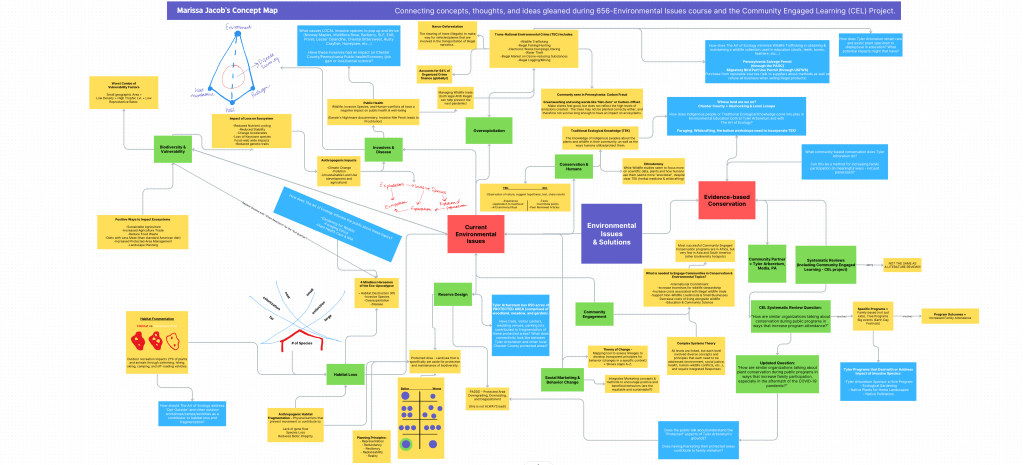
Well, my 2nd semester of grad school has now passed, meaning that I am halfway through! This is a happy thought. The light at the end of the tunnel is drawing closer. Despite being excited to finish, I learned a lot and am excited to apply the knowledge to my work.

This semester, there was a trend that spanned across all of the courses I took (Environmental Education, Wildlife Education, and Environmental Issues), and that was that human behaviors have made such an impact on our ecosystems, and therefore, how we teach needs to address these human behaviors.ย 

I led a foraging walk (also addressed the importance of using wildcrafting to increase inclusivity) at the 2023 PAEE Conference. This photo was taken by Fern Hill Nature Center. I was so happy to have several fellow Slippery Rock University undergrad & graduate students attend my session!

Perspectives & Ideologies

In both Wildlife and Environmental Education, I learned about human perspectives and ideologies towards the natural world. These perspectives (such as a moralistic, aesthetic, naturalistic, utilitarian, dominionistic, avoidance, etcโ€ฆ) help to drive WHY people engage with the natural world in the way that they do. For example, someone with a moralistic perspective on nature might be more inclined to participate in animal rights activism while someone with a more utilitarian perspective may prefer to engage with nature out of a primary concern for practical values. Being able to incorporate as many of these perspectives into my programs can help draw in a wider audience and be as inclusive in perspectives as possible.

Environmental Ideologies (such as human-based, ethics-based, or transformative) drive where peopleโ€™s attention is focused on. For example, the human-based ideology of Conservationism states that natural resources are for human use, but we need to use them wisely. There are many people in the United States who would fall into this category of protecting natural resources for future generations to use. Addressing the root of why and what they care about specifically can also help to engage a wider audience.ย 

Human Behavior & Impact on Nature

The Environmental Issues course focused on current trends and hot topics such as the โ€œ4 Mindless Horsemen of the Eco-Apocalypseโ€: Invasive Species, Habitat Destruction, Disease Spread, and Overexploitation. All four of these topics are spurred onwards rapidly by human action, whether it is intended or not. Throughout the course, we discussed how we, as educators, can use evidence-based conservation practices to inform decisions, and how interconnected these hot topics in conservation are with other disciplines, such as politics, sociology, and economics. By finding out how they are all connected, we can better understand motivations, which also helps to inform practices. Without understanding the social implications of the drivers of these hot topics, they cannot be fully addressed and solved.ย 

Throughout this course, we worked on a Community Engaged Learning project, which had each student working with a community partner to create a systematic review to provide that community partner with evidence-based answers to their questions. I partnered with Tyler Arboretum to create a systematic review that helped to answer their question of, โ€œHow are similar organizations talking about plant conservation during public programs in ways that increase family attendance?โ€ I analyzed already published articles to create the review so that the community partner could make data-driven decisions, rather than just hoping on chance and relying on what โ€œmaybeโ€ worked in the past (anecdotal evidence).ย 

Sample pages from my Visual Executive Summary (read the full document above)

Systematic Reviews & Evidence-Based Conservation

In the Environmental and green industry, there is a huge trend of making decisions because thatโ€™s what โ€œweโ€™ve always doneโ€, or โ€œso-and-so said it workedโ€, without actually analyzing data, traditional ecological knowledge, or considering scientific publication results. One example of this is often seen in mulching practices. Many (not all!) landscapers or homeowners will mulch directly around trees, piling the mulch high, which creates โ€œmulch volcanoesโ€. This is just what is done because thatโ€™s how itโ€™s always been done, yet scientific evidence states that this actually has the ability to suffocate trees, causing girdling roots, and trap in too much moisture around the bark which can lead to parasitic fungi and bacteria introduction. Mulching can be great, and healthy for young trees. Adding scientific data to our decision making process and education, we can take more positive actions for the environment.

There are two primary issues why more systematic reviews, or evidence-based conservation, isnโ€™t routinely engaged withโ€ฆ First, this takes a LOT of time. This takes hours and hours! You search through scientific databases for related articles, analyze for relevancy, and then analyze the data to answer the question. Many organizations just donโ€™t have this amount of time! And what does time equal? Money. Without proper funding, organizations donโ€™t really want to spend precious resources on this type of project. Volunteers, graduate students, or interns could absolutely help out in this regard, however then we need to address the problem of compensating these folks for their time and effort, as well as finding enough of these people to tackle all of the questions out there!

Human Behaviors Can Lead to Positive Changes

Overall, biodiversity loss due to habitat loss, invasive species and disease introduction, and overexploitation occured primarily due to human actions. This may seem sad at first, however this means that human actions, when informed, can make a positive impact too! Increased evidence-based education about the role of biodiversity across disciplines can lead to a healthy, thriving planet – thatโ€™s my goal!ย 

A portion of the proceeds from all of my work benefits wildlife conservation and habitat preservation efforts. Below are some products I made using some of the illustrations I created for this semester of grad school! Support the conservation efforts and show off your love of nature through stickers.

When we combine artistic mediums with environmental science topics, we can increase our knowledge about the natural world, and how we act as stewards of the ecosystems around us. WHY art is so beneficial to increasing our understanding, regardless of subject or topic?

The Role of Art in Learning Styles

Art, or something made via creative process, engages various learning styles and intelligences. There are 4 primary learning styles; Visual, Auditory, Reading/Writing (or working with words), and Kinesthetic (or โ€œdoingโ€). Someone who is a visual learner likes to utilize graphs, pictures, and their sense of sight. Auditory learners like to listen to instructions or stories in order to understand concepts. This can be through YouTube, listening to a lecture a podcast.

Learners who love words like to read instructions, or write things down to remember them. Finally, Kinesthetic learners would much rather attempt to learn as they go by taking action. A great example of the learning styles can be found in an example about IKEA furniture: A visual learner flips to the section of the instruction manual to follow diagrams. The auditory learner will go to the website and listen to the video tutorial as the build the piece. The reading/written learner will read each step by step instruction as they go. The kinesthetic learner will throw the rule book out and just build the piece by trial-and-error, learning about the various parts and tools by giving them a try. That being said, people usually donโ€™t learn through just one style.

art and nature enhance education

Many are multi-modal. Roughly 45% of femalesย  and 87% of males tend to learn through a variety of styles. I am a VK learner, or a Visual and Kinesthetic learner. Roughly 84% of young adults (this study examined undergraduate level students) have some amount of Kinesthetic learning desire. Why does this matter? The kinesthetic learner wants to create. Utilizing art while learning can enforce concepts. If the learner creates something as they are taught about environmental science, those concepts stick better! Looking at the fact thatย 84% of young adults enjoy learning through these action-based methods can indicate how important art and creativity can be to learning. In the education world, there is also something else to consider about how people learn best, aside from the VARK styles.

The Role of Art in Multiple Intelligences Theory

These intelligences dictate not just in what style do people learn best, how to people are taught best. These can be taught through any of the VARK styles. There are 8 primary intelligences: Musical, Naturalistic, Mathematical, Interpersonal, Intrapersonal, Linguistic, Spatial, and Body. For example, my strengths are naturalistic, spatial, and body intelligences. I not only like to learn about the natural world, but I like to have information presented to me in a way that relates to the natural world (naturalistic intelligence), my visual surroundings (spatial intelligence), and gets me moving (body or kinesthetic – thereโ€™s that word again!, intelligence). Those who focus on musical intelligences though might like to create little songs to help them remember concepts. Interpersonal learners might want to engage in deep discussion with others to learn more about the concept.

Why do the Multiple Intelligences matter? Studies document the percentage of people that fall into the various intelligence categories. Roughly 40% of people in the study focus on Bodily or Kinesthetic learning and roughly 45% of people focus on interpersonal intelligences. 39% focus on musical intelligence. This shows that people really like movement, taking action, working and learning from others, and learning through melodies! This supports our desire to create as a form of learning. Art is movement-based. Dancing, singing, painting, drawing, or other artistic mediums help us learn, and communicating our expressions with others is a huge component of why artists might create!

How do we combine art with environmental science? The why is easy – combining art with ANY field of study can increase that personโ€™s understanding of the topic! The HOW is more of a variable. Different artists or scientists use art in different ways. As many artistic mediums as there are out there, is what limits how the combination can occur.

Blending Art and Environmental Education

As an environmental educator, blending these two ideas is integral to getting my audience to learn about topics. From building terrariums to help participants learn and understand the various layers and interconnections of our ecosystems at large, to engaging with botanical illustration in order to observe and study plant morphology, or making foraged wild-edible cocktails to connect workshop participants with the role that these edible plants play in feeding wildlife, conserving soil, or how invasive species impact flora & fauna in an ecosystem – itโ€™s all important! These workshop participants can go away from the workshop with a deeper level of understanding about the environmental concepts, as well as feel empowered by the fact that they made something to bring home and have the skills to repeat the project in different or similar ways on their own.

Never miss out on an upcoming event by subscribing to my e-blasts and checking out my calendar of events. A portion of the proceeds benefits wildlife conservation and habitat preservation efforts.

Protecting Breeding Turtles & Amphibians

Starting in late March-early April, you may notice a lot of nature centers or wildlife organizations start talking about โ€œHerpsโ€…. What?! Herps are the collective term for Reptiles + Amphibians. While they each have their own distinguishing characteristics, they are similar enough so that many scientists lump them together while studying or talking about them. The study of reptiles and amphibians is called herpetology, so that often just gets shortened to โ€œherpsโ€.ย 

Reptiles and amphibians are both ectotherms (they get their internal body temperature from outside sources), may live in similar environments, and lay eggs. A primary difference is the presence of scales in reptiles. 

protecting herps

Spring & Herps 

The reason that we often talk about them in the spring (in eastern North America) is because they are starting to wake back up from their brumation period and are looking for breeding grounds or areas to lay their eggs. Herps will leave their small home ranges and travel great distances (some turtles will walk up to two miles) to find nesting sites. Starting in April, continuing through June, here in Pennsylvania, we see more herps crossing the road, especially at night. This often leads to human-wildlife conflicts, mostly in the form of roadkill. In fact, one study found that over the span of one month, 20,000 herps died as a result of vehicle traffic (93% amphibians and 7% reptiles)! This is tragic, but fortunately there are some ways to prevent that high mortality rate.

Ways to Prevent Herp Roadkill During Breeding Season

Managing the population is what they do best! Caring for snakes is caring for all species.

Many of the herp deaths come from roads that fragment their habitat. These roads are necessary for humans to travel, so this can be a difficult challenge to overcome! Connecting the fragmented habitats through tunnels under the roads, wildlife bridges overtop of roads, and wildlife fences along busy areas can all be great to reduce wildlife deaths, however thatโ€™s not something that individuals can just set up or create, and then there are concerns with the fact that many herps return to the same spot every year to lay their eggs. What would happen if they were suddenly cut off via wildlife fences?

Fortunately, there are ways that individuals can make a difference on herp populations during their breeding season. First, we can slow down and be conscientious of their movements, especially when driving at night. If you find an animal trying to cross, slow down to allow it to pass, or in the case of turtles, pull over if itโ€™s safe and gently move them across the road (always to the side that they are heading towards). We can also put up little signs in hotspot or high herp traffic areas along roadways to increase other driverโ€™s awareness. By planting native and increasing habitat in our own yards and communities, we can also reduce the distance that these species have to travel to find suitable nesting sites!

Herp Conservation Efforts

Interested in helping, but canโ€™t plant natives or are interested in other ways? Give to organizations such as the International Reptile Conservation Foundation, Southeast Partners in Amphibian and Reptile Conservation (SEPARC), or the Society for the Study of Amphibians and Reptiles (SSAR) to help fund their work. Or – shop reptile and amphibian merch through The Art of Ecology! A portion of the proceeds directly benefits wildlife conservation and habitat preservation efforts.ย 

March Madness is a great time to take a look at rankings, tiers, and analyze favorites of objects (such as basketball sports teams). This month though, instead of examining sports, I will be looking at an analyzing moths (who doesnโ€™t love good alliteration) as part of the #MarchMothMadness art challenge.

This art challenge was created by Sue Fields and Kate Hicks on instagram for artists to join in, learning about the incredible biodiversity of moth species found all over the world and to highlight the role that moths play in our ecosystems. So many artists participate in these art challenges, and getting to see what other artists create is a great way to see how peopleโ€™s perspectives and creative outlets can spark conversations about biodiversity, habitat loss, and wildlife conservation.

Below are some of my March Moth Madness illustrations, and some facts about the species that I got to learn about during this month. 

comet moth for march moth madness

Comet Moth (Argema mittrei)

This moth won the all out March Moth Madness on social media (see below).

This moth, also called the Madagascar Moon Moth, is easily recognizable with its vibrant yellow color, eye spots, and long, fluttering tails. They are excellent examples of why itโ€™s important for insects to have tails. These tails act as defense mechanisms. They confuse bats, who rely on echolocation to hunt, and if a bird or bat were to catch a tail, the tail can break off, leaving the rest of the moth intact and safe – living for another day with the hope of mating and laying eggs! 

The adults canโ€™t eat anymore, so they just reproduce after emerging from their cocoon. The males fly around in search of females, who often sit still under cover and wait. Since the males have to travel more, they have much longer tails than the females. The males also have much larger and more feathery antennae than the female, and these antennae help them to detect pheromones – letting them search for females easily!

Unfortunately, due to habitat loss (roughly 90% of Madagascar forests are negatively impacted), it is believed that their populations are decreasing. Protecting areas of biodiversity, such as islands, is so important!

Deathโ€™s Head Hawkmoth (Acherontia atropos)

Named for the skull-shaped splotch on its back, one might think that itโ€™s a creepy sort of moth at first. Really, these are gentle moths that utilize potato and other Solanum plants as food sources. In fact, it is often thought to be a scaredy-cat itself! When alarmed, the moth can produce a little grating scream to scare potential predators away. Similarly to how a saxophone reed vibrates to produce noise, the moth vibrates their proboscis to squeal. 

Io Moth (Automeris io)

Unlike the Comet Moth, the Io is currently at low risk of population decline! One of the benefits of not living on an island is that movement to adapt to changing climates and habitats is much easier. These moths, similarly to the Comet moth as well, do not eat as adults, and their caterpillar host plants are rather commonplace in the United States. The adults lay their eggs on Hackberry, Redbuds, Pears, and Willow trees, as well as on blackberry canes. Many of these are commonly cultivated trees, and can be found even in urban and suburban residential areas, meaning that the impact of development and habitat fragmentation do not impact the moth population as much as it could in other regions. 

Cinnabar Moth (Tyria jacobaeae)

cinnabar moth for march moth madness

This vibrant moth is a prime example of why introducing new species for the sole reason of managing other introduced species is a bad idea. The Cinnabar moth was introduced to western United States as a way to manage the growing ragwort population. The caterpillars of the moth were supposed to eat away and balance the aggressive ragwort plant, however it is difficult to control where animals move and feed at. The caterpillars found that many other plants in its new habitat were much tastier, and started feeding aggressively on native plants. Now, the United States contends with the ragwort AND the Cinnabar moth! This moth has spread throughout much of the United States, but is still missing in some regions. 

Despite its invasive nature, it is such a beautiful animal with its striking coloration (Pokemon nerds unite – we learned what Cinnabar meant at young ages as our characters traveled to Cinnabar Island, named after the reddish color). I would love to see it, but in its native habitat where it benefits the community. In the United Kingdom, it feeds on Common Ragwort (Senecio jacobaea – see the similarity in the scientific names of the food source and the moth?) and manages the populations of the plants without being destructive. 

sheep moth for march moth madness

Sheep Moth (Hemileuca eglanterina sub. shastaensis)

While this moth is native to North America, it is primarily found in the western portion where its host plants grow easily. The Sheep moth caterpillars are less generalist than the Io moth, so they need more specific host plants, which may not grow all over the incredibly diverse ecosystems found within the United States. They love mountainous plants, such as the Mountain lilac, Mountain mahogany, Bitter Cherry, Snowberry, and currants. While these plants can be cultivated in the eastern United States, the plants require more care and are less suited to the soil conditions, summer droughts, heat, and humidity. Without stable populations of host plants, the moths cannot survive.

In fact, this moth is so particular with itโ€™s region that there are some subspecies. The subspecies illustrated here (with pink and not just yellow or pale-orange wings) is only found in northern California and southern Oregon.

Polyphemus Moth (Antheraea polyphemus)

This moth won the bracket for Native North American Moths on social media (see below).

While other moths here have been named for their coloration, fuzzy appearance, or long, comet-like tails, this one was named after a character from Greek mythology. Polyphemus was the son of Poseidon and was a cyclops who had a giant eye in the middle of his forehead (heโ€™s the cyclops that gets blinded by Odysseus). The large eye spots on this already large moth (its wingspan can be 6โ€ wide) have earned its common name.

These are the most generalist species out of all of the moths listed here. They feed on over 50 plant species, many of which are very commonplace in urban, suburban, and rural areas. Even though habitat destruction may not be a leading threat, light pollution does impact them. These moths are attracted to lights, so at night, when they should be out mating, they are drawn to light sources, wasting their energy before they get a chance to mate and lay eggs. By turning off lights at night, we can make a positive impact on the beautiful Polyphemus moth and many other animals. 

March Moth Madness Rankings

I asked my social media followers to rank these moths for March Moth Madness, ranking the Native Vs. Exotic Species. Take a look at who won out! Do you agree with this ranking? Which are your favorite moths here?

Go Mad for Moths!

Overall, what I learned from this is just how gorgeous and stunning moths can be! While some previously drawn moths (Rosy Maple, Hummingbird, and Luna moths) have been vibrant and colorful, I hadnโ€™t really observed exotic moth species. The beauty that various species exhibit is breathtaking and really solidifies the importance of protecting all species.

Celebrate moths with some of my moth merch! 

The temperature is warming up and the days are longer. Spring migration is ramping up and I am starting to see more birds in the edge of the woodlot behind my apartment and I hear them singing early in the morning. Some of the most common birds that I see and hear are sparrows, those little brown birds with white streaking. While many look the same at first glance, there are so many different individual sparrow species that might visit your area – in fact there are over 40 different kinds!

Let’s examine how to tell some common sparrows apart in time for World Sparrow Day!

Sparrow Identification

The easiest way to tell them apart is by looking for field markings. These are marks in the coloration of their feathers such as stripes, streaking, spotting, and more. Another way to distinguish between the sparrows is by listening to their calls and observing where we find them (the habitats they prefer). Some of the common ones where I live (southeastern Pennsylvania) include the Song, White-throated, and House Sparrows.

Identifying the Song Sparrow

These sparrows, just like many others, are primarily brown, however where the brown markings are can help us figure out what little sparrow weโ€™re looking at. Song Sparrows have white throats and chests with brown streaks down the top portion of the front and along the sides. They have a reddish-brown head, and a gray-ish brown stripe above their eye. Another key marking is that they have brown triangles on the sides of their throats. 

As their name implies, they have beautiful and melodic songs. During the spring, the males often sing to attract mates, denote territory, and communicate with other birds.

Listen to their call and song HERE.

Identifying the White-throated Sparrow

This sparrow has a very easy-to-see field marking that really sets them apart from other sparrows – their yellow eyebrow! While some of these species have a more dingy yellow color than others of its kind, even the dingy yellows are clearly yellow and not a brown or tan. They have white chins (throats) and pale, creamy chests without the dark streaking that the Song Sparrows have, and a white or tan stripe down the center of their heads.

This particular White-throated sparrow is more tan than bright white, however you can still see the snow-white patch under the beak that gives this bird their name.

Listen to their call HERE

Identifying the House Sparrow

The breeding plumage and sexual dimorphism between the male and female House Sparrows can make identifying these birds quickly a challenge, however the males are easily identified as House Sparrows due to their striking coloration.

The males have gray caps with cinnamon-colored sides on their heads. There are blocks of black around their eyes, extending towards their beak and throat. Their beaks are dark browinish-black, however the females can look very different. Their chests are a grey color as well. During the breeding season the black that extends towards their throat will look more and more like a bib.

The females are more of a tan color with less contrast to their feathers. Instead of a cinnamon stripe on the sides of their heads, you can see a very slight tan stripe, although both the male and females have brown and black wing feathers. The female’s beaks are more of a golden yellow color rather than the black of the males.

Listen to their call HERE.

Celebrating Birds

While these sparrows might be commonplace, that doesn’t mean that they aren’t important or worth celebrating. These are important insectivores and seed-eaters who help to disperse seeds and keep insect populations in balance. I love seeing the Song Sparrows in my garden, flitting around, searching for grubs and other insects that when in an unchecked excess could damage the beautiful plants that I carefully grow.

Celebrate these adorable little birds with my “Birds of Pennsylvania” sticker set, which includes a sparrow and other species common to the Eastern United States.

This past month I’ve been creating art as part of the #Feathruary2023 by @MischievousRedFox on Instagram. Illustrating birds is not only fun, and a great way for me to learn more about bird identifying characteristics, and sharing the finished piece is a good way to increase appreciation and respect for the bird world. Each piece in this series is fully illustrated in Adobe Photoshop using a digital drawing tablet. 

This yearโ€™s prompts were more abstract rather than prompting individuals to draw species. This allowed the artist to draw different birds based on their unique perspectives and observations. It was so fun to see what other birds fit into prompts such as โ€œSong, Poem, or Tale Inspiredโ€, โ€œLoveโ€ (for Valentineโ€™s Day), or โ€œBird Feeder Friendโ€. 

Below are four of my favorite pieces that I drew for this yearโ€™s art challenge, along with their life history and a bit of why I selected that bird for that dayโ€™s prompt.

American Robin feathruary 2023

American Robin (Turdus migratorius)

Prompt: First Bird You See or Hear Each Day

When I take my dog out in the morning, we walk overlooking a grassy field lined with Black Walnuts and some thicket area. As our winter has been relatively mild (as it has for the past few years), the ground there is rather squishy and muddy. A lack of frozen layer makes perfect habitat for earthworms and other insects to be crawling around underground! The robins, usually hailed as a โ€œspringโ€ bird due to their iconic behavior of foraging for these worms in recently thawed ground (previously in March or April), are having a field day with the worms even this early in the year! When the ground is frozen, the robins forage for berries and dried fruits in the treetops. Even if I donโ€™t immediately see them, their call is distinctive, listen HERE.

European Starling  (Sturnus vulgaris)

european starling feathruary 2023

Prompt: Black

While there is no true black pigment in the natural world (humans have made synthetic black pigments), there are definitely animals that appear black with how saturated they are with dark red or brown pigments! The European Starling strikes me as a black bird, along with the Crow, Raven, or Red-winged Blackbird. Upon observation though, as the light hits their feathers just right (iridescence), they light up with the most beautiful greens, turquoise, and purples!

These birds are invasive here in North America. They were originally introduced because the settlers loved how they looked in Europe and wanted to bring their beauty across the ocean. Unfortunately, the birds adapted very well to the area, lack the predators and diseases that were in their native region, and have outcompeted many native bird species for resources and space. Despite this, it is hard to deny that they are indeed gorgeous birds!

Rose-breasted Grosbeak (Pheucticus ludovicianus)

Rose breasted grosebeak feathruary 2023

Prompt: Bird Feeder Friend

These spring birds tend to be rather timid around humans, which makes them hard to spot at feeders. In mid-March – April though, if there are feeders bordering wooded areas, you might just be able to catch a glimpse of them flitting back and forth between the feeder and the protective tree line! These birds love seeds, making our Black Oil Sunflower seed feeders a treat for them. During the spring though, they start to transition to a heavier insect diet, since the insects provide valuable protein to help the young birds grow and develop. 

While I may not see them often at my feeders, I do always get extremely excited when I spot one enjoying a seed or two before flying off.

Secretary Bird (Sagittarius serpentarius)

Secretary Bird feathruary 2023

Prompt: Biggest Bird Seen in Real Life

During my 2021 trip to Kenya, I had the incredible opportunity to watch a pair of Secretary birds sauntering in the tall grasses of the Maasai Mara. These birds stand at roughly four-five feet (1.22-1.5m) tall and much of that height comes from their long legs. They, as their scientific name implies (Sagittarius is โ€œarcherโ€ and serpentarius is โ€œsnakeโ€ – although the โ€œarcherโ€ name may also refer to the large feathers that look like arrows sticking out of a quiver), are predators of snakes. They will eat whatever they can catch if snakes are not easily found, though. The Secretary bird uses their long, powerful legs to lash out and kick the snakes that they come across to stun them or fling them into the air, or to flush them out of their hiding spots before using their sharp, curved beak to eat the prey. 

Their long eyelashes help to protect their eyes from dust and debris as they stare at the ground while kicking and stomping. This adaptation is especially helpful in their dry, semi-arid habitat in Central and Sub-Saharan Africa.

Two secretary birds I saw walking through the Maasai Mara, Kenya, 2021

Bird Conservation Through Art

By drawing these birds and sharing them with the public, I can encourage people to start falling in love with the incredible world of birds too! As we start to get to know the wildlife around us, even through images, books, or videos, we start to build connections to them. Through these connections, we start to understand them and develop a desire to protect them.

Do you love all things wildlife and want to share that passion with everyone you see? Check out my calendar of events for upcoming illustration classes (both in-person and virtual) or art exhibits that showcase these beautiful animals. Visit my shop to snag some bird stickers, magnets, and more! A portion of the proceeds helps to support wildlife conservation efforts.

As part of my spring 2023 “Wildlife Education” course (Masters of Environmental Science through Slippery Rock University), I conducted a survey/questionnaire that was designed to examine the public’s perceptions and attitudes towards a bird feeding; a sometimes-controversial wildlife topic. Many feel strongly about why they should or should not feed wild birds.

Below are the questions and corresponding data gathered from this questionnaire. 15 people responded to the questions, which were shared on social media and email.

Do you feed birds?

Questionnaire Responses

Question #1: Do you have bird feeder/s in your yard that you routinely fill (even for only a part of the year)?ย 

Question #2: How many different types of feeders (if you feed), do you utilize? For example, 1 black oil sunflower seed, 2 suet feeders, 3 hummingbird nectar feeders, 1 nyjer thistle feeder, etcโ€ฆย 
What feeders do you have?
  • Out of all of the responses, 16.6% of participants do not have any sort of bird feeder.
  • Of those who do put out feeders, 35% of participants put out black oil sunflower seed (and mixes including these seeds primarily), 20% put out hummingbird feeders, 30% have suet block varieties, 5% put out fruit feeders, and 10% have other sorts of feeders (which includes specialized nut or corn feeders). None of the participants put up Nyjer thistle feeders.

Question #3: What are your primary reasons to feed or to not feed the birds in your community (ie: beauty, ecological function, not permitted to, disease spread, etcโ€ฆ)?ย 
primary reason to feed/not feed birds_attitudes towards bird feeding
Primary reasons to feed/not feed the birds?
  • Out of those who do not feed the birds, 60% could not feed the birds due to their housing situation (renters, 2nd floor tenants, or HOA does not allow for feeding), 40% did not feed the birds in preference of providing natural habitat and food sources instead.
  • Of those who do feed the birds, 33.3% had an ecologistic attitude towards bird feeding. They wanted to promote biodiversity and to positively impact the environment.
  • 33.3% had a dual attitude of ecologistic and naturalistic. They wanted to not only promote positive environmental impacts, but also enjoy the act of bird or wildlife watching.
  • 25% had a naturalistic attitude towards bird feeding. Their primary reason for feeding birds was to watch and experience the wildlife up-close.
  • 8% had a moralistic attitude towards feeding the birds. They wanted to promote the bird’s welfare and found it to be an ethically responsible action to take.

Where did you hear about this disease outbreak from?
Question 4: In 2020, there was a disease outbreak in eastern US bird populations. Scientists asked the public to remove all bird feeders to reduce disease spread while they worked to determine the cause of the disease. In September 2021, this recommendation was lifted as cases fell and feeders werenโ€™t found to be the primary culprit. Were you aware of this issue (regardless of if you feed birds or not)? If so, where did you hear about it from?
  • 66.6% of participants were aware of the issue. 90% of those who did hear about it removed their bird feeders or took personal action. 10% of those who did hear about it kept their feeders up or did not take personal action.
  • Out of those who did hear about it, 71.4% heard about it through social media platforms. 28.5% heard about it through bird-friendly and wildlife organizations email notifications. 14.2% heard about it through word of mouth.
  • 33.3% of participants were not aware of the issue.

Question 5: List 10 bird species (does not have to be songbirds) that you see commonly in your community at any point throughout the year. If you cannot list 10, please list as many as possible
  • 46.6% of participants could name 10+ individual bird species that frequent their community. 53.3% of participants could name between 6-9 individual bird species that frequent their community.
  • 73% of participants listed seeing the Northern Cardinal, 66.6% mentioned the crow, 60% mentioned the American Goldfinch and the Blue Jay, 53.3% mentioned the Red-tailed Hawk and the American Robin.
  • Outliers (birds mentioned only once) include the American Woodcock, Black Phoebe, Western Kingbird, Killdeer, and the Bald Eagle.ย 

Question 6: On a scale of 1-10, how important do you think it is to feed birds as a method of conserving native bird species.
bird feeding as method for conserving bird populations_attitudes towards bird feeding
Question 7: In your opinion, rank the following personal, at-home actions on a scale of 1-5, where 1 is least important and 5 is most important, for protecting local bird populations. The at home-actions listed to rate were: Setting up bird feeders, creating native gardens, protecting birds from window strikes, providing baths/water, and keeping pet cats inside.
  • A majority of respondents believe that planting/creating native gardens is the most valuable method of conserving bird populations at home.
  • A majority of respondents believe keeping pet cats inside is the least important method of conserving bird populations at home.

What Does this Tell Us?

By analyzing the public perceptions and attitudes towards bird feeding, environmental educators and science communicators can better tailor our programs and content to address concerns and relevant issues. For example, I was pleased by how many people could identify birds by sight in their community, but concerned by the seeming lack of regard/knowledge for the importance of keeping pet cats indoors. Instead of hosting more “bird ID” programs, I can host more bird conservation at-home programs (and create more educational content) addressing the impact that feral and pet cats have on the decline of bird species. People also seem to value gardening more than setting up feeders, which can direct what sort of information I include during native gardening programs.

By understanding people’s motivations and attitudes towards birds (naturalist, ecologistic, moralistic, etc…) I can also create content that attracts more people and works in line with their ideals. In order to effectively communicate, I need to know what is important to the public!

attitudes towards bird feeding_hummingbird feeder

Hibiscus, orchids, and chrysanthemum blooms are always so vibrant and colorful. The color of these flowers are so striking, but what exactly is that color called? This year, Pantone selected Viva Magenta, a reddish hue to be the 2023 color of the year!

Viva Magenta 18-750, vibrates with vim and vigor. It is a shade rooted in nature descending from the red family and expressive of a new signal of strength. Viva Magenta is brave and fearless, a pulsating color whose exuberance promotes a joyous and optimistic celebration, writing a new narrative.

Pantone.com

Where is Viva Magenta found in Nature?

Many flowers and plants have the vibrant hues of Viva Magenta! These colors are are made of a variety of anthocyanin pigments. Anthocyanin pigments (especially found in young tissue) help to boost the plant’s immune system, prevent oxidation in the cells, and also acts as a sunscreen for the plant! On top of those health benefits, many pollinators are attracted to the vibrant reddish-pink. In fact, this is one of a hummingbird’s favorite colors! To discover more about the wonderful world of plant pigments and how pollinators see the world, click here.

In the collage below, I went through my archives and selected my favorites nature photos that highlight Viva Magenta. I will definitely be on the watch in 2023 for this beautiful, bold and uplifting color!

Supporting The Art of Ecology through the online shop or by becoming a Patron at any tier on Patreon can help keep educational content coming!

This year has had so many incredible ups and some downs, however this has been such an overall year of growth! Despite moving to a new county in the fall, the support Iโ€™ve gotten has been tremendous. Below is my year in review.

Exciting News from 2022

In the early spring, I completed my intermediate Herbalism training, which was such a fascinating program that helped solidify my path with foraging and wildcrafting. I love the blend of medicine, anatomy, and ecosystem connections!

In the summer, I held my first ever summer camp for kids and I was able to host not only one, but two successful weeks! These camp weeks got kids outdoors, engaging with the natural world through hands-on, scientific observation, and creating unique pieces of nature art. 

Then, in the fall, my husband and I moved to Chester County so that he could start a new job at Longwood Gardens and that I could start my journey with obtaining my masters degree in Environmental Education. I had to reduce some of my hours working through The Art of Ecology, but still found time to find new workshop venues and audiences in the new location while maintaining contact with my supporters in Bucks County!

Below are some photos from this past year.

My Goals for 2023

In 2023, it is my hope to further establish myself here in Chester County by offering monthly in-person, environmental education through art programs as well as host not just two, but three weeks of summer camps for kids! I also hope to increase my virtual programs that facilitate learning regardless of location so that I can reach people in Chester County, Bucks County, and around the world. I also hope to get ยพ of the way through my graduate school career and start looking at potential universities to teach Environmental Education to undergraduate students.

The Best from 2022

Left: Top “For What it’s Earth” podcast episode. Top: Top 9 on Instagram


How to Support The Art of Ecology

Interested in supporting my work? Join me on Patreon for monthly sticker merch, coloring pages, nature-art video tutorials, and exclusive environmental education content. You can also shop a number of nature-art and herbal goodies in my shop. A portion of the proceeds supports wildlife conservation, habitat preservation, and environmental education efforts.

While this reflection is in part a journal for myself, I also hope it provides valuable insight into a Masters in Environmental Education for others interested in pursuing those endeavors.

In 2019, I became a mentor for National Geographicโ€™s Educator Certification. I loved getting to meet educators from around the world, and helping them create innovative lessons that incorporated many scales, perspectives, and attitudes. Teaching the teachers was a great way for me to have a larger impact on the next generation! Then, in early 2022, I started teaching two courses through Delaware Valley Universityโ€™s Center for Learning in Retirement. I have always loved teaching adults about the natural world, and this seemed like a great opportunity to teach more formally. I immediately fell in love with it and decided that I wanted to combine my passion for teaching the teachers with my newfound love for more formal (yet still hands-on and engaging!) education.ย 

What is the Ultimate Goal?

This spurred me to pursue my Masters in Environmental Education through Slippery Rock University so that I can teach Environmental Education on the college level. I would love to create an Environmental Education program at a college or university! My program would teach future educators how to gain hands-on experience with educating others using inquiry-based scientific education, writing curriculum, exploring the various facets beyond teaching that are usually required in the non-profit or environmental education field (marketing, graphic design, volunteer coordination, landscape interpretation, social science, property management, grant writing, fundraising, etcโ€ฆ), and discovering how to read the landscape as a naturalist.

Reflecting on My First Semester in Graduate School

grant prospectus sample_TheArtofEcology_MJacobs_
This is my sample grant prospectus as part of my final in Environmental Grant Writing.

While I have these grand plans for what will come after I graduate, I didnโ€™t quite know what to expect out of my first semester in grad school. I have to admit, it was an emotional roller coaster. It was time consuming and stressful, especially since I was trying to still work through The Art of Ecology, and move to a new area at the same time! However, I learned so much and am able to look back at how far I have come just within the past 3 months.

Social Science Research Methods for Conservation course improved my critical thinking and analytical skills as I created a full Research Proposal Portfolio. Environmental Grant Writing class honed my grant writing skills and I found some new grant databases. Terrestrial Ecosystems course gave me new resources for environmental educators (including a super cool bark book to my field guide collection) and I started thinking of new ethnobotanical units that focused on threatened systems thatย  I could implement in my own programming.ย 

Interested in seeing some of my work from the courses or want to get an idea of what you might have to do if you pursue a Masters in Environmental Education? Click below to see a selection of my final projects.

Future Expectations

Next semester starts in mid-January. I will be taking Wildlife Education, Environmental Education (both of those should be relatively easy for me since those are what I do on a daily basis), and Environmental Issues. Itโ€™s an interesting line up and I look forward to discovering new teaching techniques, cool wildlife facts, and gaining new skills.

One of my concerns though is with the financial implications of going to school. Degrees arenโ€™t cheap and I have had to severely cut back on my working hours through The Art of Ecology. Support via event registration (for the few programs I am running), on my Patreon, Podcast, and in the shop support my ability to not only put out new educational content both in-person and virtually, but it also helps to ease some of the stress that comes with school loans.

Your support goes a long way, especially at this time! As always, a portion of the proceeds still benefits wildlife conservation and habitat preservation efforts – it also helps my family be able to pay these extra bills too. Thank you so much for any support you can give – whether by attending a program, purchasing some stickers and merch, or by sharing my content with others! You are appreciated.