Marvelous Mushrooms & the Fall Fungi Challenge

September marks National Mushroom Month, and rightfully so! Many amazing, forage-able fungi start appearing around this time of year. Whether you’re looking for mushrooms to eat, to use for making botanical dye, or just because you plain old appreciate them and find them fascinating, September is a great time to start going around searching for fungus. As the temperature drops from the intense summer heat and the late summer rains create a moist environment, perfect for growing fungi.

To celebrate Mushroom Month, I participated in the #FallFungiChallenge on Instagram, put on by Alison Lyon. During the whole month, I drew and learned about various fungi species. Each scientific illustration tells a story of the fungal species, from highlighting their role as decomposers, to how the fungi spread their spores, to how important their bioluminescence is in identification! What I love the most about the challenge is that with each illustration I do, I grow in my understanding of fungi and I get to see what about that species other artists find fascinating and choose to highlight!

The primary role of fungi is to act as a decomposer either through digesting dead organic material (Saprobial fungi), or through eating living organic matter (Parasitic fungi). As organic matter builds up in the fall (think of all those fallen leaves!), fungus are in heaven and will break down that matter so that the nutrients may be cycled back into the ecosystem.

Below, you’ll get to see some of my favorite pieces from the #FallFungiChallenge, as well as get to learn about the stories each fungal species tells!

Scarlet Elf Cup

First in the series was the Scarlet Elf Cup Fungi (seen above). When drawing fungi, I love showing and telling the story of the species, and in this case, I was excited to learn more about how the Scarlet Elf Cup (Sarcoscypha coccinea) gives it’s nutrients back to the cycle of life! As fungi play an important role in nutrient cycling, I really wanted to highlight one of the ways in which it does that – by being eaten! Snails and slugs LOVE this species and are and one of it’s primary resource users. As fungi break down rotting organic matter and turn that into usable nitrogen and other nutrients to share with plants again, they also store much of these nutrients inside their visible, above ground fruiting bodies. When the snails and slugs come to eat the mushroom, they are also ingesting those nutrients. Eventually, when a bird or other mammals eats the snail, they are ingesting not just the nutrients (such as calcium, which is important for healthy egg production) from the snail, they are also getting the nutrients from the fungi that the snail ate earlier! When the bird that ate the snail lays an egg, eventually the egg will hatch and the shell will break down in the nest or fall to the ground where other fungi species may help to decompose it. Everything is connected!

Jack-o-Lantern Fungi
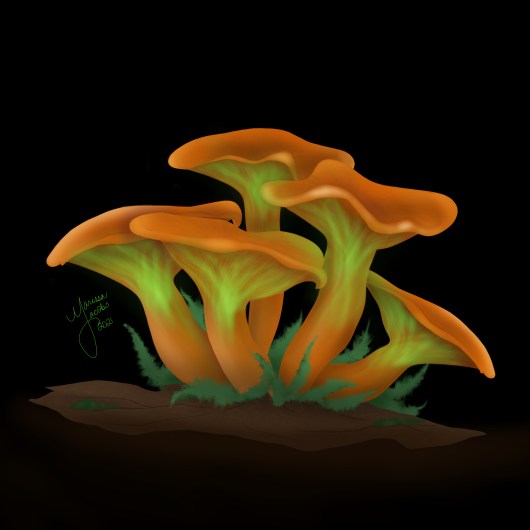
Next was the Jack-o-Lantern Mushroom (Omphalotus olearius), which is an incredible fungi for MANY reasons, but my favorite thing about it is that it is bioluminescent! This fungi produces an enzyme called Luciferase, which is also what helps create the glow in fireflies! This enzyme is used in a reaction that helps the fungi process and remove waste materials during it’s “digestion” process. During the 1700-1800s, the American Pioneers found a creative use for these fungi. Harvested Jack-o-Lantern mushrooms would still glow faintly, and if you were walking around at night, you could use them as a torch or as a trail marker so you wouldn’t get lost even if it was dark!

During the day, these fungi might be indistinguishable (to the untrained eye) from Chanterelles, a delicious edible mushroom, however, forager beware! The Jack-o-Lanterns are toxic, so getting this wild-edible wrong can have terrible consequences. One of the best ways to differentiate between the two is to look at the gills on the underside of the cap. The Chanterelle has forking, chunky gills while the Jack-o-Lantern has straight, parallel and very thin gills. f you’re out walking around at night, check to see if the fungi is glowing! If it is, it’s absolutely NOT a chanterelle and should not be eaten.

Morels

Morels (Morellcha esculenta) is one of the most common edible mushrooms, but edible is a tricky term! Not everything that’s edible can be eaten willy-nilly. Most mushrooms contain toxins that are destroyed when exposed to heat, so cooking the mushroom can remove those toxins. Morels contain amounts of hydrazine toxins, which is combustible, toxic, and can even cause cancer! This is definitely not a toxin that you want to go around eating raw in the woods. Once it’s cooked though, that toxin vanishes, leaving a delicious food that is beyond tasty in a cream sauce over chicken and asparagus!

As with many edible fungi, there is also a completely toxic look-alike. Even cooking the False Morel can still be fatal! The edible morel has a hollow stipe, whereas the False Morel isn’t hollow and is filled with a whitish, somewhat stringy material.

Now, with the next fungus, those who know me, or have listened to my YouTube videos, read previous blogs, or listened to my podcast will immediately know why I find this a fascinating species!

Blue Pinkgill

The Blue Pinkgill (Entoloma hochstetteri), native to New Zealand, is actually true blue! While this is very uncommon and extremely rare in the natural world, this fungus produces Azulene pigments that are only really found in a handful of fungi and marine invertebrates. Typically, the color blue in the natural world is caused by iridescence, although species of fish, such as the Mandarin Goby, do have a cyanophores, which contain other blue pigments. In Maori legends, the Kokako bird got a blue wattle because it rubbed up against this mushroom, forever staining it!

When looking at the gills, as one should always do when trying to identify a mushroom, you can see a faint hint of red, which gives the fungus it’s very appropriate name of Blue Pinkgill. The spores of this fungus is red, so before releasing the spores, you may notice that the gills look slightly pink!

Magpie Ink Cap

Magpie Ink Cap (Coprinopsis picacea) is typically found by itself in the wild, however you might be lucky enough to come up on a cluster of these incredible fungi! They thrive in leaf litter, so going into a deciduous broadleaf forest, especially if there are beech trees around, is a good idea if you’re looking for these elusive mushrooms.

As an artist, these are a foragers dream find, not to eat it, but to use in art! The “ink” produced by the mushroom as it ages can actually be used as an ink source for writing, drawing, and painting. This happens when the mushroom “Deliquesces”, or melts away in order to aid spore dispersal through moisture. To use the ink, you can simply bottle the melting portions and then use to refill ink cartridges or to dip a quill or brush into, or you can simply use the cap itself as a stamp or paint sponge to smear the ink around!

Fortunately, if you use the cap to smear ink, you probably won’t be tempted to eat this toxic mushroom. Similarly with the other fungi here, they do have a look-alike relative that IS edible! The Shaggy Ink Cap is known to be edible when cooked, however, when combined with alcohol, become extremely toxic. Aren’t fungi bizarre?

Fly Agaric Toadstool

A mushroom that’s very easily recognized, other than the Morel, is the Fly Agaric Toadstool (Amanita muscaria). Many people buy these as statues for fairy gardens, or just to decorate with. Dishes and tea towels are emblazoned with their illustrations; they are such an iconic mushroom! Many people people also know about their hallucinogenic and toxic properties when eaten.

While these fungi are rather toxic to humans, they are to animals for the most part too! Many mammals, such as foxes, have been known to eat these mushrooms and have similar, yet less dangerous than what humans experience, reactions that make them “feel good”.

While humans may hallucinate, have seizures or loose all control over their muscles and bodily functions, vomit, and more. However, not all animals who eat the toadstool experience this, or find the reactions as bad, and therefore are willing to consume the easy calories. For example, the Red Squirrel isn’t able to consume unripe acorns that the Eastern Grey Squirrel can. Due to this, red squirrels need to find alternate food sources and mushrooms are great for year-round calories! They will occasionally forage for the Fly Agaric mushroom and hang them up to dry in trees until they need the calories later. This drying process helps mitigate the symptoms and the squirrels don’t seem to mind, or at least, are very impacted by it!

Parrot Waxcap Toadstool

Another beautiful, yet relatively inedible toadstool is the Parrot Waxcap Toadstool (Gliophorus psittacinus). This is a small mushroom that is covered in a sticky, clear substance, hence the name “waxcap” and scientific genus name meaning “Glue Bearing”. While many waxcaps are considered edible, the slimy nature, especially when humidity increases due to dew or rain, increases and people don’t really like eating slimy things.

These waxcaps are considered relatively common, however they are becoming increasingly less. Many waxcap species, including the Parrot Waxcap, are bioindicators of the health of the land they grow on. They are known to grow in conjunction with mosses and grasses and are often growing in pastures or low-maintained grassy spots, such as cemeteries or abandoned agricultural fields. A large amount of waxcaps can signify that here hasn’t been a high use of chemical fertilizer in quite a long time, since the fungi are very sensitive to chemical pollutants. Fields with many waxcaps can also signify that there might be less nutrients in the soil overall since it hasn’t been modified.

More Things Fungi!

Do you love these fungi as much as I do? While I don’t recommend foraging for fungi unless you are beyond 100% sure of it’s identity (without a shadow of a doubt….) as an edible fungi, there are some other great ways to get your fill of fungi! You can find some mushroom prints in my shop, as well as take my online botanical illustration course “Focus on Fungi”! In that 50 minute course, you’ll learn more about mushroom anatomy and fungi taxonomy, as well as some helpful illustration tips for drawing fungi.

Supporting The Art of Ecology through the online shop or by becoming a Patron at any tier on Patreon can help keep educational content coming!

Prehistoric: WILD ART 2021

As part of the Wild Art 2021 August Challenge, put on by Zoe Keller, I illustrated two pieces focusing on the theme, “PREHISTORIC”. Each month, I am going to focus on two pieces – one highlighting flora, the other highlighting fauna. This month, I focused on two species, one commonly found along beaches and the other commonly found in wooded areas – both of which are considered to be “living fossils”.

So what is a living fossil? These are creatures that are considered to be relatively unchanged from their ancestors in a previous geological era. For example, the Ginkgo (Ginkgo biloba) is a species of tree that we may see commonly growing in spacious areas of full sun, with beautiful yellow fall foliage and some absolutely terribly smelling fruits, that was also around at the same time as the Cretaceous period (Mesozoic Era) dinosaurs, which include the T-Rex!

One reason why these species are around still unchanged from their ancestors is because they had no evolutionary advantage to changing and adapting over time! As other animals and plants had to adapt and change in order to keep up with various changes in atmosphere composition, soil and rock layer composition, water quality, and to keep up with the changes in the animals and plants around it (co-evolution), these living fossils were able to withstand these environmental changes without changing themselves! This form of extremely slow evolutionary rate is called Bradytelic Evolution. Most living things were not able to sustain life in new conditions and had to adapt, and often, these adaptations happened so drastically and in various ways so new species developed over time. These species, who changed at a normal (or average) rate are Horotelic.

Other Living Fossils include the Horseshoe Crab and the Cinnamon Fern, as shown here in my illustrations.

The Horseshoe crab (Limulus polyphemus), much like the Ginkgo, was around at the time of the dinosaurs, however the Horseshoe crab spent most of it’s prehistoric time in the Paleozoic Era, which marked the mass extinction of many animals. What is so surprising, and really is a testament to the strength and sturdiness of the Horseshoe Crab is that 90%+ of marine species (which the horseshoe crab is), went extinct during this time. Then, during the extinction of the Dinosaurs during the Mesozoic Era, the horseshoe crabs remain! And even today, during this time of climate change, horseshoe crabs remain. The biggest threat to their survival is actually overexploitation by humans. These incredible species are harvested to be used in the biomedical industry, since their blood can be used as a tool for quantifying endotoxin bacteria (such as E. coli) in the body or on objects that are put in the body (pace makers, vaccines, artificial knees, etc…). While this may be a noble cause, they are also losing habitat as well due to over development and sea level rise, and now, after millions and millions of years, are considered Critically Threatened and almost Endangered. Fortunately, many states where Horseshoe Crabs reside, there are now laws that protect these ancient animals – a good thing indeed to protect animals that are older than the human race!

The Cinnamon Fern (Osmundastrum cinnamomeum) is considered a living fossil as fossil records indicate that it was around as well perhaps 75 million – 180 million years ago! Ferns in general are incredibly ancient plants, having been some of the earliest plant species around; in fact many tree ferns have been dated back to the Triassic period! More recently (yet still ancient history to us!), the genus that the Cinnamon Fern belongs to was recognized in Norse Mythology! In fact, the Latin name references this myth. Osmandar, the Saxon name of the Norse god Thor, needed to hide in a cluster of these tall ferns to protect family. To this day, these ferns can be rather tall and the non-fertile (green) fronds form a large cluster around the fertile (cinnamon colored) fronds, which would definitely provide a hiding space for something!

Ferns are vascular plants, much like the trees and flowers that we think of growing in forests and meadows today, however they lack seeds and instead are similar to fungi in the fact that they have spores instead. In the Cinnamon Fern, the fertile frond is covered in the spores while the sterile fronds do not grow spores on the underside of their foliage as other ferns do.

As a child growing up in the mountains of the Northeast, I remember playing among these ferns in the woods and could even use the fertile fronds to pretend sword-play with my brother. Are there any of these living fossils that you interact with and love having around in this modern day? Let me know in the comments!

Stay tuned next month to learn more about various flight mechanics of animals and plants, and the difference between gliding and flying with the “Flight” theme!

Click below for more scientific illustrations, illustration workshops, or some new home décor!

Supporting The Art of Ecology through the online shop or by becoming a Patron at any tier on Patreon can help keep educational content coming!

What’s ACTUALLY Making You Sneezy This Fall?

For many of us, the start of the school year marks the start of fall seasonal allergies and… and… ACHOO!!!! (Excuse me…) our eyes, noses, and throats can suffer as we enjoy the great outdoors, but what is it that’s making us so sneezy?

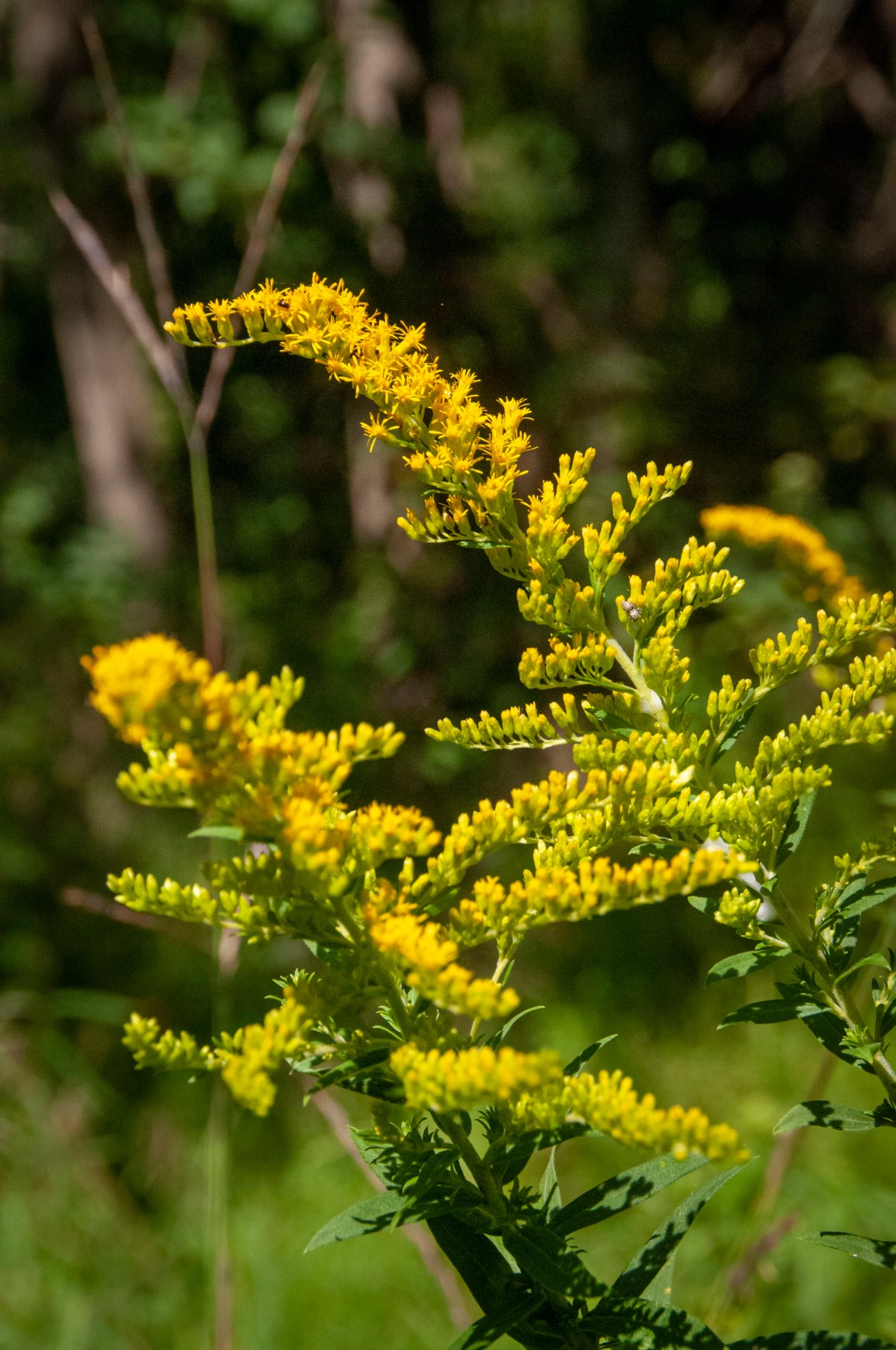
Unfortunately for this amazing plant, the blame usually is directed at the highly suspicious yellow flower that blooms right around the start of September and continues to bloom well into late fall: Goldenrod! We know that our seasonal allergies come from pollen, and nothing looks more covered in pollen than this vibrant yellow flower that the bees love to hang out on. However, what we aren’t aware of is that there is another, much sneakier culprit!

Ragweed is typically the primary cause of seasonal allergies that start this time of year. While there are many causes to seasonal allergies, including mold growth on fallen leaves, Ragweed pollen dispersion is definitely a huge source of our sniffles, without many of us event knowing it!

Ragweed often goes unnoticed, mainly due to the fact that even though it is also blooming at the same time, the flowers are very inconspicuous and the pollen grains are virtually unnoticeable. How could that be impacting us so much?!?! Well, flowers are uniquely adapted to their methods of pollination. In bright, happy, and colorful flowers, they are colorful for a reason. These flowers are primarily insect or bird pollinated and need to capture the attention of these creatures. Then, for creatures like bumblebees, the pollen grains need to be able to stick to the hairs on the body and legs in order to be moved from one flower to the next. Yellow is one of the bumblebees favorite colors and acts as leading lines or bright flags shouting “come and eat here!” to various pollinators. For inconspicuous flowers, such as the flowers for Ragweed, the pollen grains are small and don’t attract pollinators because they aren’t specially adapted to have larger creatures moving the pollen from one flower to the next. They are specially suited to be dispersed through the wind! As the wind blows the tiny pollen grains around the air, they land on the large stalks of Ragweed flowers in the surrounding area to help pollinate each other. While the pollen is blowing around in the wind, they also find their way up our noses and into our sinuses!

While you might not want to go around planting Ragweed, not just because they don’t really add color to the fall landscape, but because you also might be allergic to them, I do highly recommend that if there is one flower you will plant this year, that you plant Goldenrod!

This goldenrod stem has become a home for overwintering insects.

Goldenrod is such an important plant in your local landscape. They are natives to the entire eastern portion of North America – from the Great Plains all the way to the coastline! Not only do they have a wide native range, so they are great for many people to plant, but there are also so many species that are adapted to mountains, plains, marshes, and roadsides! Their blooms happen just in time for the end of the larger summer blooms, and their blooms can last for months! This provides important end of season food for numerous pollinators. In fact, 120+ native insect pollinators, including butterflies, moths, bees, wasps and others rely on this plant, as well as numerous native bird species. Without goldenrod, these creatures wouldn’t have enough energy to fuel migrations or be able to make it through the long winter!

Goldenrod stalks also provide habitat for overwintering insects and larvae. Several types of wasps will lay their eggs on goldenrod and create something called a gall. Galls are usually swollen portions of plants that have reacted to the laying of eggs. Often, a wasp will lay their egg inside the stem of a plant, and the hormones released encourage the plant to grow and swell, creating a “nursery” for the new baby when it hatches! On goldenrod plants, this can be seen as large spherical swelling in the middle of the stem, or as a bunch gall, where sudden, mutated leaf growth protects the larva.

Trying to figure out if what you have growing in your community is goldenrod or ragweed? Let’s take a look at some identifying traits:

Ragweed (Allergen – below swipe left to right)Goldenrod (Not an Allergen – below swipe right to left)
No conspicuous flowersBright yellow flowers
Tall spikes of flowers (looks like a candelabra)Flowers growing in spiked clusters that are usually
wider at the base and taper at the top.
Lobed, fern-like Leaves with petioleLinear Leaves that lack a petiole
Typically < 1′, but can grow up to 6′ tall.Typically 3-4′, but can grow up to 6′ tall.
Not covered in bees and butterfliesProbably covered in bees and butterflies

Supporting The Art of Ecology through the online shop or by becoming a Patron at any tier on Patreon can help keep educational content coming!

Home: WILD ART 2021

As part of the Wild Art 2021 August Challenge, put on by Zoe Keller, I illustrated two pieces focusing on the theme, “HOME”. Each month, I am going to focus on two pieces – one highlighting flora, the other highlighting fauna. This month, I focused on how different species create their homes and shelters. One uses plants, and the other forms a symbiotic relationship with other animals.

Typically, when we think of animals creating their homes, we often think of animals using plants to make their nest or cocoon. In the moth world, the caterpillars roll themselves up in plant matter such as leaves or needles, and complete the remainder of their metamorphosis. Mammals, such as beavers, build their homes out of sticks and branches. Birds build their nests out of all manners of plant life! The hummingbird collects lichen and moss and creates small nests by adhering the plants with spider silk. Swallows make mud and grass nests that stick to flat surfaces. Herons create large stick and branch platforms high in treetops near bodies of water.

One bird’s stick or grass home isn’t complete though without a little more decoration. Typically, birds finish their nests and don’t worry about home décor, yet the male bowerbird (a type of bird native to Australia) are VERY concerned about the aesthetics of the bower, or enclosed nesting site. In the case of bowers like the one shown here, where there are relatively parallel walls of sticks and grasses, they are called avenues. These avenues can be almost 6 feet in length and are adhered and made to stick up using a paste made of chewed plants and spit!

Once the sticks and grasses are placed perfectly, the male bowerbird starts the decoration process. He goes off to collect pieces of trash, flower petals, feathers, and other relatively small items that match his selected theme. Sometimes, the theme is a color, sometimes it is a texture or material. In the case of the Satin Bowerbird (Ptilonorhynchus violaceus) the theme is often the color blue. Since blue is a difficult color to find in the natural world, they often search out and bring back trash bits such as bottle caps, pens, small plastic ice cream scoops, and clothespins. Each item is placed meticulously and the male may adjust and re-adjust time and time again until he gets the placement perfect. Once he’s done, he stands outside the bower and waits for the females to arrive to check out his beautifully decorated home. She’ll examine his craftsmanship and he performs an elaborate courtship dance outside the bower to boost his chances of successful mating. If the female likes what she sees, they’ll mate and the male will no longer play a role in parenting. His job of creating the dream bowerbird home is done until he needs to create a new home.

Yet not every animal creates their homes out of plants! Some animals, such as the clownfish, forms symbiotic relationships with other animals and call that other animal their home.

As seen in this illustration, the Percula Clownfish (Amphiprion percula) spends it’s time finding solace and protection in an anemone. Not every anemone is a good fit for these fish though, and they can normally be found forming these relationships with Sebae Anemone (Heteractis crispa). The clownfish provides some valuable things for the anemone in exchange for the home the anemone provides. Most fish are stung by stinging cells, called Nematocysts, on the anemone, however clownfish – covered in a mucus layer – are immune to this sting. The clownfish take shelter inside the anemone’s tentacles. Their bright coloration attracts potential predators who come to eat the clownfish, yet ultimately succumb to the anemone’s stings. The anemone gains it’s nutrients by eating those would-be-predators! The clownfish, being the ever-perfect tenants, will also clean up. When the anemone is dirty, the clownfish eats up the muck, keeping the anemone and themselves happy!

These are some incredible examples of the many ways in which animals create their homes. While anemones and bowers aren’t found around my home of eastern USA, there are definitely some intriguing bird nests, fox dens, and insect galls. What sort of animals homes do you have around your community? Let me know in the comments!

Stay tuned next month to learn more about ancient “living fossils” with the “Prehistoric” theme!

Click below for more scientific illustrations, illustration workshops, or some new home décor!

Supporting The Art of Ecology through the online shop or by becoming a Patron at any tier on Patreon can help keep educational content coming!

Isn’t A Vulture Just a Vulture….? Uncovering differences between local species.

When looking up in the sky, we can often see vultures hovering and gliding in large circular patterns. With as much deer, fox, raccoon, groundhog, and opossum roadkill as is in this area, it’s not surprising to be able to look up at any point in time and see vultures! Many look up and see these large black birds and automatically assume, oh look, a Vulture, when in reality, there are many different vulture species, not just one general vulture! These local (Southeastern Pennsylvania) vulture species can include the Turkey Vulture and Black Vulture! So short answer for you – NO! Not all vultures are JUST vultures.

Identifying black vs. turkey vulture. Turkey Vulture eating carrion

Identifying Vulture Species

To tell the difference between these two species, you can look at the head and the underwing. When looking up at these high-soaring birds, you can see a difference in the wings. When looking up at them, you may notice that the Turkey Vulture has some silver or grey feathers. The Black Vulture will have those grey or white feathers, but only at the very tips of the wings instead of all along the bottom side. The head of the Turkey Vulture is bald and a reddish-pink color, while the head of the Black Vulture is, well, Black! The Black Vultures may also have some feathers on the tops of their heads, but leave their face featherless.

Adaptations of Vultures

Why do these birds have those bald faces to begin with? Are they sick? Nope! In fact, it’s the opposite! The bald, featherless faces allow these carrion (or dead matter) eating birds to stay healthy and clean as they eat disease or bacteria ridden carcasses. As they rip flesh with their beaks, they prevent the rest of their body and feathers from getting the gunk on them. The bald head and faces of some vultures also help them handle thermoregulation. As they fly high into the chilly air, then descend, often onto black roadways that absorb heat as they eat roadkill, they need to be able to handle these sudden temperature changes. Head is often lost from the head, and their featherless heads allow them to lose heat quickly when it’s hot. When it’s cold, you may see them hunched up, or with their head tucked back to prevent that heat loss.

While their task of eating dead things may seem pretty gross, this is actually a vital and marvelous job! Not only do they help “prettify” our world by removing dead things, they also help to sterilize and mitigate some disease spread. Their stomach acid and digestive system is so powerful that they scrub the bodies they eat of diseases like rabies, botulinum, and even anthrax! Without carrion-eaters like the Black and Turkey Vulture, the number of carcasses would pile up and the number of deadly diseases could spread quickly. Imagine having to wade through dead bodies as we tried to get around…. That is gross, but fortunately for us, we have the Black and Turkey Vultures cleaning up the ecosystem and cycling that dead creature’s nutrients back into the life cycle and food chain.

Protecting These Incredible Birds

Identifying black vs. turkey vulture. Juvenile Black Vulture

Have I convinced you to show some love to your local Black or Turkey Vulture populations yet? There may be even more, or other vulture species where you live too! You can help to protect these species by slowing down when you see roadkill. Be aware of Black or Turkey vultures that may be on the roadsides, trying to snag that meal in the middle. It would be so sad to hit a vulture as it’s trying to clean the road! Keep them safe by allowing them to do their job and slowly drive around them. If you notice them nesting in trees nearby, let them do so! They are probably cleaning themselves (they take very good care of their feathers, especially after a meal) and warming up before heading back out. If you see one, thank them for the messy job they do for the environment!

Bring these animals indoors, but not in a messy way, by exploring prints in the shop!

Supporting The Art of Ecology through the online shop or by becoming a Patron at any tier on Patreon can help keep educational content coming!
Patterns: WILD ART 2021

As part of the Wild Art 2021 July Challenge, put on by Zoe Keller, I illustrated two pieces focusing on the theme, “Patterns”. Each month, I am going to focus on two pieces – one highlighting flora, the other highlighting fauna. This month, I focus on a specific recurring pattern of the natural world. Can you guess the pattern?

Fibonacci Spirals

In the year 1202, Leonardo Pisano Bigollo, a mathematician and trader, wrote a series of math books. In one, he included a word problem where you had to find the number of rabbits that would reproduce in a given time, in an enclosed space under certain conditions. The answer to this problem is found in what is known today as the Fibonacci Sequence.

This sequence is one of proportional and exponential growth. The sequence is as follows (and if you notice, every number after equals the sum of the two numbers prior in the sequence…) 1, 1, 2, 3, 5, 8, 13, 21, 34, etc…. Once you find the pattern, you can continue the sequence forever!

The Fibonacci Spiral, is a visual graph of this sequence. At the center of the spiral is a 1 unit box next to a 1 unit box. Those boxes are next to a box that’s 2 units large. All of those are next to a box who is 3 units large. Around and around this goes in a spiral, growing larger in exactly the same proportions.

Fibonacci in Plants

This ratio and spiral can be seen all over the world, in art (people are aesthetically drawn to things that have the Fibonacci Spiral), math (in word problems like the one posed in 1202), anatomy (our closed fist makes a Fibonacci Spiral), and even in the natural world! Some of the best examples of this spiral seen in nature is in Sunflower seed heads, Succulents, and the Chambered Nautilus.

In the botanical world, there is a whole field of study (Phyllotaxy) devoted to recognizing and understanding patterns. In Phyllotaxy, scientists recognize the arrangement of leaves on stems and the recurring patterns found. In many plants, even in trees with how branches connect to the trunk and leaves connect to the branches, a Fibonacci spiral can be found. In other plants, such as succulents, pinecones, and fern fiddleheads, more spiral patterns can be seen.

In the animal world, we can still find the Fibonacci Spiral! The Chambered Nautilus, when looking at a cross section of it’s shell, is filled with sections that help control buoyancy, called camerae. As the Nautiulus outgrows the shell space, it adds a new section onto the spiral. These sections are the exact proportion as the Fibonacci Sequence. If the marine animal could grow forever, the spiraled shell would become larger and larger exponentially! All new camerae would be the size of the two previous sections.

Fibonacci in Animals

While the Chambered Nautilus is a perfect example of the Fibonacci Spiral, we can find other examples on our own bodies! Close your fist and make sure that your thumb curls around the bottom of your pointer finger. You can start at where the tip of your pointer finger nail touches your palm and draw a spiral around until you get to your thumbnail. This is a Fibonacci Spiral!

But…. why does this recurring pattern happen so often in the natural world? As plants and animals grow, spiral shapes allow for maximum growth, while staying compact and secure. There is no wasted space in a spiral. In the natural world, the proper allocation of energy and resources is vital. Wasted space that would require extra energy to build or to move around with can hurt the chances of survival. In plants, it can increase the amount of plant matter available to do photosynthesis, while keeping the overall size (and therefore reducing energy waste) to a minimum.

Everywhere you look, the natural world provides endless hours of fascination! Where can you find the Fibonacci spiral during your outdoor adventures? Let me know in the comments or feel free to share on social media (Facebook/Instagram/Email).

More to Learn & Explore!

Stay tuned next month to learn more about how animals use various structures in nature (whether plant OR animal based!) as their protection and nesting sites with the “Home” theme!

Click below for more scientific illustrations, illustration workshops, or some new home décor!

Supporting The Art of Ecology through the online shop or by becoming a Patron at any tier on Patreon can help keep educational content coming!

Kenyan Endangered Species and Their Challenges

Happy “Wild About Wildlife” Month! Throughout July, we celebrate the amazing wildlife species found on this incredible planet (although hopefully you’re thinking about them and making decisions that positively impact them throughout the whole year). Anyway, right now, let’s highlight some of my favorite animals: African Savannah species!

In the spring of 2021, I had the opportunity to re-visit my (so far) favorite country – Kenya! This time around, my primary focus was on photography (as that’s what I was brought out to do) and had the amazing privilege to photograph the landscape, wildlife, and culture of Kenya.

As I photographed animal after animal and learned more about Kenyan Ecology and conservation efforts, I wondered how long it would take for many of the species I photographed to no longer exist. There were large tracts of land that I had been to before years ago that now had lots of roads cutting through. Construction was happening in what felt like every direction. The human population is increasing rapidly and this definitely impacts wildlife habitat.

As habitat is fragmented by roads, or reduced as agriculture demands increase, wildlife is forced into smaller and smaller ranges. Many animals require large ranges in order to thrive and successfully pass their genes along to the next generation. When the ranges dwindle, so does the animals ability to have the space it needs to survive. As human-caused Climate Change continues at an exponential rate, suitable agriculture space also decreases and the need to expand crop ranges increases. Desertification continues and the search for water is on the minds of not just animals, but people as well.

Fortunately, the overall Kenyan population seems to be very pro-conservation, even understanding the ecological role or cultural importance of animals that have common human-wildlife conflicts. Conservation biologists, Wildlife Managers, Park Rangers, Veterinarians, and other scientists are working alongside policy makers and the general public to ensure that these amazing species are protected.

So, what species are getting a lot of conservation attention?

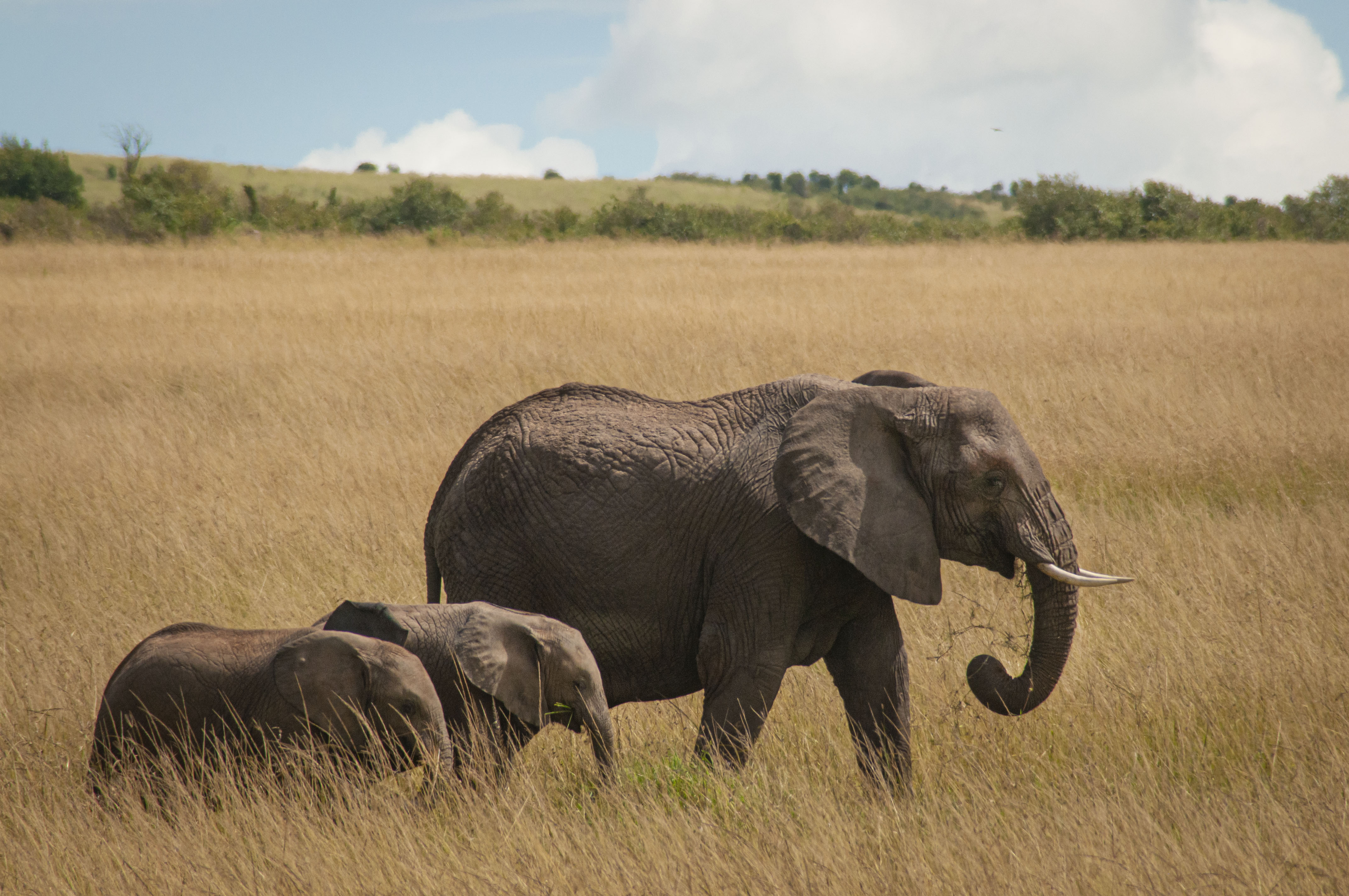
While not all of the animals seen above are technically listed as “Endangered”, they are all “Vulnerable”. The Giraffe, Grey Crowned Crane and African Elephant are listed by the International Union for Conservation of Nature (IUCN) as endangered. The Giraffe, Cheetah, Lion, and Hippopotamus are listed as Vulnerable.

Vulnerable simply means that the species population is declining in such a way that without conservation efforts, the animal will go extinct, however, with conservation practices put into place, the animal population will recover nicely. Endangered means that the animal has surpassed the Vulnerable status and without clear and serious laws put into place and enforced the animal will surely become extinct. Even with many conservation programs put into place, the amount of work it will take to bolster the population is extreme, but not impossible.

All around the world, all living things are connected. What actions we take, regardless of how geographically far away from Kenya we are, impact Kenyan wildlife and their habitats. By being good stewards of the environment where we live, we can positively impact these endangered and vulnerable animals we love. As we mitigate climate change where we can, we can positively impact the climate of places all around the globe, such as Kenya!

Anne Marie Bonneau said it well, “We don’t need a handful of people doing zero-waste perfectly. We need millions of people doing it imperfectly.” Every action we take, no matter how small it may seem to us, can make a huge impact when multiplied by millions, or billions of people. Conserve the animals you love. Protect their habitats, and make the world a brighter, greener place!

Did you know that a portion of all proceeds here on The Art of Ecology are donated back to wildlife conservation, habitat preservation, and environmental education efforts? While you shop, you not only support this artist and ecologist, but you also support the planet you live on.

Enjoy this Virtual Presentation about the Flora & Fauna of Kenya where you can discover more about conservation and the amazing life of the Kenyan landscape through my photography!

Supporting The Art of Ecology through the online shop or by becoming a Patron at any tier on Patreon can help keep educational content coming!

Leave The Weeds – Love the Pollinators!

Did you know that this week is Pollinator Week? This is a week (although it’s a Pollinator Month as well!) where Pollinator Protections are passed, local municipalities put out Pollinator Proclamations, and Pollinator-Themed activities and events happen. This is a fantastic time to learn more about local pollinators and about their importance, BUT…. pollinators need to be cared for and protected year-round!

While there are many ways to help out pollinators, from planting natives, to creating a garden, to reducing pesticide use, a great one to focus on this year is to GO WILD!!! No, I don’t mean to go crazy (well, go crazy for pollinators!) but to keep the wild in your backyard and community. Have you ever driven along and seen so many manicured, immaculate lawns? While these might look well-maintained, these lawns are actually a bane to biodiversity and require so much work to keep up with! By keeping lawns wild, you can support pollinator biodiversity, put in less effort throughout the year in yard-work, and save some money too!

What does it take to “Wild” your lawn? Not much, really! In fact, once you stop mowing all the time and re-seeding for grass, you might notice nature taking over without too much interference on your part. Dandelions, Clover, Chickweed, and Violets will start moving in. Yes, you may originally think of them as weeds, but let’s define weed… A weed is a plant that is in the wrong place, yet these flowers are vital to a healthy ecosystem! The lawn is the PERFECT place for these flowers.

A lawn full of weeds is a lawn full of healthy soil! Weeds like these use their roots to pull up nutrients from deeper in the soil to the surface to be used by other plants. Give them some time, and weeds can severely reduce your need for synthetic fertilizers, if not get rid of the need completely! Once these weeds finish their lives, they die off. This sounds sad, but hey – free organic matter for the soil! Bugs and other small decomposers, along with the fungi that will move in to your newly biodiverse lawn, will help break the weeds down into usable nutrients for other plants to use.

A lawn full of weeds is a lawn full of delicious, colorful food! Did you know that you can eat many of these weeds? Dandelion greens are AMAZING sautéed with some zucchini, peppers, onion, mushroom, and herbs for any panini. Violets are such a sweet addition to any drink or dessert. Dandelion flower tops can be lightly fried to make savory fritters as a French Fry alternative. Clover florets can be enjoyed in lemonade and other drinks.

A lawn full of weeds is a lawn full of LIFE! On top of all the other benefits that these weeds have, these flowers also will increase the biodiversity and therefore overall health of your yard. Every animal, big or small, plays a role in the health of your ecosystem, so encouraging them to come and move in will be a boon to not just your yard, but community as a whole! These weeds provide nectar sources for pollinators like bumblebees, honeybees, moths, ants, beetles and more! Larger pollinators that might not visit the small weedy flowers still need them at some point in their lives! Many of these weeds are great host plants that the butterflies lay eggs around to be able to provide the hatched caterpillars with immediate chewable food sources. In fact, fritillary butterflies use violets as their host plants! Fritillaries then grow up to be a valuable pollinator in the garden.

So this year, a great action to take for pollinators you love is to focus on “Wild-ing” your yard. Leave the weeds and enjoy the biodiversity that they support!

Looking to support pollinators in other ways? Learn more about them on the blogs below and check out my art! A portion of all proceeds supports pollinator habitat preservation.

Supporting The Art of Ecology through the online shop or by becoming a Patron at any tier on Patreon can help keep educational content coming!

WATER: WILD ART 2021

As part of the Wild Art 2021 June Challenge, put on by Zoe Keller, I illustrated two pieces focusing on the theme, “Water”. Each month, I am going to focus on two pieces – one highlighting flora, the other highlighting fauna. These creatures rely heavily on aquatic ecosystems, yet their aquatic habitats also rely on them. This interconnection between plants, animals, and their habitats are amazing.

Everything on this planet is connected. Each habitat plays a vital role in the health of the planet, and each living thing inside of it contributes to it’s health. Aquatic habitats provide a great foundation to the rest of the ecosystem since all living things need at least some water to survive.

There are many plants that act as water purifiers, helping to sequester pollutants and excess carbon inside of their roots and stems. Water lilies are one such plant, and are particularly good at this. In fact, Water lilies can handle absorbing heavy metals and other pollutants through their roots. This cleans the water and prevents algae blooms, which can cause an oxygen imbalance in the water and kill fish or other creatures living there.

One animal that lives in the water and relies on unpolluted habitat is the Axolotl. This salamander-like amphibian lives naturally in spring-fed lakes in Mexico. Originally, their native habitat spanned more than just two lakes, however, due to drainage projects, urbanization& land development, their wetland environments diminished, pushing them into only these lakes and making them an endangered species.

While their habitats may be a bit swampy and murky, that doesn’t mean that the water isn’t “clean”, or polluted. Sediment and detritus can be kicked up in swamp habitats, but if pollutants were to enter the water source, these creatures that so heavily rely on their feathery gills to breathe may find it more and more difficult to do so.

With plants helping to filter the water, axolotls can live with one less stressor in their lives and hopefully continue to breed and keep their population numbers up.

In order to keep aquatic habitats healthy and happy, to keep creatures like the cute and charismatic Axolotl alive and thriving, support your wetland environments, plant natives, and reduce single-use plastics or harsh pesticides that can run off into streams. Click below for more information about how to support your local wetland habitats!

Stay tuned next month to learn more about how both plants and animals have intricate, geometrical patterns, and what they might mean with the “Patterns” theme!

Click below for more scientific illustrations, illustration workshops, or some new home décor!

Supporting The Art of Ecology through the online shop or by becoming a Patron at any tier on Patreon can help keep educational content coming!

WONDER: WILD ART 2021

As part of the Wild Art 2021 May Challenge, put on by Zoe Keller, I illustrated two pieces focusing on the theme, “Wonder”. Each month, I am going to focus on two pieces – one highlighting flora, the other highlighting fauna. There is so much about the natural world that I wonder about, marvel at, and find fascinating, but one thing that gets me every time (especially since I am obsessed with all things color!) is that very few things that appear as blue to our eyes actually are blue! From red pigments that present themselves differently due to pH changes, to thin layers of cells to bounce light differently, blue is a deceiving color, and therefore rarely seen (as compared to the other colors) in nature.

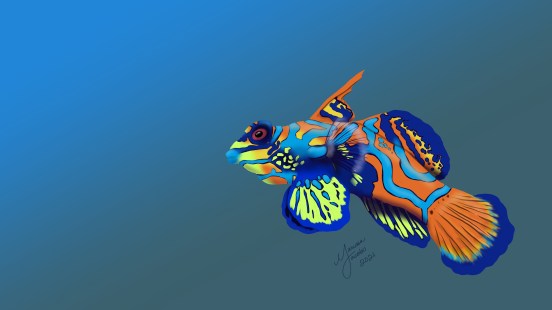
Let’s start with this vibrant fish, colored in what I have dubbed, “The Color of Epilepsy”.

Incredibly enough, this fish, known by many names such as Mandarin Dragonet, Psychedelic Mandarinfish, and Mandarin Goby, has such a succinct scientific name, that really shows just how amazing people think this fish is! They are the Synchiropus splendidus. Splendid indeed! Many people are absolutely intrigued with the coloration and swimming style of this animal. It beats its fins rather rapidly as it goes along, reminding some people of an underwater hummingbird! Similarly to the hummingbird, this fish is also incredibly colorful.

For many years, it was believed that if an animal presented itself as blue, like a Blue Jay, it was deceiving, and really the color was from an iridescence. A flat layer of cells coating the surface causes light to bounce very straight and directly, instead of scattering in every which way along the edges of rounded cells. The light waves of the straight reflected light is shorter, therefore appearing blue (click here to learn more about blue in the natural world and here for why we see the sky in certain colors!). In 1995, a study was done with the Mandarin Goby, and lo and behold! A true blue organelle in the cells was discovered! Chromatophores, a specialized cell that contains colored pigments, in animals are often Melanophores (brownish colors), Leucophores (whitish colors), and Xanthophores (yellowish colors). In this fish, though, a different chromatophore was seen, dubbed a cyanophore! This is novel, even to this day!

Again, most “blue” things in nature aren’t actually blue! Remember that Blue Jay mentioned earlier? Most things that don’t use the red-based pigment, Delphinidin, to look blue, actually use iridescence to appear blue.

This Peacock Selaginella is no exception to that rule. One way to test to see if something is pigment colored or “light” colors, is to submerge the plant in water. If the plant continues to appear blue, then it’s colored by pigments, often the Delphinidin (what makes Delphiniums look so blue). If it immediately looses the blue color when submerged, you know that it is using iridescence to look blue and with the water overtop, the light now scatters differently, making the plant look a different color. These iridescent blue plants often grow in shady environments, where normal photosynthesis using chlorophyll pigments can be difficult.

Whenever I see blue in nature, I am always blown away by how plants and animals have adapted over time and have such incredible methods and reasons for displaying whatever color they are!

Stay tuned next month to learn more about how both plants and animals have survived and adapted to aquatic habitats with the “Waters” theme!

Click below for more scientific illustrations, illustration workshops, or some new home décor!

Supporting The Art of Ecology through the online shop or by becoming a Patron at any tier on Patreon can help keep educational content coming!