Tell the Time With Garden Blooms!

In past posts, I’ve talked about how pollinators are attracted to certain flowers, and even how flowers have adapted their coloration or structure to better suit pollinators. Did you know that humans, way back in the 1700s, thought about using that sort of botanical and ecological knowledge to OUR advantage?
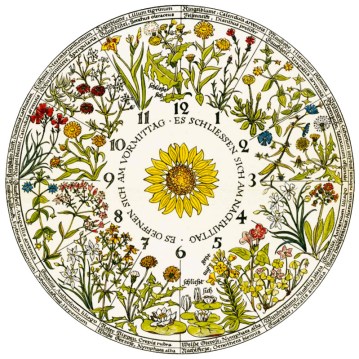
“While Carl Linnaeus never got around to planting his flower clock, he was able to create this beautiful visualization of his data – the Horologium florae, or flower clock.”

In 1751, Carl Linnaeus (the father of taxonomy, or the structural naming of things scientifically), took the study of plants a step further than other plant-observers before him. He noticed that some plants change their behaviors depending on the time of day and started documenting their changes by the hour. After extensive observation and study, Linnaeus drew out a “Flower Clock”! One would be able to plant specific flowers and be able to tell the time of day, just by observing those flowers. Amazing! Of course, the specific flowers used all depend on where in the world you are (do you have longer days vs. nights? Do your days stay cold?)

You can replicate this in your own garden! Flowers know that their pollinator might be out early in the morning (I see honey bees in my own garden between the hours of 9am-10:30am), and open their flowers up specially for their pollinators, then close them back up again after their pollinator group would become inactive. Let this knowledge and Carl Linnaeus’ study be your guide!

 Having your flowers in a spot that gets at least 6 hours of sun will help to keep your blooms happy!

You will need a partial – full sun spot, soil, gardening tools, and flowers in order to create your flower clock. You don’t need to plant them all in a circle, as Linnaeus has proposed – plant them however you’d like! It might be helpful to use plant stakes or markers to remember what time each flower is supposed to bloom if you decide to plant them out of order…

Looking for some examples of what flowers to use? Keep in mind your location, but give these a try (based on Carl Linnaeus’ flower clock and other more local clocks):

2am: Morning Glory (Convolvulus tricolor) | 3am: Goat’s Beard (Tragopogon pratensis)

Chicory (Cichorium intybus)

4am: Spiderwort (Tradescantia virginiana – native!)

5am: Chicory (Cichorium intybus)  

6am: Daylily (Hemerocallis sp.)

7am: Dandelion (between 5am-8am) (Taraxacum officinale)

8am: Fringed Pinks (Dianthus superbus), Scarlet Pimpernel (Anagallis arvensis) 

Tulip (Tulipa sp)

9am: Tulip (Tulipa sp.)

10am: California Poppy (Eschscholzia californica)

11am: Sweet Pea (Lathyrus odoratus)

12pm: Wild Daisy (Bellis perennis – not the same as the naturalized Ox-Eye)

3pm: Calendula (Calendula officinalis)

4pm: Four O’Clocks (Mirabilis jalapa)

5pm: Evening Primrose (Oenothera biennis – native)

6pm: Moonflower (Ipomoea alba)

8pm:Night-Scented Stock (Matthiola longipetala) | 9pm: Dames Rocket (Hesperis matronalis)

What does your garden look like year to year? Let me know in the comments!

Wish that you could have these blooms all day long, all year-round? Never fear! Swing by my SHOP page to snag a magnet, stationary set, or photo print of these gorgeous blooms and more!

Supporting The Art of Ecology through the online shop or by becoming a Patron at any tier on Patreon can help keep educational content coming!

Prevent the Winter Blues with Indoor Gardening

As an avid gardener who loves nothing more than to stick my hands in the warm soil and making sure that the plants provide a great space for wildlife, I have SUCH a hard time in the winter! I’ve overwintered my perennials, spread out leaves, and keep a careful eye out for little buds to pop up above the soil surface – but I want to do more!

Fortunately, there are many ways to keep the gardener inside of me happy all winter long.

air plants in indoor gardening

Indoor Gardening Methods

The first and most obvious solution for indoor gardening is to keep houseplants! There are many low-maintenance plants that do well inside. I spend much of my time in the winter making sure that these plants are getting adequate sunlight and watching them grow.

My personal favorites are my Monstera (see below for terrarium with some Monstera & Philodendrons), Asparagus Ferns, Air Plants (see image at left from when I got my 2-year-old Tillandsia to bloom!), and Lemon Tree …. But don’t tell the others!

I create terrariums (Check out my calendar of events for upcoming DIY Terrarium Nights!), mosaic decorative pots to help aid in self-watering, and photograph their bright foliage.

Winter is a great time to learn about plant health care in regards to pruning, changes in water uptake, and dealing with potential pests in plants that are crowded next to each other. While these items may sound challenging or frustrating to deal with – I enjoy learning about them! The more that I learn about and experience a plant’s problems, the more I come to appreciate the beauty and importance of the plant’s life.

indoor gardening
Monsteras and Philodendrons are some of my favorite plants to keep inside and observe their seasonal and nutritional changes. See those brown spots on the Monstera – those are mini educational opportunities!

Hydroponics & Aquaponics

Another way to get into winter indoor gardening is by setting up mini hydro & aquaponic systems! These can be made easily and provide a great way to grow your veggies and herbs inside so you can have them fresh year-round!

One simple way to set up an aquaponics – or growing system where the plant relies on the natural cycle of nutrient uptake via fishy –  system is provided below. Enjoy!

Keep in mind that this is designed to be quick and easy – there are more sophisticated, fish-friendly designs out there. Let me know if you have questions about these designs!

Materials:

  • 1 fish (goldfish work really well, I’ve found)
  • 2L Soda bottle
  • Favorite Veggie/Herb seeds (or small established plant for quicker return)
  • Soil, Coconut Fibre, and Horticultural Charcoal bits
  • Coffee filter
  • Duct Tape or Clear Packing Tape
  • Exacto-knife or scissors or a drill
  • Cotton string
  • Water
  • Colored Gravel (optional)

Methods: 

  1. Cut the soda bottle in half using scissors or your exacto-knife.
  2. Flip the top part with the bottleneck upside down. This will be where the plant goes. It will look like a funnel with the neck pointing down.
  3. Poke a small hole in the coffee filter with a pencil and thread the string through it. You will want the string to be long enough that when finished, it reaches the bottom of the bottle.
  4. Add soil or coconut fibre to the coffee filter with a little bit of horticultural charcoal. Then, either add your plant (make sure that you keep some space for that!) or add seeds according to their packaging instructions. Then put this part of the bottle to the side.
  5. Cut or drill some air holes and one larger feeding hole to the bottom portion of the bottle. Remember, you’ll be adding water to this portion, so don’t put the holes down too low for the water to leak out!
  6. Add water and colored gravel (if desired). Keeping the fish in a small bag, place the fish in the water for 15-30 minutes for the fish to adjust to the new water temperature, then place the fish in its new water.
  7. Set the top part of the bottle (the part with the plant in it) gently on top of the bottom half. The weight of the top portion may cause the top part to fall into the bottle, so keep it raised a little higher and staple the sides in 2 or 3 spots so it won’t completely fall in (you will want the string to be hanging down into the water). 
  8. If needed, use the duct tape or clear packing tape (depending on your preference) to tape the edges of the bottom portion to the edges of the top portion in segments for extra support and reinforcement.  
  9. Place the completed aquaponics system in a sunny place away from the cold (a drafty window sill isn’t the best place…)
  10. When the water gets dirty, remove the tape and change the water. Remember to give your fish with an adjustment period so it can get used to the change in water temperature!
  11. Feed the fish through the larger feeder hole that you cut out every 2 days or so. 

The fish will eat its food and excrete waste. This waste contains valuable nutrients that the string will absorb and carry up to where the plant’s roots are. The plant will absorb these nutrients and the water, making it grow healthy.

While this is a fun way to get plants back into your life even during the winter season, it’s also fun to watch the little fish go about it’s fish business! The connection between plants and animals is an amazing one and this aquaponics system really highlights the connection that the plant growth has to the fish’s daily life.

I had the pleasure of teaching this “Intro to Aquaponics” for kids a while back. It was perfect to highlight the importance of the nutrient cycle in the natural world in an observable environment!

Supporting The Art of Ecology through the online shop or by becoming a Patron at any tier on Patreon can help keep educational content coming!

Classic Blue – Pantone Color of the Year

Sky, Water, Butterfly wings, Bird Plumage, and flowers…. What do these all have in common? They can be “Classic Blue”, the Pantone Color of the Year!

This color was chosen after lots of careful thought, study, and trend analysis, by Pantone color specialists because:

“A timeless and enduring blue hue, PANTONE 19-4052 Classic Blue is elegant in its simplicity. Suggestive of the sky at dusk, the reassuring qualities of the thought-provoking Classic Blue highlight our desire for a dependable and stable foundation on which to build as we cross the threshold into a new era.

Imprinted in our psyches as a restful color, [Classic Blue] brings a sense of peace and tranquility to the human spirit, offering refuge. Aiding concentration and bringing laser like clarity, [Classic Blue] re-centers our thoughts. A reflective blue tone, Pantone Classic Blue fosters resilience.”

What can be found in nature that embodies this color? In nature, we have a hard time finding anything blue, yet it can be done! (Click here to read more about why we see very little actual blue in nature). I went through my archives and selected my favorites, and will definitely be on the watch in 2020 for this calm, relaxing hue.

Interested in adding Classic Blue Nature Photography into your home? Visit my shop and browse all of the different “Blue” themed photos to select your favorite one! Then, order that photo as a print, pillow, or more! A portion of the proceeds benefits wildlife conservation and habitat preservation efforts.

Supporting The Art of Ecology through the online shop or by becoming a Patron at any tier on Patreon can help keep educational content coming!

A Look Back at an Amazing 2019

This year has been one of incredible growth here at The Art of Ecology!

Throughout the 2019 year, I was able to stay true to my mission of building visual connections between people and the natural world through the blend of arts and sciences. I had the pleasure of holding some new workshops as part of my Artsy Naturalist DIY Nights for adults, speak at an iSTEAMM Conference for girls, and leading educational outreach programs for school-aged children. I also was able to further my educational experiences by becoming a National Geographic Certified Educator and then an Education Certification Mentor – In fact, this fall, I was awarded a grant through National Geographic to be able to provide a low income school district with a Professional Development opportunity that will provide teachers with the skills and resources needed to increase Environmental and Geographical Literacy rates in their students through Interdisciplinary studies and Citizen Science projects!

With each activity, not only do I teach about environmental and conservation topics, but I give back to conservation work as well. A portion of all proceeds from any event I ran or art piece that I sold, I was able to donate back towards wildlife conservation, habitat preservation, and environmental education organizations.

While Bucks County, PA (where The Art of Ecology is based out of currently) is a great place to raise awareness for the environment, The Art of Ecology opened it’s doors to the whole world and was able to reach over 1,500 individuals in over 70 countries!

It is my goal in 2020 to be able to strengthen and increase my educational outreach events, create more interactive and conservation minded workshops, and grow professionally through more National Geographic Certifications and programs.

Favorite Photos from 2019

Click here to order any of these as prints!

Create your Spring Garden Early with Bulbs!

As we get further into fall, the gardener inside of me gets sad. I miss spending time out among my flowers. The fall rains are providing the water they need, and the birds are busy picking the old flowers clean of their seeds. The wind is blowing the leaves over the plants – prepping the garden for winter! I don’t have much to do anymore!

Fortunately, I can get a head start on my spring garden and get to do some more digging in the soil by planting spring blooming bulbs! These bulbs will get a head start on the growing season and be ready to bloom as soon as those first warm days of spring hit.

To plant your bulbs, dig a deep hole (4” for small bulbs like Crocus and Grape Hyacinth, and 8” for larger bulbs like Daffodils, Hyacinth, or Alliums) and place the bulb gently at the bottom with the root side sticking down. As you dig your hole, it’s a great idea to dig a little deeper and wider, then fill it in with compost and other soil amendments (like bone meal, bio-char, kelp, alfalfa pellets, and organic mulch or pine chips) as necessary – if you are going to do this step, be sure that you are mixing and adding only what’s necessary so as to avoid burning or over saturating the bulbs!

Siberian Squill have such tiny bulbs and don’t need to be buried as deeply as other bulbs.
Hyacinth bulbs like being DEEP in the ground, making it…. interesting…. to try to transplant their bulbs!

As you continue to back-fill the hole once you’ve placed the bulbs in, fill it, but don’t pack it down. You want your bulbs to be able to breath and not rot away immediately! Water immediately to help stimulate root growth. The next step is the hardest (at least for me, anyway)…. Wait.

As the winter snow starts to melt away, you’ll start to notice small green leaves poking up through the surface of the soil. Sometimes, with flowers like Snowdrops or Crocus, they might even have the ability to grow up through the snow (click here to learn more about late winter/early spring flowers)! These colorful blooms will be sure to bring a smile to your face as you see evidence that winter is ending. 

These iris heads will eventually fade away, leaving long, blade-like foliage. Trim away the flowers, but leave the leaves!

Remember to help your bulbs store energy to last through the winter by only deadheading the flowers and NOT cutting back the leaves. Yes, the leaves may not add a ton of late-season interest, but as the leaves undergo photosynthesis, the plant will store the energy produced in its bulb. As winter drags on, the plant will use the energy stored to stay alive and start producing spring growth.

What are your favorite bulbs (or rhizomatic/tuber) that show up in the spring? Let me know in the comments below! Want to keep the colors of your favorite flowers around even into the grey winter months? Add some botanical art to your walls by clicking here to visit my print shop!

Bloodroots are wonderful, small flowers whose leaves hug the flowers and appear first. They have long rhizomes (not bulbs) that stay close to the surface of the soil.

Supporting The Art of Ecology through the online shop or by becoming a Patron at any tier on Patreon can help keep educational content coming!

Happy Squirrel Awareness Month!

Heart & Soul of an Eastern Grey Squirrel” highlights the importance of a deciduous forest habitat to the health and well-being of a squirrel.

October is Squirrel Awareness Month, so let’s celebrate by learning more about them. Many people see Eastern Grey Squirrels as pests – critters that eat all of their birdseed, hang out around urban trash cans searching for pizza crusts, critters that make homes in walls of houses, or garden pests – but squirrels are so much more than that! They are vital members of the ecosystem and are super cute to boot.

Squirrels (Scuirus carolinensis) have an important place on the food chain. They impact the levels below them by feeding on plants and even insects! They are some of the best Oak seed disperses (acorns), but they also love other nut producing trees like hickories, walnuts, and beeches. Similar to a hungry tween/teenager, juvenile squirrels are in their growing phase and need a lot of protein to make them strong and dexterous so they will often eat insects that they can catch and then switch back to their cache of seeds in the winter. These seeds and nuts are high in calories which helps to keep them well-fed during the winter. 

Ever watch them? They are very entertaining when displaying their acrobatic skills.

Not only do they impact the balance of the level below them, but they also impact the ones above them – the predators. They provide food for a wide range of predatory animals like hawks, owls, fox, snakes, coyote, and even some weasels! 

Squirrels have many incredible adaptations that help protect them from predators (although predators have adaptations that help them to catch sneaky prey). Their amazing agility makes them hard to catch. If a hungry fox is chasing them, squirrels will run in a zig-zag pattern to throw the fox off and if they need to, they can jump 5-6 feet straight up off of the ground, launching them away from the fox and into the safety of the nearest tree. 

Prey species also have unique cranial structure. Their eyes are located on the front of their face and, like squirrels, have large, almost bulbous eyes that are somewhat angled upward. The position and size of the eyes allows the prey to be able to scan the skies for hungry hawks all while being able to monitor if something is sneaking up next to them. Humans and other predators have eyes that are more attuned to movement, and the squirrels know this! If they are afraid that something is watching them, they will either dart off in that zig-zag pattern or freeze. Their grey fur blends in with the forest canopy that they love and a predator will have a hard time seeing them if they aren’t moving!

By creating a wildlife habitat in your backyard, you’ll create a safe space for all of life! The squirrels can thrive and happily eat the nuts that trees drop and have nesting space OUTSIDE of your walls. Backyard habitats also encourage predatory species, like hawks, to help you manage the squirrel population if they get too out of control. By emulating nature, we can help to keep balance in populations!

Love these cute squirrel images and want to celebrate Squirrel Awareness Month? Bring them inside (without having chewed wires or drywall!) with art!

This month, love your neighborhood squirrels by planting a native seed-producing tree for them to use as nesting sites and food resources! Click here to find good trees native to your area.

Supporting The Art of Ecology through the online shop or by becoming a Patron at any tier on Patreon can help keep educational content coming!

“Galaxy Print” – What is it Made of?

Galaxy print is trendy right now. There are Galaxy print leggings, back-to-school supplies decorated with galaxies, and I’ve even seen Galaxy print bed sheets! In fact – I have a galaxy tattoo (long story….)

We find space to be mysterious, beautiful, and awe-inspiring, but do we even know what galaxy print is made of – or do we just love the colors, sparkle, or the mystery of it? Let’s figure out the different layers of “Galaxy Print”.

First of all – why is space “black”? On Earth, the light from our sun enters the atmosphere and gets trapped beneath it where it bounces around on gases, dust, and other particles in the air. Blue light is the most efficiently scattered and the other waves of light don’t scatter as much – which is why we see the sky as blue. During the night, when the sun’s light isn’t able to reach us and bounce around, we don’t see blue sky, but the black of space. Space doesn’t have an atmosphere like our planet, so the light from stars doesn’t get trapped. 

The New Mexican Sky. Tiny pinpricks of light are stars. Grainy “dust” right over the mountains in the faint outline of the Milky Way!

We may wonder why, with so many stars in the heavens, why they don’t light up space as much? This exact question is called Olber’s Paradox. Despite there being bright lights everywhere, space isn’t fully lit up. This could be because the light from stars VERY far away have not reached our eyes yet – we’re only seeing the light from stars that are close enough to have their light waves reach our eyes.

Now, then if space is so black, why does “Galaxy Print” even exist with all of it’s colors? Those colors are nebulae, or clouds of various gases and dust particles. The light from various stars bounce off of those gases and particles and scatters, similarly to how the light from our sun scatters blue light into our atmosphere.

Different Nebulae are comprised of different things, which allows them to reflect those various colors that we love so much. For example, Emission Nebulae, which are mostly comprised of Hydrogen particles, scatter red light. Sites of star formation have a relatively even distribution of dust and gas particles, thus scattering blue (again, it’s the most efficiently scattered wave of light). Larger dust particles do a great job of blocking light and causing light to bend around them. These Nebulae are called “Dark Nebulae” and are black with hints of dark purple. Dying stars produce a gas that hovers in a shell around them until they finally implode. During the process of dying, the Nebulae will appear a teal color (blueish-green). When the star finally dies, it creates an event called a Supernova. The gases and star matter from this event cause a Nebulae that appears Golden-Yellow.

These wispy, wavy clouds are what comprise “Galaxy Print”, but the print wouldn’t be complete without a smattering of shiny stars! One reason why stars are so shiny is because they are continually undergoing a process of transformation where hydrogen gas is converted into Helium. This process creates an amazing amount of heat, which creates light. Think of fire, or metal being heated (red-hot/white-hot metal glows) – they both create light. The sun is so close to our solar system that it doesn’t take as long for the light to reach our eyes. Stars that are farther away, like those in the Orion constellation, shine light that takes much longer to reach our eyes.

Yes – Galaxy print is amazing and mysterious, but hopefully, you now understand more about the beauty behind it!

During one of my Artsy Naturalist DIY Nights, we painted Galaxy Print Wine Glasses all while learning about some of the beautiful facets of space. Feel like you missed out on a great event? Don’t worry! I hold these art & science workshops routinely. You can find my upcoming events, Artsy Naturalist DIY Night Themes, and more here!

Supporting The Art of Ecology through the online shop or by becoming a Patron at any tier on Patreon can help keep educational content coming!

Colors of the Rainbow as Seen in the Garden

Flowers have so many beautiful colors, but other than just to make us humans happy, why are flower colors so diverse?

Pollinators have the important job of transferring genetics from one flower to another to allow for fertilization and ultimately growth of future generations of flowers and plants. In order to attract the most effective pollinator, flowers have a very specific shape and color (see my blog about pollinators and their relationship to flowers here!).

Flowers get their colors from various pigments, similarly to how humans all have different skin and eye colors. Anthocyanins, Carotenoids, Chlorophyll, and Xanthophylls are all different types of pigments that, when combined in different amounts, creates the beautiful colors that we see in our gardens and in the wild! (Click here for my post about pigments and the science behind their function)

As gardeners, we often have our favorite colors that we try to garden with, personally, I love vibrant yellows. One way that I can make sure that both myself and the pollinators/wildlife that I plant the garden to care for are happy, is to make sure that I have a wide variety of shapes and flower sizes. For example, butterflies like flat-topped flowers, hummingbirds like tubes, and bees like flowers they can crawl around on and in. By including flowers like Sunflowers (birds love), Zinnias (butterflies love), and Goldenrod (bees love), I am making sure that a wide variety of pollinators are happy, yet also ensuring that smile on my face when a sunny yellow garden greets me each day!

Did you know that the Royal Horticultural Society has actually developed a color chart by which horticulturalists, botanists, and other ecologists have a standard of color measurement? Personally, I find this fascinating that each of these little color swatches can be specifically matched to pigments displayed in nature. 

Below, view some of my favorite flowers (each with a unique shape to attract diverse pollinators and wildlife), displayed in their rainbow of colors! Which color is your favorite for your garden? Let me know in the comments below!

Bring these vibrant colors home. Each image is available in my shop or let me know if there’s a specific flower you’d like to see as a print. Immerse yourself in color today! A portion of all proceeds goes back towards habitat preservation to ensure that pollinators thrive for years to come.

Supporting The Art of Ecology through the online shop or by becoming a Patron at any tier on Patreon can help keep educational content coming!

American Goldfinch vs. Climate Change

For my most recent course with National Geographic, I was learned all about Teaching Climate Change and Scientific Modeling – which was absolutely fascinating! Despite having a degree in Wildlife Conservation and therefore taking so many classes that talked about the implications of human-caused climate change, there was still plenty to learn!

The goal of the course was to help educators effectively teach about climate change in a way that students would not only understand, but discover more about the different causes/effects of climate change and then determine the best way to mitigate or adapt to climate change. The goal is to leave the student not feeling discouraged and fearful of the future, but, by providing them with tools like scientific models to visualize dry data, empowered and inspired to use their voice to make a change for the better.

In order to teach a student about scientific modelling, I first had to learn how to create my own model! It was amazing to start out with a rough question – “Why are populations of American Goldfinches decreasing in the state of Pennsylvania?” – and watch the model morph over time as I continued to learn about the birds, model creation, and the depth of climate change. Models should be editable over time as new data is collected, and each time I submitted my model, there were lots of changes!

This was my first scientific model submission. It shows the basics of what the American Goldfinch eats, describes how the flowers and ideal habitat don’t overlap with the birds during their migration, and how their range is changing.

While climate change is inevitable and has happened many times throughout the course of this planet’s history, Human-caused Climate Change is increasing the rate of change too quickly for plants and animals to adapt. When any piece of the puzzle is out of balance, the whole planet suffers. For example, as trees continue to be clear-cut or burned (as in the case of the Amazon fires currently), there are fewer trees to sequester carbon dioxide. The carbon dioxide created by the burning of fossil fuels and decomposing organic matter is released into the atmosphere and causes an increase in Greenhouse Gases. The Greenhouse gases can’t escape out of the atmosphere (think of the Greenhouse Effect), which then causes the temperature of the earth to rise. The rise in temperatures causes glaciers to melt. When glaciers on land start melting, the extra water flows into the ocean, causing a rise in sea level, which in turn, this all impacts marine ecosystems and wildlife such as corals suffer.

This rise in temperatures impacts more than just sea and land ice, though – it impacts all of life! In the case of my local observed phenomenon, climate change is creating a disconnect between bloom time of food resources and migration time (through Pennsylvania) for the American Goldfinch. The American Goldfinch relies on plants like the Black-Eyed Susan, Coneflower, and Thistle as food resources and trees overlooking meadow areas as nesting habitat. As temperature increases, the flowers that they use as food no longer overlaps with their migration time in Pennsylvania. This, combined with human impacts (such as over-development from clear cutting for agricultural or residential purposes) has caused the American Goldfinch to move their range farther north (as far as Vermont/Maine) in order to have the right amount of food and nesting sites.

This was my final submission (there was one other edit between the first and this one). Do you notice how the “simple” matter of a decrease in goldfinch populations is much more involved than just – “there’s no more food”?

So far, everything that I’ve explained sounds super sad. The earth is burning, wildlife populations are declining, and trees are dying. However, the course helped to teach me how to inspire the next generation to act and let their voices be heard. By learning about scientific modelling and encouraging students to learn about the different facets of climate change, I can empower them to create a plan of action, even simple ones!

No matter how young or how old you are – your voice can be heard and your actions make a huge difference in the health of the planet we love. Let your voice be heard too! Tell your legislator how important the environment is to their constituents today and vote for a healthier tomorrow. Click here for some other easy ways to make a difference.

I was able to present about National Audubon’s Climate Report and the implications of a changing climate on birds, all while hopefully sparking a bit of hope in a discouraging scenario.

Supporting The Art of Ecology through the online shop or by becoming a Patron at any tier on Patreon can help keep educational content coming!

Clean Water For All – Frogs and Humans Alike!

August is nationally recognized as “Water Quality Month”, but really, we should be caring about water for more than just one month per year! Not only is clean water important for humans to stay hydrated, but it’s also important to all animals and plants.

Many times, we immediately think of poor water quality impacting humans (and other cute mammals) or fish, yet there are many other animals that rely heavily on clean water. One of these is the frog!

The word Amphibian literally means “to Live a Double Life”. Frogs, toads, and salamanders are in this category and spend their lives both on land and in water. Frog adults go to the water to lay their eggs, which hatch into tadpoles. Tadpoles eat algae, which is beneficial to our wetlands since algae blooms decrease the amount of oxygen available in the water for other animals and plants to use. As tadpoles munch away, they create healthy and vibrant aquatic ecosystems. They also eat eggs in the water from insects like mosquitoes. Again, as tadpoles munch away, they reduce the population of mosquitoes that can carry diseases like Zika, West Nile Virus, Yellow Fever, Malaria, Dengue, and more.

The tadpole will continue to grow into a froglet, which then transitions into an adult. Adults eat insects such as spiders (which I am very thankful for), grasshoppers, flies, and again – mosquitoes. Frogs keep the food chain in balance not just by keeping insect populations in check, but also by providing food to animals like snakes, herons and other birds of prey, mammals like skunks, and even larger insects like fishing spiders!

Another cool thing about frogs is that they have permeable skin, meaning that molecules (like Oxygen and Hydrogen that they need) can move from the water through their skin, and into their bloodstream to be used. This amazing ability is also a double-edged sword. Bacteria, toxins, and pollutants also have the ability to pass through the amphibian’s skin causing disease, mutation, and in many cases – death.

This permeable skin issue may seem like it’s limited to frogs, however, as mentioned earlier, many animals eat frogs. When a frog has absorbed pollutants and bacteria, something called “Biological Magnification” can occur. When something larger, like a skunk, eats an impacted frog, the skunk eats the frog as well as the pollutants. Skunks can eat many frogs over a season, and now the skunk has even more of the toxin in their body than the one frog did!

Tree frogs, while spending much of their time in trees, still are sensitive to changes in water quality. Even other amphibians like salamanders, newts, and toads have that permeable skin and need clean water for a healthy life.

Fortunately, there are many easy ways to positively impact your local bodies of water and make them safer not only for cute froggies, but for all of the food web and ourselves! First, we can reduce impermeable surfaces that prevent storm water from being absorbed into the ground. We can reduce our fertilizer and pesticide use on our lawns and yards which, when it rains, get washed away and wind up in the nearest stream or body of water. Finally, we can reduce erosion (did you know that Sediment is the #1 water pollutant here in Pennsylvania?!?!) on our properties by adding plants with great root systems to keep the soil in place. Many of these plants have an added benefit – they act as a sponge to absorb and store water and pollutants that runoff may carry! Double bonus!

This month, let’s focus on improving our local waterways to make it not only safer for frogs and other amphibians, but ultimately for humankind as well!

Supporting The Art of Ecology through the online shop or by becoming a Patron at any tier on Patreon can help keep educational content coming!