Birds and their population numbers are important for indicating overall health of ecosystems, making them bioindicator species. Have you participated in a bird count in your backyard, as part of a community science project, or as part of an event at an educational center?

The Great Backyard Bird Count is an important way for scientists to gather information about bird species and bird migration, and it is a great way for absolutely anyone to get involved in the scientific community.

Why is Birding Data Important to Scientists?

Overall, scientists can examine what bird migration tells us about our changing climate. The migratory patterns of birds are important bioindicators of climate change, and we are beginning to see the dire effects this indicator has.

Birds are heavily affected by changes in temperature, moisture, and extreme weather conditions, so it is no surprise that they are sensitive to climate change. One of the most prominent ways that the changing climate has affected migration is the loss or alteration of their habitat. Many conserved areas for birds can no longer sustain many species, therefore forcing birds to relocate to unprotected areas.


Additionally, according to a Climate Risk Report by the World Wildlife Fund (WWF), the doubling of CO2 in the Arctic could cause the loss of nearly half of the breeding grounds of 10 million geese and 15 million wading birds by 2080-2099. There are even species of birds that are abandoning their migration altogether because of the extreme temperatures, like cranes in Germany that halted their migration to Spain and Portugal in the winter. This is particularly concerning because birds are then forced to combat the winter weather that they would normally travel away from.

Another issue is that the changing climate is disrupting and confusing biological clocks for migratory bird species. Birds are starting to arrive early or late to their destinations. This may not seem like a huge issue, however birds can miss out on valuable food resources! Many that rely on the spring insect emergence, or need certain plants to be in bloom, can miss out. Ornithologists all around the world are collecting data on the arising migratory trends to help mitigate problems.

Marissa of The Art of Ecology shares her submitted bird count checklist.

Submitting Bird Count Data

Counts such as the Great Backyard Bird Count or the Christmas Bird Count are some of the best ways to help ornithologists collect data on birds. It gives them the ability to see trends in migration on a large scale, and itโ€™s a great way to help the scientific community and our diverse bird population.

Another method of contributing to the scientific community throughout the year is to use the iNaturalist app. This free app is not only a way to help you identify living creatures that you see, but each observation that you submit and include geo tags, images, and species data contributes to a data collection database. Scientists from all over the world can view the species populations, population movement, geographical data, and more by using observations submitted by you!

As The Great Backyard Bird Count comes to an end, consider continuing to monitor your local birds. You can still plug in your data through birdcount.org and on eBird! Did you get to count this year? Share some of your bird count highlights in the comments section below. Thank you to everybody who participated in this yearโ€™s bird count for contributing to the scientific community at large.

Lucy McGinty - 2022 Intern
Lucy McGinty – 2022 Intern

I am an environmental studies college student, and The Art of Ecology’s new intern! My career goal is to become an environmental microbiologistโ€”a person who studies the microorganisms in the environment and their relationship to pollution! I am so excited to [learn more about ecology] and ways we can do better.

February 11th marks this celebratory day of Women & Girls in Science! Despite being naturally science-minded (typically getting better marks in biology & medical related studies than men), women still don’t venture as much into the science fields. Women comprise only 28% of STEM (science, technology, engineering, and math) industries!

Today we celebrate women & girls who pursue the science fields passionately, but everyday we encourage women and girls to engage with their natural scientific curiosity!

The Art of Ecology brings scientific education to people regardless of gender identity. As an educator, I am always amazed and excited by the number of women that explore the fields of environmental and biological sciences through my programs! Over 75% of my programs are attended by women, and while teaching children, I have heard young girls say things like, “Wow! If this is what scientists do, then I want to do it too!” It is my goal to empower students, regardless of age, to let their scientific curiosity shine.

The Women & Girls Behind The Art of Ecology

Marissa Jacobs: Founder, Lead Educator, and Artist
What Inspired You to Pursue Science?
me restraining lungfish in kenya
Marissa is taught how to restrain a Lung Fish in a village on Lake Victoria, Kenya

Growing up in the rural Pocono Mountains, there wasn’t much to do except to play outside! I’d search for toads and salamanders in the ephemeral creeks. I spent time foraging for wild-edibles, pretending that I was a lost Medieval adventurer (I read a lot of Redwall, Lord of the Rings, and other fantasy books) who survived in the wilderness. The more I learned about the scientific world, the more I could see God’s hand at work in His intricately connected creation (which as a Christian, I think is pretty neat!). In elementary through high school, I participated in the PA Envirothon, an eco-industry based competition, and the science fairs. In high school, I studied Chemistry, Biology, and Marine Biology so that I could further my dream of being a veterinary surgeon.

What did you study in college/university?

Originally, I attended Delaware Valley College (now University) for Pre-Veterinary Medicine, to be an exotic wildlife veterinarian in Kenya to work with giraffes, or on a coast working with marine species. Life had other plants and I had to re-evaluate my career path. My personality and goals were better suited for environmental education and teaching as many people as possible about wildlife conservation. I wound up with a B.S. in Wildlife Management & Conservation with a focus in Digital Art & Education. I am finishing a Herbalism certificate and am starting a Masters Degree in Environmental Education.

Do you have any advice for future scientists?

Don’t feel boxed in to one topic or facet of the scientific world! There are so many ways to blend your passions and strengths with science. I thought I wanted to help protect the animals that I love, and I still do! Now I blend my passion for art and love of conservation to protect animals in a different way than a veterinarian does.

Do you love fashion design and physics? Look into how fashion designers impact astronaut safety as they create sturdy space suits!

Do you love textiles and chemistry? Explore how various components of animal or plant fibers of textiles interact with plant phytochemicals in botanical dyes!

Do you love social activism and environmental science? Discover what it takes to pursue a path of social justice and how it correlates with climate change!

Don’t feel like you have to choose between science and something else. You can mix & match!

Lucy McGinty: 2022 Winter-Spring Ecology Education Intern
What Inspired You to Pursue Science?

Ever since I was a young girl, biology has been my favorite subject. I was homeschooled, so I was able to focus more on the things that interested me. This allowed me to do a lot of science experiments with my mom growing up.

What did you study in college/university?

I am an environmental studies student, and once I transfer to another college I
will major in microbiology with a minor in environmental science. It amazes me that there is such an abundance of life all around us that we canโ€™t see. Each time I get to look through a microscope, I get so excited and can feel my curiosity for microorganisms growing!

The whole world of science is so incredibly fascinating to me. If I had more time and money, I would love to take classes in all of the different science subjectsโ€”especially physics and astronomy.

The number of accomplishments female scientists have made is another reason why I am so drawn to working in STEM; Rachel Carson discovering the dangers of DDT, Marie Curie being the first woman to win a Nobel prize for doing extensive research on radiation, and Jane Goodall being the best primate scientist in the world is why I feel so hopeful for my future career in biology.

Do You Have Advice for Future Scientists?

If you are interested in getting more involved in science, the Philadelphia Education Fund has a wonderful STEM outreach guide for the Philadelphia area with numerous resources.

Supporting The Art of Ecology through the online shop or by becoming a Patron at any tier on Patreon can help keep educational content coming!

Female Cardinal Great Backyard Bird Count

Do you love all things birds, nature, and want to contribute to scientific studies easily? Join in on the 25th annual Great Backyard Bird Count, hosted by Cornell Ornithology. This global event includes roughly 100 million bird sightings each year and wildlife biologists, climate change scientists, and others use that data to create scientific models, create conservation strategies, and understand population movements.

This event takes place closely after Valentine’s Day (February 14th), each year. This helps provide data for bird movement right before they get ready to migrate in the spring!

Can Anyone Participate?

Yes! While many community science projects require training for their volunteers to go through, this is a simple count for the whole family!

  1. Pick your count location. Backyards, nature centers, at your favorite park; these are all great spots as long as you can stay there for 15+ minutes.
  2. Count the various bird species you see from that spot. This can be done at any point over the Great Backyard Bird Count timeframe.
    1. If you can identify birds by ear, be sure to count those too! Count them all, provided that you can properly identify and document them.
  3. Upload your count documentation to eBird. You will need to create an account, then include data such as location, date/time, how many people you birded with (if any), the time you spent birding, and the species seen. eBird includes an easy to use birding checklist so you can simply check off the birds seen!
    1. Keep in mind, if you submit a “rare bird” sighting, you may be required to also upload an image so the sighting can be verified. It’s fun to take pictures anyway, and upload them to iNaturalist as part of a data collection & collaboration effort.

Where Can I Count?

While you can count anywhere, search to see if any local nature centers or environmental organization are leading bird walks and counts. If so, then you would be participating in a group count.

Group counts are recorded differently, so consult with the count organizer about how they will be collecting sightings and documenting. You can learn more about group counts HERE.

Can’t participate, but still want to support bird conservation and habitat protection? Snag some The Art of Ecology swag and a portion of the proceeds will benefit wildlife conservation efforts!

Supporting The Art of Ecology through the online shop or by becoming a Patron at any tier on Patreon can help keep educational content coming!

Air plants have become quite trendy to have around the home or office, and they definitely live up to the hype!

These incredible plants are easily-maintained, have stunning blooms (unlike many other common houseplants), and are great for the both the beginner house-plant enthusiast and master botanist & plant expert!

Air Plant Hanger Workshop Event

What are Air Plants?

These plants require very little moisture and live in trees, using their roots to anchor themselves to bark. While there are many epiphytic plants (non-parasitic plants that use other plants as their substrate/support rather than soil), most people think of the Tillandsia genus as an air plant. Other epiphytes include orchids, pothos, philodendrons, and Spanish moss. Occasionally, Tillandsias also are lithophytes, meaning that they grow on rocks and other non-organic surfaces too!

Tillandsia sp. Native Habitat & Ecology

Tillandsias grow in many habitats of South & Central America, and Southeastern United States. They love tropical swampy, forest, desert, or mountainous environments.

When they mature and are ready to pass it’s genes off to the next generation, the plant produces a large, vibrant flower. This flower attracts pollinators such as hummingbirds, moths, and bats. The flower may last for a few days in order to maximize it’s ability to get pollinated. If the flower is successfully pollinated, the air plant produces seeds.

The poofy, light-weight seeds (think fluffy like Dandelion, milkweed, or clematis seeds) of the plant are caught in the air and float around until they land and germinate on trees, wires, rocks, or other stable surface. Some desert species can even grow on top of the shifting sands!

After the seeds are dispersed, the host (or mother) produces a pup, or baby plant that is genetically identical to the mother. This pup allows for the plant to once again try to produce a flower, get pollinated, and spread seeds.

Air plants trichomes

If the roots are for support, how do they get water?

Tillandsia have a unique part of their anatomy that many other plants don’t have: Trichomes.

Trichomes are small hair-like structures that any air moisture sticks to. While a rain can quickly drench the air plants, and any other plants, these trichomes also can absorb dew, fog, or general excess humidity. A dry plant is a white, or grey-ish green plant, and when the trichomes get wet, they appear translucent, making the plants look much greener!

My bathroom isn’t their native range. How do I care for house plant air plants?

As mentioned earlier, air plants make amazing house plants! You don’t need an expensive pot, soil, or a flat windowsill. In fact, these plants like to cling to other objects, so if you have other houseplants, you can set the air plant gently on top of sturdy species.

They like bright light however, many are used to being covered by tree canopies, so indirect light is best.

There are two ways to water your air plant:

  • Give it a room-temperature bath every week or so. Allow the plant to soak in water for a half hour, then shake excess water off thoroughly and allow to “drain” upside down before returning to it’s spot. Water in the foliage causes rot.
  • Misting daily also can provide the necessary water requirement, and is a great way to add a water-soluble fertilizer when needed! They do like baths best, though.
Air plants pups

After a while (it can be months or even years), your air plant may bloom! This is always exciting, but be on the lookout for pup growth. Once they are at least 1/3 the size of the mother, you can gently remove the pup if desired.

Keep in mind that different species and individuals may look slightly different. In the image here, the mother plant (Tillandsia ionatha) has a pup attached to her on the left. A genetically different Tillandsia ionatha was much smaller when it had a pup, so the removed pup (on the far right) is smaller.

Try playing around with these amazing plants! If one produces pups, gift to a friend and spread your passion for plants.

Interested in Adding Tillandsia sp. to Your Collection?

Supporting The Art of Ecology through the online shop or by becoming a Patron at any tier on Patreon can help keep educational content coming!

sustainable seed starters for seed swap

Are you missing gardening and getting your hands in the lovely soil? Fortunately, just in time to stave off the winter blues, is Seed Swap Day! Get your soil, little pots, and seeds ready to trade with a friend (or a stranger!) on the last Saturday in January each year.

Why Participate in a Seed Swap

Have you ever gone seed shopping and just couldn’t find that one weird variety of morning glory that your neighbor has growing up a trellis? (I live in a blue barn and my upstairs neighbor has these GORGEOUS deep blue morning glories traveling up and they reach his window in the summer… They look stunning against the blue wood!) Are you just getting started in the gardening world and want to discover what other people in your area have success growing?

Seed swaps are the perfect way to get some unique seeds that are able to thrive in your community. You’ll be able to round out your garden and also help someone find the plant that they were looking for with your seed trade! They’re great ways to contribute to the gardening community and share your passion for gardening with others.

Where to Get Seeds to Swap

sunflower garden seed saving

In order to participate in many seed swaps, you need to have some seeds to trade! The easiest way to get seeds is to simply go to a nursery or garden center and purchase a little bag of seeds. The rarer or weirder the seeds, the more fun the trades are! However, if you want to step up your seed swap game, try seed collection from your garden!

To collect seeds from your own plants, you’ll need to pay attention to when your flowers go to seed. This will be at varying times depending on the plant.

How to Collect Seeds from Your Garden

If you have flowers such as Marigolds, Cosmos, or Zinnias, it’ll be very easy to tell when the plant has only the dried seeds left. The petals will fall off, leaving the seeds exposed. You can collect the seeds and remove any debris. Then, lay them on a paper towel in a dark spot to fully dry before putting them in a labeled seed pouch to store for next planting season.

If you’re looking for fruiting plant seeds you’ll want to wait until the fruit has been produced, and has been on the vine or branch for a while (you won’t want to eat this anymore). You may also need to ferment the seeds in order to remove the slimy outer seed coat. Typically, when an animal eats the fruit, they ingest the seeds, them poop them out later. That seed coat is digested in the body and then is deposited elsewhere in convenient little fertilizer piles, but we’re not going to do that with our seeds…

Instead, slice a tomato (try with an heirloom tomato!), stick the pulpy mush in a pint mason jar half filled with water, and shake it. Seal and set aside for a few days, until the mushy pulp rises to the top and the seeds sink. When you open it, the water may smell from the fermentation, but that’s okay! Compost the mush, and set the seeds on a paper towel in a dark spot to fully dry. Seeds need to dry before storing since if they mold, your seed is no longer viable. Storing seeds in dark spots prevent the seed from germinating too quickly.

milkweed seed dispersion by wind for seed swap

Get Seed Swapping!

Interested in getting involved in a seed swap? A simple google search “seed swap events near me” may reveal some! In the case where you don’t find any near you, you can always participate in online seed exchanges.

In fact, Seed Savers Exchange is a group of gardeners who focuses on sharing seeds in order to maintain plant biodiversity. You can find all sorts of plants, including potato tubers, tree cuttings, garlic bulbs, and more – not just seeds!

Are you local to the Bucks County region of Southeastern Pennsylvania? View my calendar of events to see if there are any seed swap or gardening events coming up with The Art of Ecology. I’d love to meet you, help you grow your garden, and explore what I can add to mine!

seed packets available for seed swap

Supporting The Art of Ecology through the online shop or by becoming a Patron at any tier on Patreon can help keep educational content coming!

Winter is here! The trees have lost their leaves, small mammals are eating their caches of black walnuts and acorns, and the birds are picking away at the last of the sumac and crabapples. So what’s left for us foragers? Winter is the perfect time to take advantage of the many edible coniferous trees and berries that sweeten after the first frost for our winter recipes!

When we forage for and create winter recipes for our meals, snacks, and drinks directly from nature, we have such control of what goes into our bodies as well as start to understand and appreciate the ecosystems around us a little bit more.

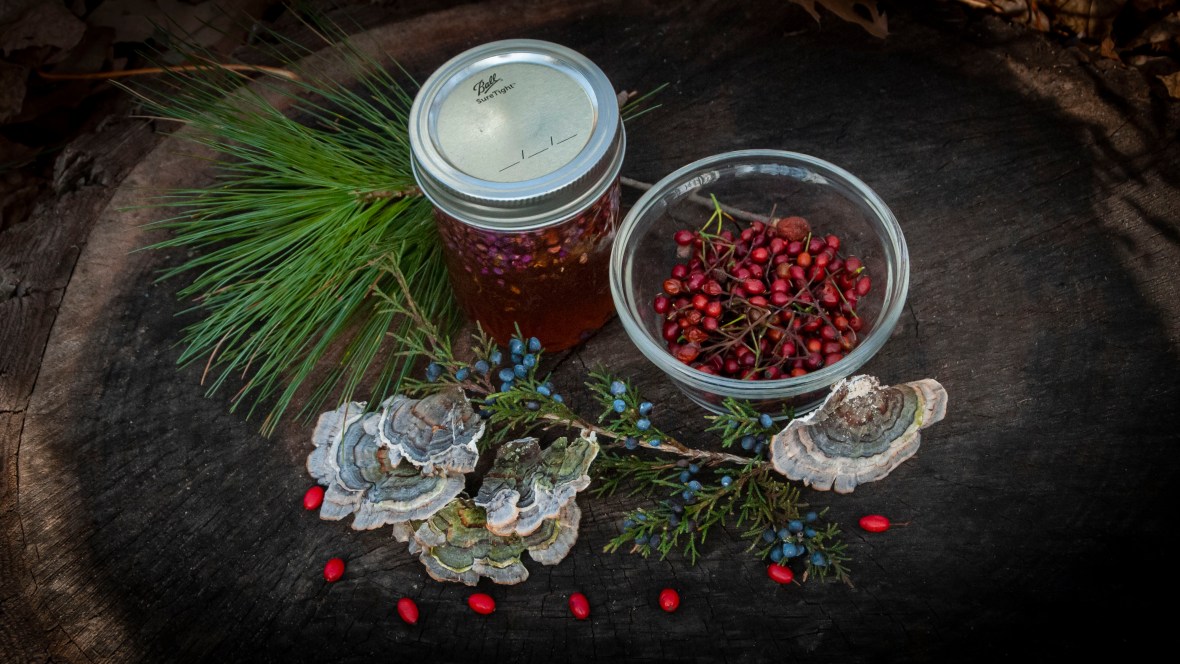
What are you foraging for in Winter? Here in Southeastern PA, there are many goodies available, from the needles of trees such as the Eastern Red Cedar, Eastern White Pine, and Blue Spruce, to the invasive hips of the Multiflora Rose. Mushrooms, such as the Turkey Tails, are available, provided we’ve identified them correctly.

Are you new to foraging and want to learn how to get started and what foraging etiquette to abide by as you harvest?

Get inspired to forage with some of these wild-plant based snacks and winter recipes and you’ll never look at the natural world the same way again!


Beautyberry Honey Spread

  • 8 oz. local, unflavored, wildflower honey
  • 1 c. Beautyberries from the Beautyberry shrub (Callicarpa sp.)
  • 1 clean pint ball jar
  • 1 pear
  • 3 tbsp. crumbled feta cheese (optional)

Harvest berries from the Beautyberry shrub and dry between paper towels for a few days, or quickly in the microwave (do not heat the berries in the microwave for more than 15 seconds at a time). Once they are dried, add to clean jar and crush them with the back of the spoon or pestle. Pour honey overtop of the crushed berries and seal the container. Every day, for two weeks, flip the jar over to ensure that all of the berries are covered and infusing their purple-goodness into the honey. When ready to serve, slice pears thinly and lay them out, slightly overlapping each other. Double boil the infused honey until it becomes runny, then strain out the plant matter (compost or eat them raw). Drizzle honey over the pears, then crumble the feta overtop.


Pine Shortbread Cookies

winter recipes foraged pine shortbread
  • 2 c. flour
  • 1 c. sugar
  • 1 c. salted butter (or unsalted butter + 1/4 tsp. salt)
  • 1/2 c. Eastern White Pine needles
  • Handful of Juniper berries, Rosehips, or Barberries for decoration
  • 2-3 tbsp. sugar for topping

Preheat the oven to 325 degrees F. Add all ingredients (minus the pine needles) into a bowl and beat on low until homogenous. Finely chop up pine needles and stir in. Knead dough until it is warm and forms one solid dough ball. Roll dough out on a floured surface to be 1/4″ thick, then cut into shapes using cookie cutters. Place cut out cookies onto cookie sheet lined with parchment paper and gently press 3 garnish berries/hips into the top. You can also gently poke holes into the cookies with a fork or skewer to allow for even baking & decoration. Put sheet in freezer or refrigerator for 15 minutes, until they are cold to the touch, then bake for 15 minutes!

Immediately out of the oven, sprinkle sugar overtop, then let cool before serving.

If you don’t want to bake a large batch at once, you can keep cookie dough in the freezer until you’re ready to bake the rest of them.


Rosehip Winter Punch

winter recipes rosehip syrups and tea
  • 1 c. Multiflora Rose (Rosa multiflora) rosehips
  • 1 c. water
  • 1/2 c. white sugar or honey
  • 8 c. Ginger Ale
  • 1/2 c. lime juice
  • 1/2 c. Cranberries chopped

Wash the harvested Rosehips and remove unwanted debris. Add fruits and 1 c. water to a saucepan and bring to a simmer for 30 minutes. Some of the water may dissipate as steam – don’t worry! Continue heating until the fruits are easily squished. Once the fruits are soft, mush them up with the side of a spoon, or a fruit masher. Remove from heat and let cool. Strain out seeds, then dissolve the sugar or honey in the remaining liquid to create a syrup. When dissolved, pour rosehip syrup into a punch bowl. Add the remaining liquids and cranberries. Adjust lime to sour/sweet taste. Serve cold.


winter recipes for pine need tea hot toddy

Winter Tea Blends

  • Clean, sealable jar
  • Dried herbs of choice (I suggest pine needles, anything in the wild mint family, rose hips, crab apples, barberries, etc…)
  • Raw Honey to taste

Allow herbs to dry thoroughly prior to using for tea (you have to use more fresh material since the nutrients are less concentrated, so it’s less efficient in the winter). When ready to make your tea, cut or grind up 1 tbsp.. of dried plant matter of your choice and put into a tea steeper. Bring water to a boil, then pour into mug. After a minute, add the steeper. Excess heat breaks enzymes down, making your tea less medicinal. If you boil your tea, it’ll still taste yummy though! For maximum medicinal function, steep your tea for 10-20 minutes. If you just want a delicious hot tea that has some medicinal value, you can steep your tea for 3-6 minutes.

Note – Since my garden herbs have finished drying from the summer and fall, my personal favorite tea to have in the winter includes many non-winter plants. I love a blend of peppermint, ginger, and lemon balm in the evenings. This decoction (what we commonly call hot tea) improves digestion – something helpful for the cold holiday season when we’re eating heavier meals!


Now that you’re more comfortable with foraging, learn more about creating specialty drinks with wild-edibles, regardless of the season with my “Trails-to-Tasting” Foraging Guide & Cocktail Eco-Recipe Book!

Discover more wonders of the natural world, tips for how to forage, and some eco-recipes and tutorials on my YouTube channel’s Wild-Edibles & Foraging playlist!

Supporting The Art of Ecology through the online shop or by becoming a Patron at any tier on Patreon can help keep educational content coming!

Kokedama translates to “Moss Ball” and is a Japanese method of creating beautiful live plant decorations! Creating these kokedamas can be very rewarding and is a fun way to explore some unique epiphytic plants, however they do require extra care. Potted plants are only exposed to air only on the top, however kokedamas are exposed to air on all sides. This results in rapid moisture loss.

Let’s examine how to care for a Kokedama once it’s created.

Light Requirements for a Kokedama

Kokedama moss balls typically do not require a great amount of sunlight. Many of the epiphytic plants that lend themselves well to Kokedamas are understory plants. As they climb or sit in a tree that acts as their substrate, they are shaded by the canopy above. Avoid putting your plant in direct sunlight as it could burn. It is best for these plants to have less sunlight in the summer and more sunlight in the winter since the angle of the sun has changed and the light is less harsh in the winter season.

Water Requirements for a Kokedama

As mentioned previously, Kokedamas are exposed to air on all sides, so moisture loss is a huge concern! It is incredibly helpful to keep your creation in a high-humidity room. Consider placing it in a bathroom where it can get lots of humidity from showers.

For the plant to get sufficient water, submerged in room temperature water for 15 minutes about once a week (scroll down for specifc plant notes). When you remove your kokedama from the water, allow excess water to drain out.

If you have an Orchid Kokedama, as you “bathe” it, the base of the foliage should not be submerged. Only submerge the moss ball that house the orchid roots. This prevents the cluster of leaves from holding onto water and rotting. Other plants, such as Bromeliads, need water to stay on the foliage, so find what your specific plant needs.

For vibrant moss, mist the moss with a water spray bottle every morning to keep it hydrated.

Fertilizing a Kokedama

As an indoor plant, the plant inside the moss doesn’t have the same access to nutrients that wild plants do. Epiphytic plants have the ability to gain nutrients and minerals from the tree they live on, so when we bring it inside, they need a little help from time to time. Fertilizing your plant once a year at the start of the growing season (spring/early summer) will help immensely. When you are watering your plant, add a pinch or two of soluble fertilizer into the water so your Kokedama can soak it up.

showing off Tropical Houseplant Sticker Set
Pothos (Epipremnum aureum)

If you have created an orchid Kokedama, try to find a fertilizer that is specific for orchids as their nutrient requirements are a little different from many other epiphytic plants.

Specific Plant Notes

Different plants have unique growth requirements. What sort of plant did you use? Below are some helpful pointers for a handful of species:

  • Spider Plant (Chlorophytum comosum) – Keep in bright indirect light, water when ball feels dry.
  • Pothos (Epipremnum aureum) – Does well in low or bright indirect light, water when leaves start to droop.
  • Rabbit’s Foot Fern (Phlebodium aureum) – Likes bright indirect light. Keep the ball moist. They live in subtropical regions and like high humidity environments.
Tillandsia air plant
  • Philodendron (Heartleaf & Ivy Philodendron’s are great, manageable options, Philodendron cordatum or Philodendron hederaceum) – Best in bright indirect light, water when leaves show start to droop.

  • Ficus bonsai (Ficus retusa) – Likes bright indirect light, water when ball feels dry. These are not epiphytic and grow in soil substrates, rather than on another tree. These are well-suited for kokedamas since they tolerate low-humidity.
  • Scarlet Bromeliad (Guzmania lingulata) – Likes bright indirect light, water when ball feels dry. The area where all of the leaves connect at the base forms a cup. In nature, rainwater fills this cup and provides the plant with extra water. Fill that cup and wash it out regularly to prevent stagnation and salt/calcium collection if your water is hard. Tillandsia (in the Bromeliad family) are also suitable for kokedama!
  • Bird’s Nest Fern (Asplenium nidus) – Likes medium to bright indirect light, water when plant feels a little moist.
  • Christmas Cactus (Schlumbergera bridgesii) – Best in low to bright indirect light, water when the the base feels dry.
Christmas Cactus (Schlumbergera bridgesii)
Lucy McGinty โ€“ 2022 Intern

I am an environmental studies college student, and The Art of Ecologyโ€™s new intern! My career goal is to become an environmental microbiologistโ€”a person who studies the microorganisms in the environment and their relationship to pollution! I am so excited to [learn more about ecology] and ways we can do better.

Did you know that today is America’s National Bird Day? Discover more about the birds you love and how to celebrate this winter season!

Winter Bird Adaptations

During the cold days of winter, we often worry about the birds that roam outside of our houses, especially because we can’t hear or see them as much. Luckily, the birds who stay put in Pennsylvania are well equipped to stay warm this winter!

Birds fluff up their feathers to trap air which makes them capable of trapping more heat! At night time, they typically go into a state called torpor, similar to the hibernation that mammals undertake in the winter; their body temperature significantly lowers, their metabolism slows, and they conserve all possible energy until they need to use it. Birds also store little bits of fat under their skin which allows them to go longer without eating while simultaneously keeping them warmer! Have you seen many birds this winter? Can you identify any of the bird calls you hear at this time of year?

Support Winter Birds with Feeders

Peanut butter is great for birds because it has lots of fat for them to store and they find it yummy just like us! This simple bird-feeder craft is easy and fun, and the birds trying to keep warm will be very grateful.

Materials:
  • Old toilet paper tube
  • Peanut butter
  • Birdseed
  • String
Methods:
  • Start by smearing peanut butter all over the toilet paper tube. You can do the inside if you’d like, but it might get pretty messy.
  • Once you’re done applying the peanut butter, spread some birdseed on a plate. Then roll your peanut butter tube over the birdseed, and make sure to really get that birdseed stuck in the peanut butter.
  • After you have your tube coated in birdseed, run some string through the tube, tie it somewhere in your backyard, and then you’re done!

On National Bird Day, your local birds will chirp many thank-yous for making this delicious food available to them. Just make sure to clean up the strings once your birds finish off the food!

Lucy McGinty - 2022 Intern
Lucy McGinty – 2022 Intern

I am an environmental studies college student, and The Art of Ecology’s new intern! My career goal is to become an environmental microbiologistโ€”a person who studies the microorganisms in the environment and their relationship to pollution! I am so excited to [learn more about ecology] and ways we can do better.


Celebrate National Bird Day with The Art of Ecology’s bird-themed merch! A % of the proceeds benefits wildlife conservation & habitat preservation efforts.

Verbena, Viper’s Bugloss, and Chicory blooms blend reds and blues to look vibrant, yet soothing at the same time. The color of these flowers are so beautiful, but what exactly is that color called? This year, Pantone selected Very Peri, a periwinkle hue to be the 2022 color of the year!

Displaying a carefree confidence and a daring curiosity that animates our creative spirit, inquisitive and intriguing PANTONE 17-3938 Very Peri helps us to embrace this altered landscape of possibilities, opening us up to a new vision as we rewrite our lives. Rekindling gratitude for some of the qualities that blue represents complemented by a new perspective that resonates today, PANTONE 17-3938 Very Peri places the future ahead in a new light.

Pantone.com/color-of-the-year-2022

What can be found in nature that embodies this color?

Many flowers are Very Peri, and range in color from soft purples, to periwinkle-blues. These colors are attractive to pollinators and are made of a variety of anthocyanin pigments. Since anthocyanins cover a wide spectrum of red colors, there can be many subtle shifts in how these reds, purples, and soft blues can appear. To discover more about the wonderful world of plant pigments, click here.

In the collage below, I went through my archives and selected my favorites nature photos that highlight Very Peri. I will definitely be on the watch in 2022 for this beautiful, cheerful yet soothing color!

Very Peri 2022 Pantone Color of the Year found in nature

Find some of these prints and more in my photo or illustration print shop!

Supporting The Art of Ecology through the online shop or by becoming a Patron at any tier on Patreon can help keep educational content coming!

New Summer Camp for 2023! Habitat-themed Nature Art Camp weeks offered. Camp takes place with Downingtown Area Recreation Consortium (DARC), in Chester County.

Do you have questions? Learn more by clicking below, or email Marissa at mjacobs@theartofecology.com

Activities may include: Photography, Foraging, Painting, Holistic Wildcrafting, Paper crafts, creating custom summer camp t-shirts, and more!

Register Today! Space is limited.