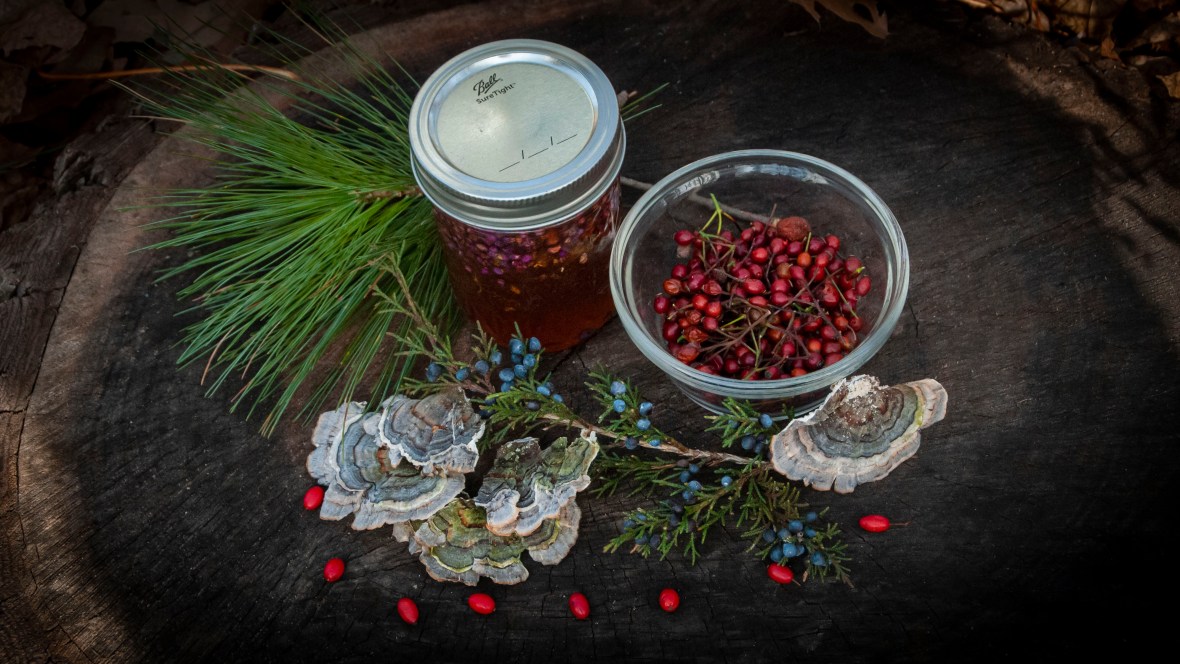
Winter is here! The trees have lost their leaves, small mammals are eating their caches of black walnuts and acorns, and the birds are picking away at the last of the sumac and crabapples. So what’s left for us foragers? Winter is the perfect time to take advantage of the many edible coniferous trees and berries that sweeten after the first frost for our winter recipes!

When we forage for and create winter recipes for our meals, snacks, and drinks directly from nature, we have such control of what goes into our bodies as well as start to understand and appreciate the ecosystems around us a little bit more.

What are you foraging for in Winter? Here in Southeastern PA, there are many goodies available, from the needles of trees such as the Eastern Red Cedar, Eastern White Pine, and Blue Spruce, to the invasive hips of the Multiflora Rose. Mushrooms, such as the Turkey Tails, are available, provided we’ve identified them correctly.

Are you new to foraging and want to learn how to get started and what foraging etiquette to abide by as you harvest?

Get inspired to forage with some of these wild-plant based snacks and winter recipes and you’ll never look at the natural world the same way again!


Beautyberry Honey Spread

  • 8 oz. local, unflavored, wildflower honey
  • 1 c. Beautyberries from the Beautyberry shrub (Callicarpa sp.)
  • 1 clean pint ball jar
  • 1 pear
  • 3 tbsp. crumbled feta cheese (optional)

Harvest berries from the Beautyberry shrub and dry between paper towels for a few days, or quickly in the microwave (do not heat the berries in the microwave for more than 15 seconds at a time). Once they are dried, add to clean jar and crush them with the back of the spoon or pestle. Pour honey overtop of the crushed berries and seal the container. Every day, for two weeks, flip the jar over to ensure that all of the berries are covered and infusing their purple-goodness into the honey. When ready to serve, slice pears thinly and lay them out, slightly overlapping each other. Double boil the infused honey until it becomes runny, then strain out the plant matter (compost or eat them raw). Drizzle honey over the pears, then crumble the feta overtop.


Pine Shortbread Cookies

winter recipes foraged pine shortbread
  • 2 c. flour
  • 1 c. sugar
  • 1 c. salted butter (or unsalted butter + 1/4 tsp. salt)
  • 1/2 c. Eastern White Pine needles
  • Handful of Juniper berries, Rosehips, or Barberries for decoration
  • 2-3 tbsp. sugar for topping

Preheat the oven to 325 degrees F. Add all ingredients (minus the pine needles) into a bowl and beat on low until homogenous. Finely chop up pine needles and stir in. Knead dough until it is warm and forms one solid dough ball. Roll dough out on a floured surface to be 1/4″ thick, then cut into shapes using cookie cutters. Place cut out cookies onto cookie sheet lined with parchment paper and gently press 3 garnish berries/hips into the top. You can also gently poke holes into the cookies with a fork or skewer to allow for even baking & decoration. Put sheet in freezer or refrigerator for 15 minutes, until they are cold to the touch, then bake for 15 minutes!

Immediately out of the oven, sprinkle sugar overtop, then let cool before serving.

If you don’t want to bake a large batch at once, you can keep cookie dough in the freezer until you’re ready to bake the rest of them.


Rosehip Winter Punch

winter recipes rosehip syrups and tea
  • 1 c. Multiflora Rose (Rosa multiflora) rosehips
  • 1 c. water
  • 1/2 c. white sugar or honey
  • 8 c. Ginger Ale
  • 1/2 c. lime juice
  • 1/2 c. Cranberries chopped

Wash the harvested Rosehips and remove unwanted debris. Add fruits and 1 c. water to a saucepan and bring to a simmer for 30 minutes. Some of the water may dissipate as steam – don’t worry! Continue heating until the fruits are easily squished. Once the fruits are soft, mush them up with the side of a spoon, or a fruit masher. Remove from heat and let cool. Strain out seeds, then dissolve the sugar or honey in the remaining liquid to create a syrup. When dissolved, pour rosehip syrup into a punch bowl. Add the remaining liquids and cranberries. Adjust lime to sour/sweet taste. Serve cold.


winter recipes for pine need tea hot toddy

Winter Tea Blends

  • Clean, sealable jar
  • Dried herbs of choice (I suggest pine needles, anything in the wild mint family, rose hips, crab apples, barberries, etc…)
  • Raw Honey to taste

Allow herbs to dry thoroughly prior to using for tea (you have to use more fresh material since the nutrients are less concentrated, so it’s less efficient in the winter). When ready to make your tea, cut or grind up 1 tbsp.. of dried plant matter of your choice and put into a tea steeper. Bring water to a boil, then pour into mug. After a minute, add the steeper. Excess heat breaks enzymes down, making your tea less medicinal. If you boil your tea, it’ll still taste yummy though! For maximum medicinal function, steep your tea for 10-20 minutes. If you just want a delicious hot tea that has some medicinal value, you can steep your tea for 3-6 minutes.

Note – Since my garden herbs have finished drying from the summer and fall, my personal favorite tea to have in the winter includes many non-winter plants. I love a blend of peppermint, ginger, and lemon balm in the evenings. This decoction (what we commonly call hot tea) improves digestion – something helpful for the cold holiday season when we’re eating heavier meals!


Now that you’re more comfortable with foraging, learn more about creating specialty drinks with wild-edibles, regardless of the season with my “Trails-to-Tasting” Foraging Guide & Cocktail Eco-Recipe Book!

Discover more wonders of the natural world, tips for how to forage, and some eco-recipes and tutorials on my YouTube channel’s Wild-Edibles & Foraging playlist!

Supporting The Art of Ecology through the online shop or by becoming a Patron at any tier on Patreon can help keep educational content coming!

Kokedama translates to “Moss Ball” and is a Japanese method of creating beautiful live plant decorations! Creating these kokedamas can be very rewarding and is a fun way to explore some unique epiphytic plants, however they do require extra care. Potted plants are only exposed to air only on the top, however kokedamas are exposed to air on all sides. This results in rapid moisture loss.

Let’s examine how to care for a Kokedama once it’s created.

Light Requirements for a Kokedama

Kokedama moss balls typically do not require a great amount of sunlight. Many of the epiphytic plants that lend themselves well to Kokedamas are understory plants. As they climb or sit in a tree that acts as their substrate, they are shaded by the canopy above. Avoid putting your plant in direct sunlight as it could burn. It is best for these plants to have less sunlight in the summer and more sunlight in the winter since the angle of the sun has changed and the light is less harsh in the winter season.

Water Requirements for a Kokedama

As mentioned previously, Kokedamas are exposed to air on all sides, so moisture loss is a huge concern! It is incredibly helpful to keep your creation in a high-humidity room. Consider placing it in a bathroom where it can get lots of humidity from showers.

For the plant to get sufficient water, submerged in room temperature water for 15 minutes about once a week (scroll down for specifc plant notes). When you remove your kokedama from the water, allow excess water to drain out.

If you have an Orchid Kokedama, as you “bathe” it, the base of the foliage should not be submerged. Only submerge the moss ball that house the orchid roots. This prevents the cluster of leaves from holding onto water and rotting. Other plants, such as Bromeliads, need water to stay on the foliage, so find what your specific plant needs.

For vibrant moss, mist the moss with a water spray bottle every morning to keep it hydrated.

Fertilizing a Kokedama

As an indoor plant, the plant inside the moss doesn’t have the same access to nutrients that wild plants do. Epiphytic plants have the ability to gain nutrients and minerals from the tree they live on, so when we bring it inside, they need a little help from time to time. Fertilizing your plant once a year at the start of the growing season (spring/early summer) will help immensely. When you are watering your plant, add a pinch or two of soluble fertilizer into the water so your Kokedama can soak it up.

showing off Tropical Houseplant Sticker Set
Pothos (Epipremnum aureum)

If you have created an orchid Kokedama, try to find a fertilizer that is specific for orchids as their nutrient requirements are a little different from many other epiphytic plants.

Specific Plant Notes

Different plants have unique growth requirements. What sort of plant did you use? Below are some helpful pointers for a handful of species:

  • Spider Plant (Chlorophytum comosum) – Keep in bright indirect light, water when ball feels dry.
  • Pothos (Epipremnum aureum) – Does well in low or bright indirect light, water when leaves start to droop.
  • Rabbit’s Foot Fern (Phlebodium aureum) – Likes bright indirect light. Keep the ball moist. They live in subtropical regions and like high humidity environments.
Tillandsia air plant
  • Philodendron (Heartleaf & Ivy Philodendron’s are great, manageable options, Philodendron cordatum or Philodendron hederaceum) – Best in bright indirect light, water when leaves show start to droop.

  • Ficus bonsai (Ficus retusa) – Likes bright indirect light, water when ball feels dry. These are not epiphytic and grow in soil substrates, rather than on another tree. These are well-suited for kokedamas since they tolerate low-humidity.
  • Scarlet Bromeliad (Guzmania lingulata) Likes bright indirect light, water when ball feels dry. The area where all of the leaves connect at the base forms a cup. In nature, rainwater fills this cup and provides the plant with extra water. Fill that cup and wash it out regularly to prevent stagnation and salt/calcium collection if your water is hard. Tillandsia (in the Bromeliad family) are also suitable for kokedama!
  • Bird’s Nest Fern (Asplenium nidus) – Likes medium to bright indirect light, water when plant feels a little moist.
  • Christmas Cactus (Schlumbergera bridgesii) – Best in low to bright indirect light, water when the the base feels dry.
Christmas Cactus (Schlumbergera bridgesii)
Lucy McGinty โ€“ 2022 Intern

I am an environmental studies college student, and The Art of Ecologyโ€™s new intern! My career goal is to become an environmental microbiologistโ€”a person who studies the microorganisms in the environment and their relationship to pollution! I am so excited to [learn more about ecology] and ways we can do better.

Did you know that today is America’s National Bird Day? Discover more about the birds you love and how to celebrate this winter season!

Winter Bird Adaptations

During the cold days of winter, we often worry about the birds that roam outside of our houses, especially because we can’t hear or see them as much. Luckily, the birds who stay put in Pennsylvania are well equipped to stay warm this winter!

Birds fluff up their feathers to trap air which makes them capable of trapping more heat! At night time, they typically go into a state called torpor, similar to the hibernation that mammals undertake in the winter; their body temperature significantly lowers, their metabolism slows, and they conserve all possible energy until they need to use it. Birds also store little bits of fat under their skin which allows them to go longer without eating while simultaneously keeping them warmer! Have you seen many birds this winter? Can you identify any of the bird calls you hear at this time of year?

Support Winter Birds with Feeders

Peanut butter is great for birds because it has lots of fat for them to store and they find it yummy just like us! This simple bird-feeder craft is easy and fun, and the birds trying to keep warm will be very grateful.

Materials:
  • Old toilet paper tube
  • Peanut butter
  • Birdseed
  • String
Methods:
  • Start by smearing peanut butter all over the toilet paper tube. You can do the inside if you’d like, but it might get pretty messy.
  • Once you’re done applying the peanut butter, spread some birdseed on a plate. Then roll your peanut butter tube over the birdseed, and make sure to really get that birdseed stuck in the peanut butter.
  • After you have your tube coated in birdseed, run some string through the tube, tie it somewhere in your backyard, and then you’re done!

On National Bird Day, your local birds will chirp many thank-yous for making this delicious food available to them. Just make sure to clean up the strings once your birds finish off the food!

Lucy McGinty - 2022 Intern
Lucy McGinty – 2022 Intern

I am an environmental studies college student, and The Art of Ecology’s new intern! My career goal is to become an environmental microbiologistโ€”a person who studies the microorganisms in the environment and their relationship to pollution! I am so excited to [learn more about ecology] and ways we can do better.


Celebrate National Bird Day with The Art of Ecology’s bird-themed merch! A % of the proceeds benefits wildlife conservation & habitat preservation efforts.

Verbena, Viper’s Bugloss, and Chicory blooms blend reds and blues to look vibrant, yet soothing at the same time. The color of these flowers are so beautiful, but what exactly is that color called? This year, Pantone selected Very Peri, a periwinkle hue to be the 2022 color of the year!

Displaying a carefree confidence and a daring curiosity that animates our creative spirit, inquisitive and intriguing PANTONE 17-3938 Very Peri helps us to embrace this altered landscape of possibilities, opening us up to a new vision as we rewrite our lives. Rekindling gratitude for some of the qualities that blue represents complemented by a new perspective that resonates today, PANTONE 17-3938 Very Peri places the future ahead in a new light.

Pantone.com/color-of-the-year-2022

What can be found in nature that embodies this color?

Many flowers are Very Peri, and range in color from soft purples, to periwinkle-blues. These colors are attractive to pollinators and are made of a variety of anthocyanin pigments. Since anthocyanins cover a wide spectrum of red colors, there can be many subtle shifts in how these reds, purples, and soft blues can appear. To discover more about the wonderful world of plant pigments, click here.

In the collage below, I went through my archives and selected my favorites nature photos that highlight Very Peri. I will definitely be on the watch in 2022 for this beautiful, cheerful yet soothing color!

Very Peri 2022 Pantone Color of the Year found in nature

Find some of these prints and more in my photo or illustration print shop!

Supporting The Art of Ecology through the online shop or by becoming a Patron at any tier on Patreon can help keep educational content coming!

New Summer Camp for 2023! Habitat-themed Nature Art Camp weeks offered. Camp takes place with Downingtown Area Recreation Consortium (DARC), in Chester County.

Do you have questions? Learn more by clicking below, or email Marissa at mjacobs@theartofecology.com

Activities may include: Photography, Foraging, Painting, Holistic Wildcrafting, Paper crafts, creating custom summer camp t-shirts, and more!

Register Today! Space is limited.

The Art of Ecology’s mission is to build visual connections between people and the natural world we’re a part of by blending the arts & environmental sciences.

Through eco/art public and private workshops, participants can discover the ecosystems we live in and how connected the various facets of people, plants, and wildlife are. From foraging workshops, to terrarium building classes, to scientific illustration programs and more, you can learn all about the wonderful world we live in here, with The Art of Ecology!

Search Events by Category

Discover the Great Outdoors with The Art of Ecology

Did you know that beyond just education, Marissa of The Art of Ecology also creates her own, original artwork that you can snag for your own collection? A portion of the proceeds benefits wildlife conservation & habitat preservation efforts.

Shop wall art, home decor, sustainable fashion, stickers, and more! View the best sellers here, and see more in the shop!

2021 was an emotional rollercoaster. I switched from working at a nature center to having The Art of Ecology be my full time job! This is a dream come true, but I’ll be honest, running your own business is an emotional challenge. There were moments where I jumped up and down with excitement and moments where I was so discouraged and felt overwhelmed. Overall, it has been fantastic and those disheartening moments serve as motivation.

Exciting News from 2021

In April, I returned to Kenya to photograph daily life as part of a project for Forgotten Missionaries International. I photographed wildlife, the beautiful landscape, and ways that people interact with the world. These photos tell the story of Kenyan life so others understand some challenges the people face and experience the country’s beauty. Watch recordings of presentations I gave using my photos below!

Over the year I did a lot of Professional Development. I presented at the PA Environmental Education Conference about National Geographic’s educator certifications and ways to empower students. Then, in August, I blended the mental and physical benefits gained from being in the great outdoors with the benefits of creating art through a certification in Neurographica. Now, I teach Nature & NeuroArt classes where learners discover the wonderful benefits of art and nature! I also followed my foraging & wild-edibles passion through training in Wild Foraging. I am continuing this and will be certified in Herbalism (medicinal values of using wild-edibles) in spring 2022 through the Herbal Academy.

Speaking of foraging, I also published my book, “Trails-to-Tasting” : Foraging Field Guide and Drink Recipe Book! It includes recipes for seasonal foraged cocktails & mocktails as well as an illustrated field guide and botanical study.

By going full time, I expanded my reach and led many workshops, both in-person and virtually! I ran 25+ programs that encouraged learners of all ages to explore the natural world through art, such as Kokedama, Terrarium Building, Botanical Illustration, Photo Walks & Presentations, Foraging Classes, and new for 2021: Botanical Dye Workshops. One of the virtual presentations was even for a Montessori school in Southern India!

My Goals for 2022

Now that The Art of Ecology is my full time job, I can give it the attention needed to make each new year the best. With the extra time, my 2022 goal is to get more of my original art out into the world, sparking conversations about ecosystems and the importance of environmental stewardship. With YOUR help I can continue making the world a greener place. Stay tuned for monthly workshops and my new Conservation Photography & Nature Art Summer Camp! As always, a portion of all art sale proceeds benefits wildlife conservation & habitat preservation efforts.


View my top selling products of 2021 and make sure that you get your own today!


Get Social with The Art of Ecology!

2021 Year in Review Instagram Top Nine
Top 9 Photos from 2021 (Instagram)
My 2021 Top Watched Video on my YouTube Channel

Here’s to a 2022 filled with growth, exciting opportunities, and new ways to connect you to the natural world!

Supporting The Art of Ecology through the online shop or by becoming a Patron at any tier on Patreon can help keep educational content coming!

Transformation: WILD ART 2021

As part of the Wild Art 2021 December Challenge, put on by Zoe Keller, I illustrated two pieces focusing on the theme, “Transformation”. Each month, I will focus on two pieces – one highlighting flora, the other highlighting fauna. This month, the first is an animal that has the unique ability to swap out the shelters it lives in whenever it outgrows them: The Hermit Crab! The second is a plant with a colorful adaptation to communicate to it’s pollinators, “Hey, this floret has already been pollinated!” Both of these transformations, whether in color or shell type, are adaptations that aid in survival.

Transformation to Protect

hermit crab transformation

First, we have the delightful little hermit crab, who transforms it’s home once it has outgrown it’s current home.

Hermit crab shells do not grow over time, like the Chambered Nautilus does. As the crab ages, it outgrows it’s tight shell and leaves it’s home. It discards the old shell once it finds a new, larger shell. These shells do not have to be crab shells; any specie’s shell, as long as the crab can wriggle inside, will do!

Occasionally, a hermit crab finds something to live in that’s not even a shell. As plastic pollution becomes more prevalent in marine environments, hermit crabs find new items to live in! These little crabs were documented living in broken bottles, soda cans, laundry detergent caps, tin cans, and even broken old tennis balls! While this seems like a clever use of plastic debris, this can actually hurt the crab. Not only are some edges sharp and rusty, which can cause lesions on the crab, but chemicals from the plastic leech out into the crab! These chemicals can cause hyperactivity in crabs, and they die from exhaustion and lack of nutrition to fuel their energy.

Transformation to Communicate

Second, we have a flower who changes it’s appearance to communicate to insect and bird populations!

The Lantana (Lantana camara) are vibrant flowers that grow in clusters. You can find cultivars that have yellow and pink flowers, or red and orange flowers, or are all one color! You may notice that over time, after the flowers have bloomed, that they change colors.

Many pollinators love the color yellow and it signifies, “Hello! I have yet to be pollinated!” As the flowers become pollinated, they produce a anthocyanin (red) pigments to saturate the petals. They then fade to a less attractive color so pollinators don’t waste time visiting already-pollinated blooms.

Why Go Through the Hassle of Transformation?

In order to survive, animals and plants adapt. Hermit crab’s organs would outgrow their stunted bodies if they lived in a shell that’s too small! Pollinators would waste precious energy visiting unnecessary flowers, and the Lantana would be pollinated too slowly to efficiently disperse it’s seeds.

To help protect both plants and animals that go through transformation, you can start by not bringing whole shells home from beach trips. As shells are removed from habitats, hermit crabs have no choice but to scavenge for inappropriate homes. Take pictures as keepsakes or search for broken shells that would no longer be suitable for hermit crabs to move into. You can also help pollinators by planting more native plants in your garden and community!

Click for scientific illustrations, illustration workshops, or dรฉcor that supports conservation!

Supporting The Art of Ecology through the online shop or by becoming a Patron at any tier on Patreon can help keep educational content coming!

New for 2022! Mini-Grants for Conservation

A portion of the proceeds from my art sales benefits conservation efforts. In 2022, instead of donating a small % to habitat preservation or wildlife conservation non-profits, I will switch to something that can have a greater impact!

Why the Change?

I feel strange about donating $2 here, $.50 there, $5 somewhere else based on the art sold, yet I know, after working with non-profits for years, that every bit adds up. I still wanted to come up with a way to make more of a difference. Starting in 2022, a % of every purchase will instead be added to The Art of Ecology’s Grants for Conservation pot! Applications open in February 2022.

By making this change, the impact can be as big as possible! I can connect with local environmental leaders who actively make a positive impact on the ecosystems we share. Occasionally, I’ll host special events to impact global conservation, too. I will specify them beforehand and you can make a larger contribution if desired.

Mini-Grant Details

These mini-grants are awarded to groups that:

  • Run Conservation Projects
  • Involve the Public to Increase Impact and Project Reach (not required, but projects that have an educational component will be given priority)
  • Focus on Endangered or At-Risk Species & Habitats

Applicants must describe their project, the impacts the project can have, how they educate or empower the public, and how they will improve species health that need our immediate attention. These grants are open to the public and groups or individuals who wish to make a difference can apply!

Grant applications will open on February 1st, 2022.

Once an organization is selected, I’ll announce the conservation projects funded with your help! The grant reports, including photos and impact details will be publicly available. Based on previous years total donations from art sales, I estimate that the grants for conservation will be for roughly $250-500. Ultimately, they are determined by the sales throughout the previous year.

Spread the Word!

Do you know an organization that could benefit from grants for conservation like this? Please pass this information along to them! I will announce grant information on Instagram, Facebook, and through my eblast. You can also email me with questions at mjacobs@theartofecology.com

Watch this video for a tutorial on application!

Supporting The Art of Ecology through the online shop or by becoming a Patron at any tier on Patreon can help keep educational content coming!