Masked bandits like this one leave little hand prints all over forest trails! Raccoons are opportunistic feeders and can be found anywhere that food exists!
Masked bandits like this one leave little hand prints all over forest trails!

One of the things I remember my father saying the most when I was a child was – “There’s always evidence!” This was typically said because I would wonder how he knew that I didn’t do a certain chore, but it definitely applies in the ecology world too.

Mammals are among some of my favorite animals (followed closely by sharks and octopuses!), so naturally, I tend to look for them wherever I go. If you, like me, want to go mammal tracking here are some tips!

Tracking Down Mammals

When you go mammal tracking, look for the animal itself. If you can’t find it, look for evidence like tracks, scat/droppings, bones (especially skulls), or behavioral signs (like buck rub or digging). These things can not only let you know what mammal was around, but even what it was doing and when! Here are some key features of PA’s more common mammals.

  • Raccoon (Procyon lotor) – These masked mammal’s tracks look like little hand prints that can be often seen near water as they like to hunt for aquatic animals like, crayfish, and wash their food. If you ever come across a skull (as I have!) you can identify that they are omnivores, having large canines, cutting teeth, and grinding molars. They love berries, so if you find their scat, it’ll be yellowish-red and full of seeds!
  • Eastern Cottontail Rabbit (Sylvilagus floridanus) – This isn’t your pet. This wild rabbit is a rusty brownish-grey color with white undersides (their cotton ball looking tail is where they get their name from!). Search for browse (twigs low to the ground that have been chomped to a stub) or droppings similar to a deer’s, but more spread out. They are a common prey animal, so finding rabbit bones in the woods is more likely. Their skull is easily identifiable as they are lacey in front of the eye sockets. They also have pronounced front teeth (incisors). Another great thing to look for are rabbit droppings. They are small and round, and slightly bean-shaped. If you look closer, you can see that they are usually a dark, muddy green since they eat so much plant-matter!
deer and mammal tracking
Deer will make huffing sounds and stomp their feet when they want to look intimidating and scare something away. More often than not, they will turn their tails up and leap away!
  • White-tailed Deer (Odocoileus virginanus) – They are almost the only cloven hoofed mammal in PA and come into so many people’s yards that they are well known. They are a greyish-brown color and have white around their eyes and nose and on the underside of their chest and tail. Their tail is a flag signal for other deer when they feel threatened. Evidence of them being nearby can be droppings (round pellets clumped in large piles), browse, or buck rub (when males rub bark from trees using their antlers to get rid of the velvety covering). Their skull is identifiable as they may still have antlers attached. The nose part (rostrum) is prolonged and they have several incisors in the front with grinding molars in the back of their jaw. Looking at how worn these back teeth are can help you to identify how old the deer was. If they are very worn, and almost flat, this is an old deer! While a deer lifespan can be up to 20 years old, it’s more likely to only live to 2-3 years.
squirrel and mammal tracking
This squirrel may look as if it has some red tints to it’s fur, but it’s not a Red Squirrel. Red squirrels have long ear tufts, while the Eastern Grey doesn’t.
  • Eastern Grey Squirrel (Sciurus carolinensis) – These dusty greyish-brown mammals are easily identifiable with their bushy tails and tiny paws! Their tracks look like tiny hand prints and are in a hopping formation more than a walking one. Search the tree tops for bushy, leafy, squirrel nests (called dreys) or chewed through acorns. Their skulls are smaller, rounder, and have a more blunt rostrum with large incisors and blunt molars.
  • Skunk (Mephitis mephitis) –  With their black body and long white stripe running from their nose to their tail, these animals are easily identifiable! Search the woods for large dig marks, crushed egg shells near nests, and scat made of insect parts and seeds. Don’t confuse this skull with the raccoon! This skull is wider and has a slightly more blunt rostrum.
  • Red Fox (Vulpes vulpes) – Don’t think a “Red” fox needs to be red! There are various color morphs (black, silver, blonde and red), but have white on the tip of their tail. They have dog-like tracks, but with a longer stride. Search for dens in the woods with food scraps or dirt piled up outside the entrance. Their scat looks similar to a dog’s, but with twisted ends. In the winter, it’ll be full of hair, but in the growing season, the hair is mixed with berries. The skull is easily identifiable as a canine since there are large “bubbles” on either side of the brain stem opening. These are called auditory bullae and are pronounced in dogs. They also have large and sharp canines and teeth called carnassial pairs that are built for cutting meat.
fox kit in spring - bucks county Pennsylvania

Next time you take a nature walk, look for animals and go mammal tracking! If you don’t see any just know – there is always evidence!

Ecologists and naturalists love the quote “Take only photos, leave only footprints.” While we may want to pick up feathers, rocks, and other animal artifacts, leave them be. If want to bring one of these adorable mammals to your home , do so with a photo! You’ll be able to start some great mammal tracking conversations.

Supporting The Art of Ecology through the online shop or by becoming a Patron at any tier on Patreon can help keep educational content coming!

Discover more about local PA species, how to identify them, and how to participate in an easy Community Science project during my Fall 2020 “Intro to Mammals” virtual presentation with Bucks Audubon

what causes sunsets
This sunrise greeted me one winter morning, but was so much more vivid right when I had woken up! In a matter of minutes, it was completely gone. How does this happen?

Recently, I’ve been waking up to some strikingly vivid sunrises. Unfortunately, by the time that I see the sunrise, get my camera, half stick my boots on and dash into the backyard, the colors have lost much of their vibrancy.

How do the colors disappear so quickly and what causes sunsets and sunrises to be there in the first place?

What Causes a Colorful Sky?

The colors of both sunrises and sunsets have to do with scattering. When light hits an air particle, the light waves bounce and scatter. Blue-ish violet is the shortest wavelength and is easily scattered by the numerous particles in the air. However, the human eye has a difficult time perceiving violet. This is why we see the sky as bright blue, not purple, during the day when the sun is right on top of us. The waves don’t have as far to travel to get to the rods and cones in our eyes!

Once the sun starts going down (or coming up), the sun is farther away from us and the light waves have to travel farther to reach our eyes. The greater the distance, the more molecules there are in the air. This causes the bluish-violet color to scatter and bounce so much that it bounces away and we lose it. The rest of the colors, like red, orange, pink, and yellow, wind up being what we see!

What’s amazing is that we on the East Coast of America are seeing the same sky as someone on the West Coast. The only difference is that (other than varying weather conditions) the wavelengths of light are traveling different amounts to reach our eyes. The blue sky doesn’t change into a pinkish sky – It’s our eyes missing out on the bounced blue light that the West Coasters are seeing. It’s almost as if we’re getting California’s “leftover” light waves.

Light Waves and a Round Surface

So why do sunsets and rises come and go so quickly? Well, the answer is because the Earth bends A LOT. We may not realize in our day to day lives how circular our seemingly “flat” path is. The sun may seem to move more quickly once it reaches the horizon because the atmosphere is bending the light – the sun isn’t going down a flat plane.

This sunset was the second one during our Maine vacation and I almost missed it! It's incredible how the colors change and fade into the dark night sky so quickly.
This sunset was the second one during our Maine vacation and I almost missed it! It’s incredible how the colors change and fade into the dark night sky so quickly.

Fortunately, once I get a good photo of the brilliance of the painted sky, I can have that with me even once the sun fully sets or rises and you can too! Explore what causes sunsets through art.

Supporting The Art of Ecology through the online shop or by becoming a Patron at any tier on Patreon can help keep educational content coming!

Right now there is a trend in “owl-love”. People think they’re so cute and decorate everything from paper-products, to clothes, to wall art with rather cartoony looking owls. Is there anything wrong with that – NO!

Owls definitely are super cute, but they are so much more than just fluffy balls of feathers. They are important parts of our ecosystem and food web.

Barred Owls are general predators that eat more than just rodents. They will also eat lizards, frogs, snakes, and salamanders!

Owls & The Food Chain

These nighttime raptors are Apex Predators. This means that not only do they eat animals lower on the food chain, but they also eat other predators, such as insect-eating birds, weasels, bats, and shrews. Owls themselves are predated upon by almost nothing. They die from natural (or man-made) causes.

Rodents – one of the main food sources of owls – can cause many problems. They can get into our houses (I have a mouse in my walls that I’ve named Fievel), eat our food, and spread diseases. Amazingly enough, one Barn Owl can eat up to 1,000 rodents each year! Imagine a whole population (over 1,000 Barn Owls have been banded in PA) not playing their part – that’s a whole bunch of rodents running around that we wouldn’t have had otherwise! By eating mice, rats, and other rodents, owls are helping to decrease some of the negative impacts that these pest species can have on humans.

The Great Eagle Owl may not be found in American, but it's relative, the Great Horned Owl does!
The Great Eagle Owl may not be found in America, but it’s relative, the Great Horned Owl does!

Not only can owls help to reduce problems for humans, but they can also reduce problems (specifically those of the genetic kind) in their prey populations. By eating animals that are too slow or weak to evade capture, the owls are getting rid of the “weakest-links.”  This can help to ensure that overall prey population is healthy and strong.

While we may not see these nocturnal raptors often, we can definitely appreciate the benefits that they have on our ecosystem!

Eastern Screech Owl
The Eastern Screech Owl is similar to the Barred Owl in that it is also a general predator eating insects, crustaceans, amphibians, reptiles, and other small mammals!

Do you need more of these elusive species in your life? I don’t blame you! Add any of these photos to your collection today.

Supporting The Art of Ecology through the online shop or by becoming a Patron at any tier on Patreon can help keep educational content coming!

Juncos are identifiable by being the tiny grey bird that "sat in milk". These are one of the common birds that you may see during the winter.
Juncos are identifiable by being the tiny grey bird that “sat in milk”. These are one of the common birds that you may see during the winter.

We always think of birds as migrating south for the winter (wish I could too!), but obviously, some birds do stick around. There are many bird adaptations to the cold to allow them to stick around chilly Pennsylvania!

How do Birds Adapt to the Cold?

Birds adapt in many ways that are similar to humans. They eat yummier foods (did Christmas treats hit anyone else pretty hard?), change their clothes (feathers), stay out of the wind, cuddle and stay inside!

Many songbirds eat insects in the spring, summer, and fall. However, when the insects die off or go into dormancy for the winter, the birds still need to eat! This is when these little songbirds will change their diet and eat more seeds. This works out nutritionally as well. Insects are high in protein, which is great for growing and developing babies! Once winter rolls around though, a bird’s need changes from getting strong to staying warm. Eating seeds that are high in oils and fats provides them with burnable energy to stay warm. By eating seeds from plants like trees and wildflowers or by visiting feeders, they are able to stay warm.

This White-Throated Sparrow loves the seeds of the Sumac during the cold winter months!

Another method of staying warm is by puffing up. Humans have the ability to put on base layers, hoodies, and scarves. Birds have the ability to fluff up their downy feathers. This lets the bird stay insulated and keep warm air trapped against their little bodies. Many bird species will nest in tree cavities (or a box if you’ve put some up for them) lined with their own soft, warm feathers. Their whole family may be in there helping to keep each other warm!

Temporary Torpor

For some birds, this may not be enough to keep them warm at night, however they have another method of staying warm – they simply cease to function at night. Birds like chickadees can enter something called “torpor”, which is similar to hibernation. They temporarily drastically slow bodily functions in order to conserve energy.

Chickadee Bird Adaptations to the cold
Chickadees can enter torpor, which is similar to a self-induced hypothermia or mini-hibernation, in order to save energy.

During the day, birds, like humans, have to deal with the wind! Research has shown that birds try to avoid the wind by ceasing flying and hopping around to protected sides of trees or buildings.

Help Birds this Winter

If you’re looking to help these little guys out, try putting up nest boxes to provide them with a home, or put up suet and black-oil sunflower seed feeders to provide them with that yummy, fatty food to keep them warm! These will help ensure that even with their bird adaptations to the cold, that they stay warm.

Miss the birds this winter? Check out my Shop so they can stick around your home with ease!

Supporting The Art of Ecology through the online shop or by becoming a Patron at any tier on Patreon can help keep educational content coming!

Sometimes you visit a place, not knowing what impact it’ll have on you, and when you leave it, all you want is to return! For me, that place is Kenya.

I have been to Kenya, to a small village on the coast of Lake Victoria to do some missions work in orphanages and for other groups. The first time, I didn’t have a fancy camera to document the trip, but the second time I did! Below are some images of the wildlife I captured the second time I visited. Each and every photo I took has a story behind it!

Exploring Elephants

This baby is potentially in danger - not from wildlife, but from the poaching industry. The tusks are made of Ivory, something relished in the poaching world.
This baby is potentially in danger – not from wildlife, but from the poaching industry. As the tusks grow larger, so does it’s risk of attracting poachers!

During the second trip, my family and I had the chance to visit David Sheldrick’s Wildlife Trust in Nairobi. This organization is one of the most successful orphaned elephant rescues in the world. They rehabilitate babies that have lost their mothers due to, or have been directly impacted by, the poaching industry. Most of the poaching is for Ivory, but elephants will also be hunted for bush meat and to prevent (or get revenge for) human-wildlife conflicts.

The elephants seen here are two of the cuties that were in the process of being rehabilitated when I visited in 2015. All elephants at this wildlife trust are babies or very young juveniles. As of today, they have successfully raised and released over 150 elephants back into the wild!

To learn more about their amazing work or to get to know some of the elephants in need, click here!

Observing Ostriches

It's not just elephants that David Sheldrick's Wildlife Trust rescues! This ostrich was also an animal in need who found a temporary home at the rehabilitation center.
It’s not just elephants that David Sheldrick’s Wildlife Trust rescues! This ostrich was also an animal in need who found a temporary home at the rehabilitation center.

Also seen at David Sheldrick’s Wildlife Trust were a pair of Ostriches who were rescued. It’s amazing how when raised together from a young age, different species can become friends! This ostrich (along with the other one seen there) appeared to think that it was a baby elephant, often playing among and with the herd of large, baby mammals. It would walk through mud, pick up tree branches to swing around, and poke some of the elephants!

Examining Egrets

The Great Egret and the Little Egret are both common wading birds near Lake Victoria.

These Egrets can often be seen right around Lake Victoria. Their primary food is fish so they love hanging around near fishermen, waiting to see if they can sneak a meal! While the Great Egret (the one with the yellow bill) had relatively low numbers in America due to hunting for it’s plumage, it’s a common bird in Africa. The Little Egret (the one perched on the boat) was similarly hunted and it’s populations are now back to where they should be. During their migration they stop at Lake Victoria and may reach over 25,000 at one time at the lake!

Gazing at Giraffes

Giraffes and Elephants were only two of the various wildlife species that I had the opportunity to see during my trips to Kenya!
This beautiful Rothschild giraffe has antiseptic saliva, making it’s kisses actually good for you!

This is a Rothschild Giraffe (Kelly, who gave me lots of giraffe kisses!) at the African Fund for Endangered Wildlife in Nairobi. This centers goal is to provide education to the local groups and visitors and help increase the population of this endangered giraffe species through conservation efforts. To learn more, click here!

The Rothschild giraffe is only found in the grasslands of Eastern Africa and no where else. In the 1980’s, there were roughly 130 of these giraffes left, due to habitat loss from overdevelopment. Today, thanks to conservation efforts, there are now over 300 Rothschild Giraffes scattered throughout Kenya!

Want to bring one of these animals to your home? Do it through art! Getting a Kenyan Wildlife print set is a great idea, but stickers are wonderful too! A portion of all of the proceeds supports organizations like David Sheldrick’s Wildlife Trust and the African Fund for Endangered Wildlife!

Supporting The Art of Ecology through the online shop or by becoming a Patron at any tier on Patreon can help keep educational content coming!

kenya photo summary 2015
There were so many wildlife photos to go through from my trip to Kenya, and funnily enough, each trip I’ve taken has also marked a milestone in my photography path. The first time I went, I had a simple point and shoot digital camera. The second time, I had just learned what shooting RAW meant and had my NikonD300 body. Who knows what stage I’ll be at when I get to visit my favorite place on earth next!

Winter is here and it makes me miss the vibrant colors of spring, summer, and fall. I personally LOVE yellow. I love Sunflowers, Coreopsis, Daisies, Goldfinches, and Blue-Ringed Octopus. I’m not super picky though. I just love color! I love Butterfly Weed, Zinnia, Hibiscus, Purple Beautyberry, Cuttlefish, Common Sea Dragons, Giraffes… the list can go on forever, but all of them have something in common – none are blue.

Why does it seem like there is No Blue in Nature?

bluits small
These little bluets even have the word “blue” in their name, yet look closer. Are they blue or actually purple?

What about Blue Jays or certain tree frogs? They’re intensely blue. In the plant world, Bluets, Big Leaf Hydrangea, or Grape Hyacinth flowers are blue.

Or are they?

Short answer – it’s all a scam. The brain has been tricked into seeing blue – there are hardly any true blue pigments in the natural world.

Long answer – Animals and plants typically ingest pigments, or colors, from their food. Many birds, such as Cardinals, Robins, and Goldfinches eat foods that allow their body to process the pigments and have more vibrant plumage. For example, baby flamingos start out grey. Through their life, flamingos eat shrimp and algae that have a pigment called “Carotenoids” which allow them to turn a brilliant pink as they mature. This specific pigment is also in tree leaves and when Chlorophyll disappears, they get to show off.

grape hyacinth small
These Grape Hyacinths (Muscari sp.) look very blue against the pink in the background, yet they still aren’t a “true blue” flower!

Examining the Blue Color

We may see animals that look blue, such as Blue Jays, Blue Morpho Butterflies, or Poison Dart Frogs, but are they really blue? No. They are a dingy brown-gray color but have structures on them such as keratin and chitin on bird wings, prisms of butterfly scales, and iridophores on frog skin all shine and reflect colors that the brain interprets as blue. There are always exceptions to the rules, though, and some rare fish and fungi have developed a true blue pigment!

Other animals and plants have developed a color mixer that takes different pigments and minerals and blends them to give the appearance of blue. For example, when blending a type of Anthocyanin and Iron, tulips can seem blue. There are three types of anthocyanins – 1) Pelargonidin (orange-pinkish) 2) Cyanidin (reddish-purple) and 3) Delphinidin (violet-blue). This Delphinidin pigment when combined with the right minerals (which can raise or lower soil pH) will present itself as a blue color in flowers such as Delphiniums, Bluebells, Hydrangeas (think back to the soil pH impacting if they’re pink or blue), and Morning Glories.

Next time they bloom, look at all of those plants you thought were blue and study them! Many are actually varying shades of purple! Pick up that Blue Jay feather you found on the ground and hold it up to the sun. Suddenly it’ll look brown because you’re not looking at the reflective part!

Nature is amazing and it reminds us that not everything is as it first appears. Things in nature require a second, closer look and once you take the time to look deeper, you’ll find out how complicated, intricate, and beautiful the world really is!

Fascinated by plant and animal colors like I am? Add any of these photos to your collection!

Check out these links for more information about the color blue and how plants and animals have been able to trick us!

Animals and their Pigmentation

The Biochemistry of Anythocyanins and their Hydroxyl groups

Iridophores in Poison Dart Frogs

Blue Flowers

Supporting The Art of Ecology through the online shop or by becoming a Patron at any tier on Patreon can help keep educational content coming!

Did you know that a group of Flamingos is called a Flamboyance? These amazing birds are under threat of climate change, but fortunately, are being protected.

What is a Flamboyance?

Did you know that a group of Flamingos is called a Flamboyance? These amazing birds are under threat of climate change, but fortunately, are being protected. Being Flamboyant means being colorful and vibrant. It only makes sense then that a group of Flamingos would go by this name (among other names like a “flock” or a “pat”).

Flamingos are vibrantly pink birds that live in tropic and subtropic regions that have saltwater. They love lagoons, estuaries, mud flats, and saltwater lakes. While the birds themselves don’t drink saltwater and therefore need to also live near freshwater, the food they rely so heavily on likes the salt. Flamingos eat crustaceans, mollusks, aquatic insects, and algae.

Flamingo Conservation

Unfortunately, while the birds themselves aren’t being threatened, their food source is. An increased amount of pollution and toxins entering precious water sources has been a detriment. The small aquatic animals and plants are dying, causing the Flamingos to spend more time and energy searching for food. Click here to learn more about how pollution has impacted several African populations.

Climate Change is also impacting the bird’s population as drought can dry up their water source and rising waters can prevent the flamingo from properly eating. They eat upside down, making it a little difficult if the water isn’t shallow enough. Extreme temperature changes can cause a lessened desire to mate, which also reduces the numbers.

Fortunately, despite all of this, the flamingo populations across the globe appear stable and the birds do well in captivity, giving zoos the proper time to study the magnificent birds.

Support these Birds!

Want to add any of these photos to your collection? This photo was on display at the D & R Greenway Land Trust as a framed and matted 11×14 (most popular size!) . Snag this Conservation minded decal to show your support for the wildlife you love!

Supporting The Art of Ecology through the online shop or by becoming a Patron at any tier on Patreon can help keep educational content coming!

All I wanted was a puppy… REALLY BADLY. I wanted a cute little fuzz friend to vent to and care for. But alas, no puppy for me. Instead, I came home from my parent’s house one day with a plant that my father propagated for me. Soon, that one plant turned into three plants, which quickly turned into eight and now – I have roughly 35 plant varieties in my 1 bedroom apartment, many of which I have multiples of!

Can't get plants inside your home? Visit a botanical garden to have a whole day of plants!
Can’t get plants inside your home? Visit a botanical garden to have a whole day of plants!

So what happened? Yes, I did eventually get a dog, but the plants helped increase my well-being and give me a rewarding feeling of helping something grow. Plants make people happy. It’s a fact that I wished I realized sooner.

Benefits of Indoor Plants

Need some reasons to start your own indoor botanical garden? Here are 10 to get you started on your road to plant obsession.

Colorful hibiscus plants definitely help to brighten up a cloudy day! Knowing plant temperature requirements (this is a tropical plant that doesn't like PA winters!) will help you care for it year-round!
Colorful hibiscus plants definitely help to brighten up a cloudy day! Knowing plant temperature requirements (this is a tropical plant that doesn’t like PA winters!) will help you care for it year-round!
  1. Plants increase productivity – Having plants around reduces stress and increase concentration by up to 15%. Put them in your work space!
  2. Plants increase vitality – Working with plants, even indoors, releases adrenaline, which increases energy and well-being!
  3. Plants provides us with something to nurture – Humans want to care for things. We want to help nurture a little being into maturity and watch it grow, that’s why many find parenting so rewarding! Not everyone can have or want children though, so what do those people care for? Many have pets, but plants are a great option. Watching a plant start as a sprout and continue to thrive, produce flowers, and seeds is exciting and can fulfill that need to care for others.
  4. Plants increase self-esteem – As plants grow, your self-esteem will too! This little green lifeform needs you and it definitely gives one’s confidence a boost when you see your plant thrive.
  5. Plants purify the air – Photosynthesis removes toxins from the air. Humans have added more pollutants to the air, so being around plants can help us literally breathe easier. A NASA study has shown that plants can remove up to 87% of toxins!
  6. Plants add Oxygen to the air – Not only do they remove toxins, but they also replenish our O2 . We breathe out CO2, the plants breathe that in and release O2 for us to use! It’s a beautiful cycle!
  7. Plants boost immunity and healing – Hospitals have increased the number of gardens and plants on their campuses because plants reduce anxiety that inhibit the healing process. Also, plants produce chemicals called “Phytoncide” that help to protect the plant from germs. Being around plants for even 30 minutes a day can improve our immune systems!
  8. Plants are natural humidifiers – Plants need water to survive, but they also release a small amount of water as a byproduct of photosynthesis. They don’t lose a lot, but it’s enough for us to notice, especially during the winter when the air is dry and stale.
  9. Plants improve our relationship with others – As you care for your plant and learn to recognize what it needs to be happy, you’ll notice that you start to learn more about people as well! Studies show that those who care for plants are more likely to be compassionate towards others.
  10. Plants are colorful decoration – If you find that your home needs some new color and life, add plants! The greenery of nature is soothing and having green in the winter is so refreshing! Vibrant pots and hangers are great ways to add color and personality to a room.
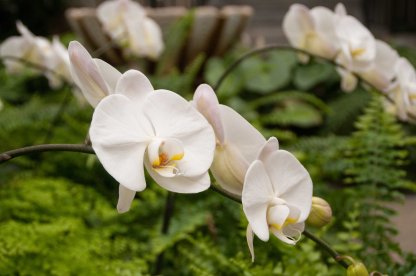
white orchids
Caring for plants definitely increases happiness, but make sure to start with an easy to care for plant! Orchids are beautiful, but may be difficult to grow.

Houseplants for Beginners

Now that you are convinced of the benefits of plants, click here to see a great list of houseplants for beginners! Remember – start out with easy-to-care for plants until you learn more about plant care. Nothing is worse than getting plants to make yourself feel happier, and then watching them slowly die.

Need more plants in your life, but don’t have the light or space for them to thrive? No worries – I’ve got plenty of plant prints, illustrations, and more to decorate with! No green thumb required! If you’re local and looking for ways to get more plants in your life, register for an upcoming plant themed workshop (like Terrarium Building, Staghorn Fern Mounting, Kokedama, and more!)

Supporting The Art of Ecology through the online shop or by becoming a Patron at any tier on Patreon can help keep educational content coming!

Traveling, especially to places that look and feel different than Pennsylvania where I have lived for all of my life, is so exciting! Fortunately for me, I had the chance to go out to New Mexico to do some photography this past summer! It was amazing to see the many plant & animal adaptations to a desert. For a climate that only gets around 9 inches of rain/year it’s amazing anything lives at all, but everything has their own adaptations to help them survive.

Adaptations in Plants

For example, many plants have thick, waxy layers, called cuticles, to prevent excess water loss. The spines of the cacti prevent other animals from getting too close and eating through (although animals always find a way!). Even buds look thick and rubbery!

This Cane Cholla is one of many cactus species in the Valley of Fires, a strip of igneous rock formations that runs through the desert.

While it may be uncommon to see groundwater, it’s really not that far underground! The roots of trees and plants go down deep to take advantage of this and in a location like White Sands National Monument, you can even dig your toes into the sand (actually, it’s gypsum that’s been deposited by runoff from the San Andreas and Sacramento Mountains) and feel how much cooler it gets!

The sign says "Gypsum from the San Andreas Mountains is being carried down and deposited in the Tularosa Basin, creating the White Sands."
The sign says “Gypsum from the San Andreas Mountains is being carried down and deposited in the Tularosa Basin, creating the White Sands.”

In White Sands, you can see a variety of scraggly looking plants such as Yucca. These can continue growing even when their trunk is completely covered! Trees and plants are great for soil retention. As wind blows the gypsum around, it collects at the base of the Yucca. The yucca will continue to grow, no matter how tall a dune builds up around it. As long as its leaves are exposed to the sunlight, it can undergo photosynthesis and grow. In fact, there are very small Yuccas that look as if they are only 1-2ft. tall, when really, they are 10+ ft. and are simply buried!

yucca plant & animal adaptations to a desert
Who knows how tall these Yucca plants actually are! Their trunks and roots go down deep.

Adaptations in Animals

It’s not just plants that need to survive though, animals do too! New Mexican animals have behavioral and morphological adaptations helping them survive the heat and dryness. Many are crepuscular (out at dawn and dusk) or nocturnal to avoid the heat and sun of the day. Those animals have a burrow or cave that they sleep in during the day to keep them cool. Diurnal animals, like the Jack Rabbit, rest in the shade before heading to their next hiding spot! Their big ears also help to release heat and keep them cool.

This female hummingbird has some incredible adaptations to help her survive in the wild. Here in Bosque Del Apache, her needs are met with the nectar from many flowers!

Hummingbirds can handle higher body temperatures, which is great in warm environments. They also take advantage of the beautiful plants around them and dart around in search of nectar. This keeps them fueled and in turn helps the plants survive by pollinating them. Lizards, like the Little Striped Whiptail, are very speedy (making them hard to photograph!) which keeps their feet from touching the hot ground for too long.

plant & animal adaptations to a desert, little whiptail
This Little Whiptail digs in the dirt in search of groundwater. It’s amazing how much cooler the gypsum gets even just one inch down!

In terms of water, many small mammals and reptiles rely heavily on metabolic moisture. When an animal eats seeds or insects, it retains most of the water that it’s food had. Therefore, it doesn’t need to drink nearly as often, if at all. In fact, when the reptiles excrete waste, it is a dry, powdery substance called uric acid. This prevents water loss. Rodents, have specialized kidneys that are able to remove water from the toxins in their urine and recycle it in their body.

Bringing New Mexico Home

While I really wanted a New Mexican Bird of Paradise for my garden and a Quail family, they would be unsuited to the PA environment. It’s amazing how animals and plants are so unique and fit so well into their habitat!

Explore the plant & animal adaptations to a desert through photography prints – bring the American Southwest into your home! Check out my shop today.

plant & animal adaptations to a desert photography
Some of my personal favorites from the trip I took in 2017 to Alamogordo, New Mexico! Highlights are from: the base of the San Andreas Mountain Range, Lincoln National Forest, White Sands National Monument, Bosque del Apache, and Fires National Park.

Supporting The Art of Ecology through the online shop or by becoming a Patron at any tier on Patreon can help keep educational content coming!

I’ll gladly go bungee jumping or skydiving. Not much scares me, yet for some strange reason, I gasp at small things. A door closed unexpectedly? Gasp. Did a leaf fall on my shoulder? Gasp. I’m startled for a fraction of a second and react. Who knew that this is a similar trait to shy, cute, forest-dwelling rodents?

Chipmunks & Vocalizations

Studies show that Chipmunks can have personality. They can be bold or they can be meek. How do we know? By observing vocalizations and recognizing patterns.

Scientists attached microphones to several chipmunks and recorded all sorts of valuable sounds! They were able to determine that chips, chucks, and trills are the main sounds that a chipmunk makes and that the chipmunk will use those noises in different patterns to relay messages. For instance, a quick, high-pitched chip says “BE AWARE,” if there is a predator close by, while the same chip followed by a rapid trill may say “DANGER! I’m being actively chased!” Lower pitched chucks are often used while protecting territory.

Just like us, chipmunks also use body language. They lay their ears back and fluff up to look large and aggressive. They may shrink and lower themselves to look submissive.

Personalities of Chipmunks

As scientists observed these vocalizations and postures, they realized something amazing. Individual chipmunks have personalities! Bold chipmunks only chipped if there was a real threat. They also took initiative during aggressive encounters and tried to look and sound as threatening as possible. Typically, if a chipmunk is close to its home, it will win territory disputes, but the bold chipmunks regularly won regardless of if the fight was on their home turf or not.

Shy chipmunks, on the other hand, are quick to surrender. In a fight, they make less vocalizations and try to get as small as possible. Yet, funnily enough, they chip “Danger!” much more often. These shy chipmunks have been known to chip at a gust of wind or a falling leaf (I can relate…). Unfortunately, the rest of the chipmunk population figures that this is the “Chipmunk who cried wolf” and ignores it, even if a threat is real.

While thinking that self-esteem or pride are the same across all animal species isn’t quite appropriate, it is interesting to see similarities between how human and other mammals brains work and can therefore gain a new appreciation for the little cuties!

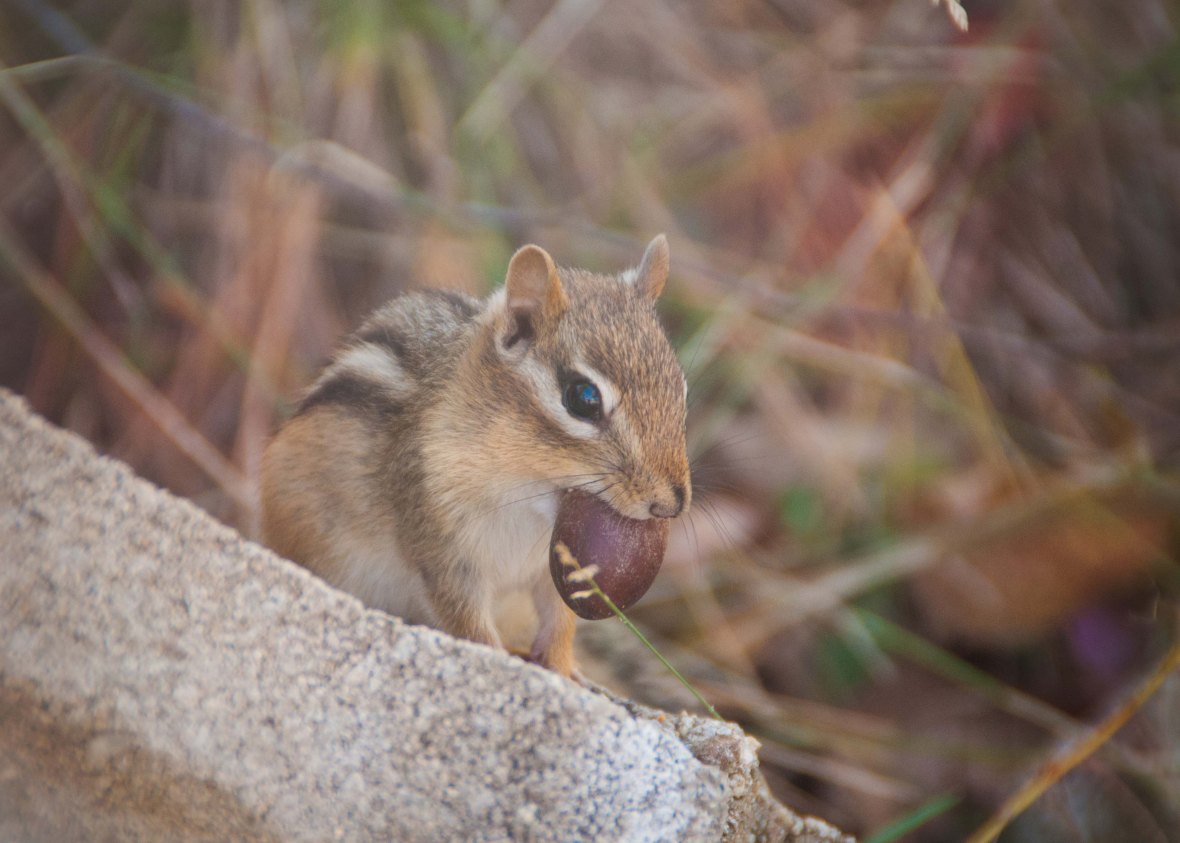
The chipmunk pictured here lives in Sabattus, Maine and was particularly fearless. This “bold” chipmunk knew that I was no predator.  It did not sound any warnings as I have found many other Pennsylvania chipmunks do. Next time you see (or hear) a chipmunk, try to figure out what it’s trying to communicate – if it’s in danger or if it’s just a shy chipmunk gasping unnecessarily.

Chipmunk Vocalizations – A National Geographic video

discover chipmunk vocalizations and how this impacts personality
Chipmunks are amazingly cute members of the rodent family, each with their own personality!

Supporting The Art of Ecology through the online shop or by becoming a Patron at any tier on Patreon can help keep educational content coming!